
From Ars Technica · · 2m
Drained peatlands warm the planet by 2.7 percent
A new study quantifies how draining wetlands for farming has driven climate change, and shows restoration could reverse the damage.
In brief
A new study quantifies how draining wetlands for farming has driven climate change, and shows restoration could reverse the damage. Draining peatlands for agriculture has caused two point seven percent of human-caused warming since eighteen hundred, but restoring water levels could halt future emissions. Originally…
Drainage flips carbon release from methane to CO2

Peatlands naturally release carbon slowly as methane through anaerobic decay. Draining them with ditches lets oxygen in, switching emissions to carbon dioxide, which is released much faster and in far greater quantities.
“Methane emissions get turned down, and CO2 emissions get turned way up.”
Study measures warming from drained peatlands
Researchers led by Jevan Yu at MIT used gas emission data to model carbon dioxide and methane release as water levels dropped since eighteen hundred, calculating the total climate impact in twenty twenty.
Drained peatlands caused 2.7 percent of warming
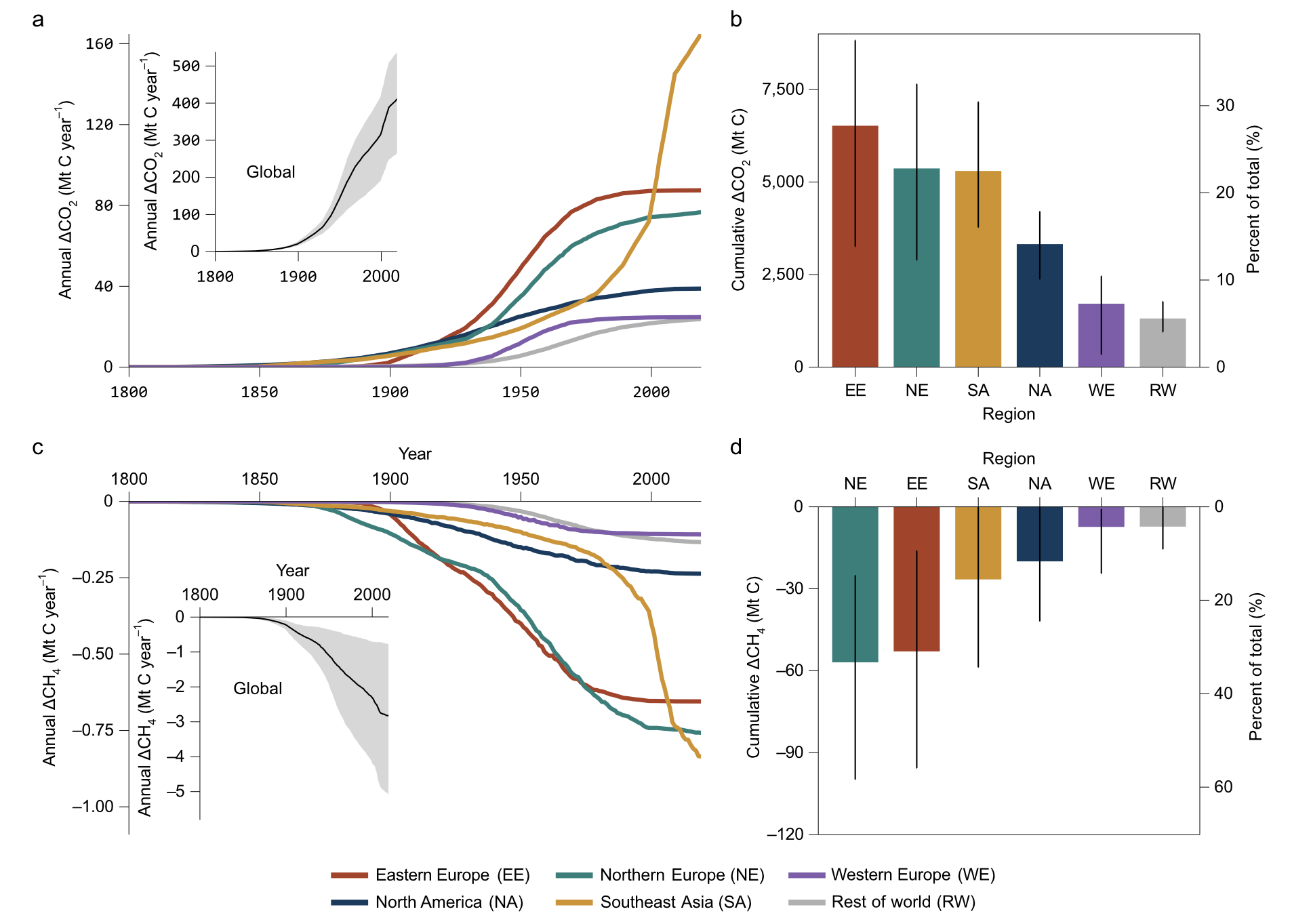
The team calculated the total effect in twenty twenty at about eighty three milliwatts per square meter from carbon dioxide emissions, minus nine milliwatts from reduced methane, totalling seventy three milliwatts.
“That is 2.7 percent of the total human-caused change in Earth's energy budget.”
Europe and Southeast Asia drove most emissions
Over half of total carbon dioxide came from Europe, almost a quarter from Southeast Asia, and only fourteen percent from North America. Southeast Asia's contribution only jumped up in the last few decades.
Emissions will continue without restoration
If peatland water levels stayed constant from twenty twenty onward, the warming effect would nearly double to one hundred thirty eight milliwatts per square meter by twenty one hundred.
“If peatland water levels were simply held constant from 2020 on, the total change in Earth's energy budget would nearly double, from 73 to 138 milliwatts per square meter by 2100.”
Restoring peatlands could halt future warming
Moderate restoration of peatland water levels could reduce future warming growth.Ambitious restoration could even cause the effect to shrink below its twenty twenty level.This is a process we can halt if we really want to.
“This is a process we can halt if we really want to.”
What it means
Draining peatlands for agriculture has caused two point seven percent of human-caused warming since eighteen hundred, but restoring water levels could halt future emissions.
Read the TL;DR — this story on one card.