From Ars Technica · · 3m
Neutron's first launch slips to 2027 over carbon composite defects
Rocket Lab delays its medium-lift Neutron rocket after discovering voids in propellant tank domes during manufacturing.
In brief
Rocket Lab delays its medium-lift Neutron rocket after discovering voids in propellant tank domes during manufacturing. Rocket Lab pushed Neutron's first flight to 2027 after finding manufacturing defects in carbon composite propellant tank domes, doubling the rocket's original development timeline. Originally…
Neutron launch pushed to 2027
Rocket Lab announced Wednesday that its Neutron launch vehicle won't fly until 2027, citing manufacturing issues with the rocket's carbon composite structures.
What went wrong with the domes
Peter Beck, Rocket Lab's founder and CEO, identified a manufacturing defect in the dome sections at the ends of the rocket's first stage propellant tanks as the reason for the delay.
Voids discovered in carbon fiber layers

Engineers discovered voids, or air pockets, between layers of carbon fiber that make up the domes' composite structure during inspection of a newly cured forward dome.
Why carbon composites are tricky
Carbon composite manufacturing involves laying down carbon fiber layers in a mold, then curing the material to bind the fibers together. This is especially difficult for large structures that won't fit into an autoclave.
Neutron's unprecedented scale
The Neutron rocket's first stage is the largest pressurized structure ever made out of carbon composite. Rocket Lab developed new out-of-autoclave processes and custom cure cycles to build it.
“the largest pressurized structure ever made out of carbon composite”
What the voids mean for safety

Inspections revealed voids in the forward dome that could affect the structure's strength, durability, and reliability.
Design change triggered the problem
Engineers traced the voids to a recent design change intended to strengthen the rocket's structure after a Neutron propellant tank unexpectedly ruptured during a hydrostatic pressure test in January.
Thicker sections caused the voids
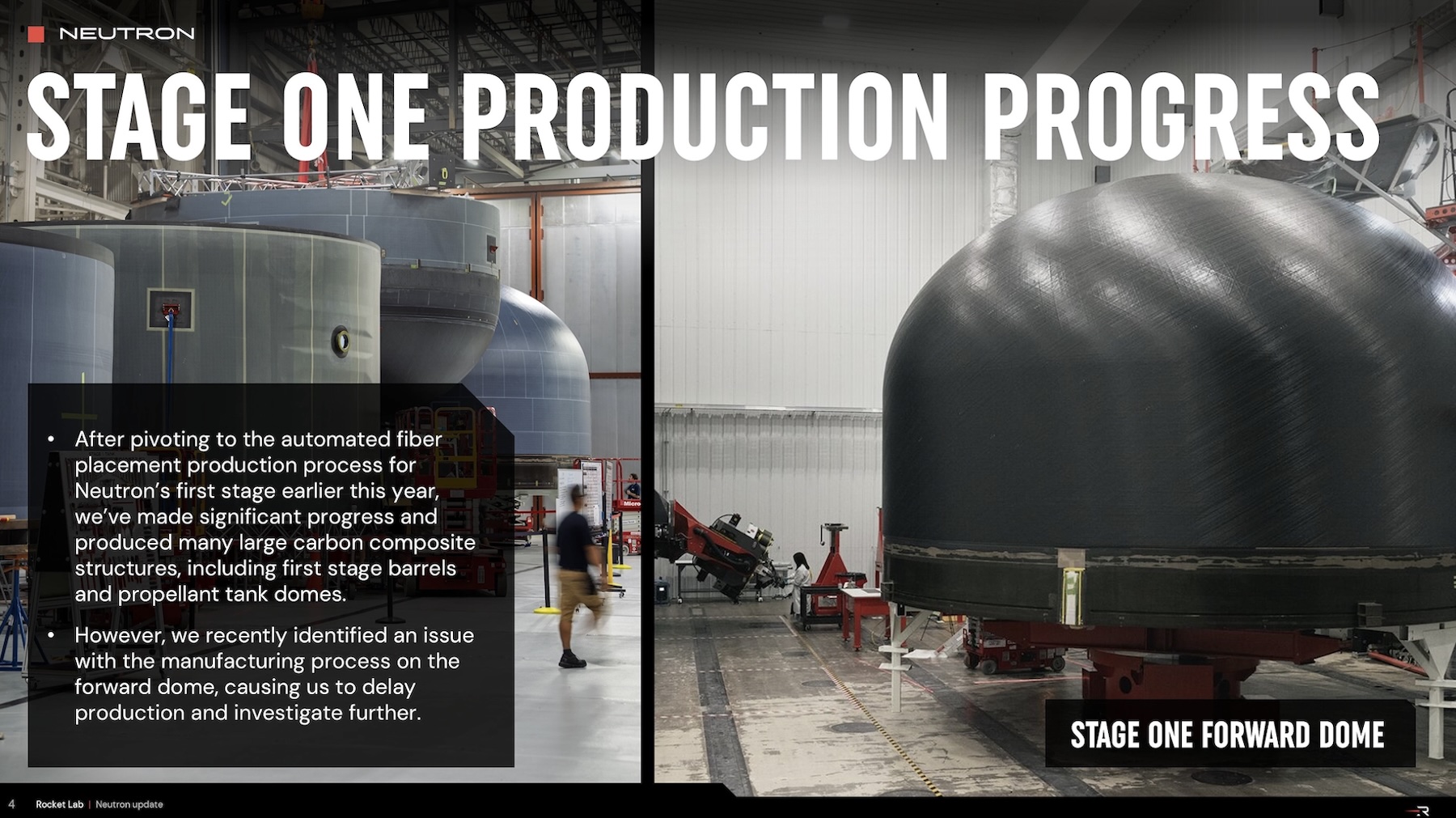
Rocket Lab deleted joints in the first stage tank structure and increased the thickness of some sections of the carbon composite. Those thicker sections are where the voids formed.
“Those thicker sections are where the voids formed”
Solution found and tested
Rocket Lab modified the manufacturing process again. An aft propellant dome made with the updated procedure passed inspection, giving the company confidence to move forward with production.
“We've solved the problem”
Neutron dwarfs Rocket Lab's Electron
The light-class Electron rocket is three point nine feet in diameter, while the medium-lift Neutron measures twenty three feet across at its widest. Neutron can lift nearly twenty nine thousand pounds to low-Earth orbit.
Remaining qualification work ahead
Final qualification of Neutron's first stage is still pending, as is qualification of the rocket's methane-fueled Archimedes engine, nine of which will power the booster.
Timeline doubled since 2021 announcement
Rocket Lab announced Neutron in twenty twenty-one, aiming for a first flight in twenty twenty-four.The development timeline has now doubled.
“we won't rush to the pad with unnecessary risk”
The key point
Rocket Lab pushed Neutron's first flight to 2027 after finding manufacturing defects in carbon composite propellant tank domes, doubling the rocket's original development timeline.





