From Ars Technica · · 2m
Webb finds ice older than the star it orbits
The James Webb Space Telescope detected water and carbon dioxide ice in a young star's disk, suggesting the ingredients for water-rich worlds are common.
In brief
The James Webb Space Telescope detected water and carbon dioxide ice in a young star's disk, suggesting the ingredients for water-rich worlds are common. The James Webb Space Telescope found water and carbon dioxide ice in the disk around Beta Pictoris, a twenty million year old star, suggesting the raw materials for…
A young star surrounded by dust
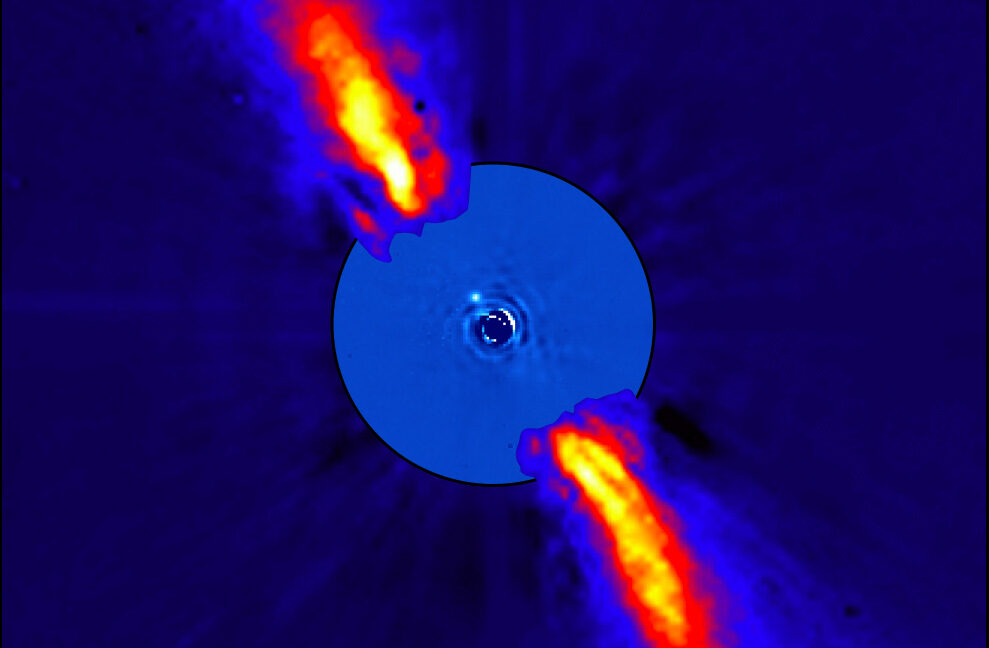
Beta Pictoris is roughly twenty million years old and located about sixty four light years away from Earth. It is surrounded by a vast disk of dust and rubble where planets are still forming.
Webb finds water and carbon dioxide ice
A team led by Sarah Betti, an astronomer at the Space Telescope Science Institute in Baltimore, used the James Webb Space Telescope to search for ice in the disk.
Ice composition matches our solar system
The water ice is glassy rather than crystalline and mixed with carbon dioxide in roughly the same proportions seen in comets of our own Solar System.
Why ice was hard to find
Earlier searches failed to detect water vapor and a search for the telltale dip that water ice leaves in starlight at a wavelength of three micrometers also failed.
How Webb detected the ice
Betti and colleagues observed Beta Pictoris on December seven, twenty twenty three, using Webb's Near Infrared Spectrograph.
The ices are thoroughly mixed
Carbon dioxide features were shifted toward shorter wavelengths and much broader than pure carbon dioxide ice measured in the lab.
Ice composition matches comets
The team calculated roughly eleven percent of the ice is carbon dioxide, falling within the two point five to thirty percent range measured in Solar System comets and the seven to twenty percent seen in…
Ice is older than the star
The water ice is almost entirely amorphous, a glass like solid that forms when water freezes so fast and cold that molecules stick wherever they land.
Collisions spread ice across the disk
The team argues that even ice distribution requires frequent collisions among planetesimals. Each collision releases fresh icy dust, including ice buried deep inside colliding bodies, replenishing what starlight destroys.
Habitable worlds may be common
If a young planetary system sixty four light years away started with the same icy ingredients as ours, then primordial interstellar ice might be a common ingredient of planetary systems in general.
The headline
The James Webb Space Telescope found water and carbon dioxide ice in the disk around Beta Pictoris, a twenty million year old star, suggesting the raw materials for habitable worlds may be widespread.
Read the TL;DR — this story on one card.