From Colin Breck · · 3m
I Don’t Want to Read What You Didn’t Write
AI writing is unreadable, but it can help with technical tasks.
In brief
AI writing is unreadable, but it can help with technical tasks. People who use AI for writing face a dilemma: AI produces fast but impersonal text that lacks context and emotional depth, while human writing remains essential for meaningful communication. Originally reported by Colin Breck.
AI writing is unreadable
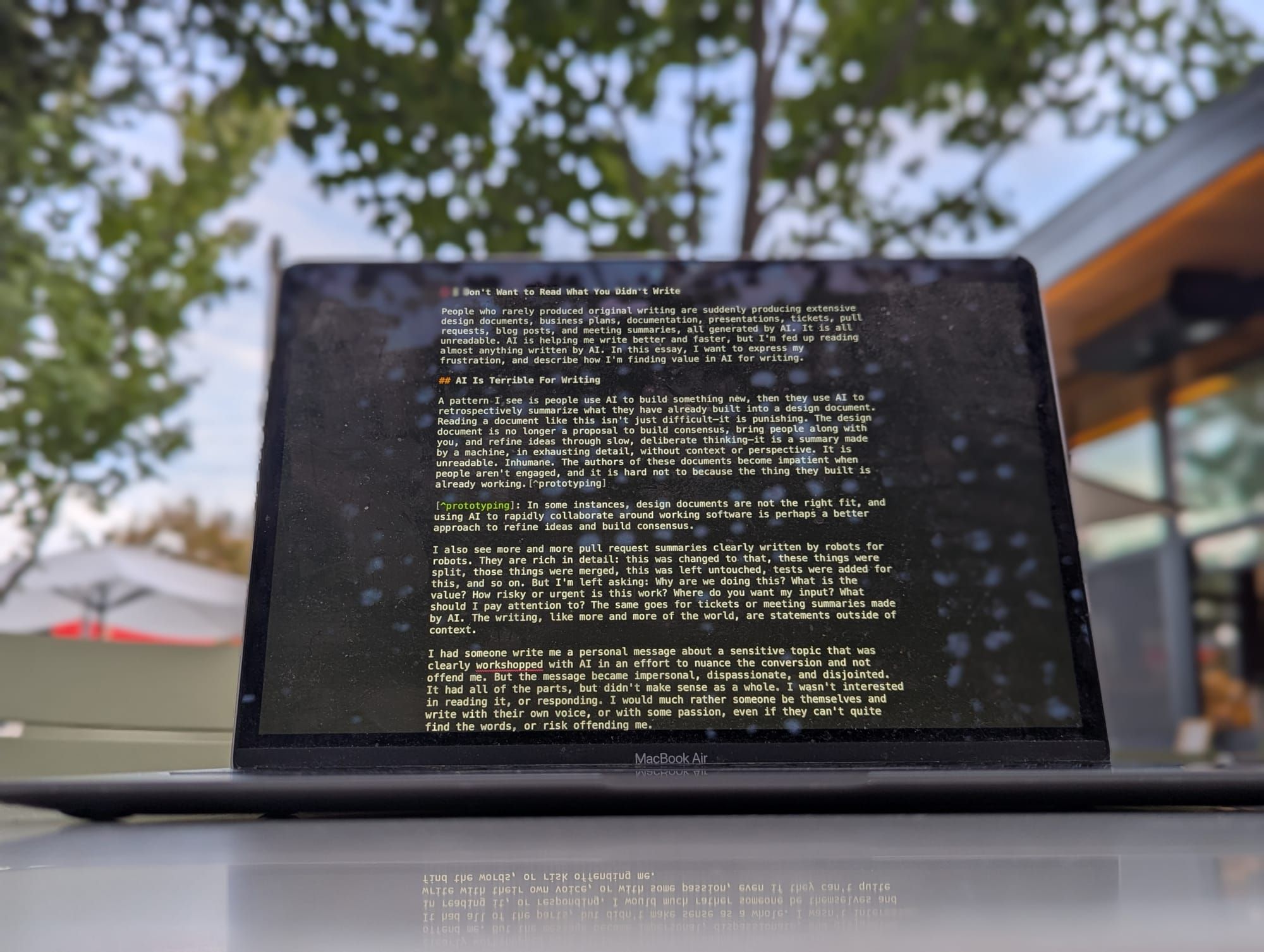
People who rarely produced original writing suddenly generate extensive design proposals, business plans, documentation, presentations, tickets, pull requests, blog articles, and meeting summaries using AI, but these are unreadable.
“It is all unreadable.”
AI summaries are inhuman
AI-generated design documents are no longer proposals to build consensus but summaries made by machines in exhausting detail without context or perspective, making them unreadable and inhumane.
“It is unreadable. Inhumane.”
AI pull requests lack context
AI pull request summaries are rich in detail but lack context, making it hard to determine the value, risk, urgency, or where input is needed.
“Why are we doing this? What is the value? How risky or urgent is this work?”
AI personal messages feel impersonal
AI-generated personal messages about sensitive topics become impersonal, dispassionate, and disjointed despite having all parts but failing to make sense as a whole.
“It had all of the parts, but it didn’t make sense as a whole.”
AI eliminates vulnerability
Using AI in communication removes vulnerability and risk, eliminating the process of relationship itself, as Simon Sarris writes: 'I think one should write as much as they can with their own empiricism, their own senses, giving the reader their own characterization of life or events.'
“I think one should write as much as they can with their own empiricism, their own senses, giving the reader their own characterization of life or events.”
AI responses are impersonal
Using AI to summarize comments on proposals as responses creates impersonal, dispassionate messages that lack the human touch, such as 'Thanks! I couldn’t have said it better myself!'
“Thanks! I couldn’t have said it better myself!”
Readers stop reading AI content
78% of readers stop reading AI-assisted or AI-authored articles, and 71% avoid the author in the future after thinking an article is AI-generated.
“78% of readers stop reading (71%) and avoid the author in the future (71%).”
Human writing connects better
98% of readers prefer the author’s own writing with all its flaws and idiosyncrasies over a soulless AI rewrite, as Bjarne Stroustrup notes: 'When I read a book, I really feel that if I can hear the author’s voice ringing in my head...'
“When I read a book, I really feel that if I can hear the author’s voice ringing in my head, complete with weird accents and peculiarities of their speaking patterns, then I feel like something has succeeded.”
AI helps with technical writing
AI speeds up technical writing by verifying technical details, suggesting simplifications, drawing diagrams, and finding subtle errors, but it does not write the paper itself.
“It was great at suggesting simplifications to sentences that are too long or unclear.”
AI writes abstracts well
AI excels at writing abstracts, the most terse, mechanical part of a paper, without needing human intervention, as it is great at summary and abstraction.
“It wrote the abstract, the most terse, mechanical, inhuman part of the whole paper, indeed, the most abstracted part.”
AI writing has limits
AI lacks active mental models of human readers, empathy, and lived experience, making it difficult to produce creative, context-aware writing that connects with people.
“They cannot empathize with the human reader, as they don’t have the human lived experience.”
ASD-STE100 improves clarity
ASD-STE100 Simplified Technical English, a standard for technical documentation, helps AI generate clearer instructions for users, though it is specific to easy-to-follow manuals.
“ASD-STE100 isn’t appropriate for all AI-generated writing, it is specifically targeted at clear and easy-to-follow instruction manuals.”
Pangram detects AI writing
Pangram, a model fine-tuned to detect AI writing, mandates that all public writing at Oxide be reported as human-authored to avoid the social contract violation between writer and reader.
“To use an LLM to write is to void the social contract between writer and reader: we readers shouldn’t be expected to labor to understand a sentence that the writer themselves didn’t work to create.”
Writing requires context
Human writing connects through context, vulnerability, and lived experience, while AI writing lacks these elements, making it difficult to build meaningful relationships.
“The more important something is, the more we have to struggle in the attempt to reduce it to language.”
AI writing lacks emotional depth
AI writing cannot convey the emotional depth, beauty, or relationship that human writing provides, as it lacks lived experience and the ability to empathize.
“I want to hear you, imperfections and all. I want your interpretation of aesthetics, beauty, quality, relationship, time.”
Human writing is irreplaceable
Intentional writing will remain valuable for capturing complex ideas, relationships, and emotions that AI cannot replicate, as it requires lived experience and emotional depth.
“I don’t want to read what you didn’t write.”
The big picture
People who use AI for writing face a dilemma: AI produces fast but impersonal text that lacks context and emotional depth, while human writing remains essential for meaningful communication.