From Daily Maverick · Tristen Taylor · · 4m
Spain and Taiwan's blue shark trade drives species toward extinction
Industrial fishing has made Spain and Taiwan the world's biggest blue shark catchers, but flawed science and political inaction are accelerating overfishing, hurling sharks towards extinction.
In brief
Industrial fishing has made Spain and Taiwan the world's biggest blue shark catchers, but flawed science and political inaction are accelerating overfishing, hurling sharks towards extinction. Spain and Taiwan catch most of the world's blue sharks, but weak science and political gridlock at fishing regulators are…
The Spanish shark factory
At Hermanos Fernández Ibáñez in Vigo, workers process frozen blue sharks caught in the Atlantic, Pacific and Indian oceans.
A recent business shift
Claudio Ibáñez says the company started fishing swordfish thirty five years ago. Blue sharks were caught as bycatch initially, but starting fifteen years ago became a very good complement to the swordfish fishery.
“a very good complement to the swordfish fishery”
Two countries dominate the catch
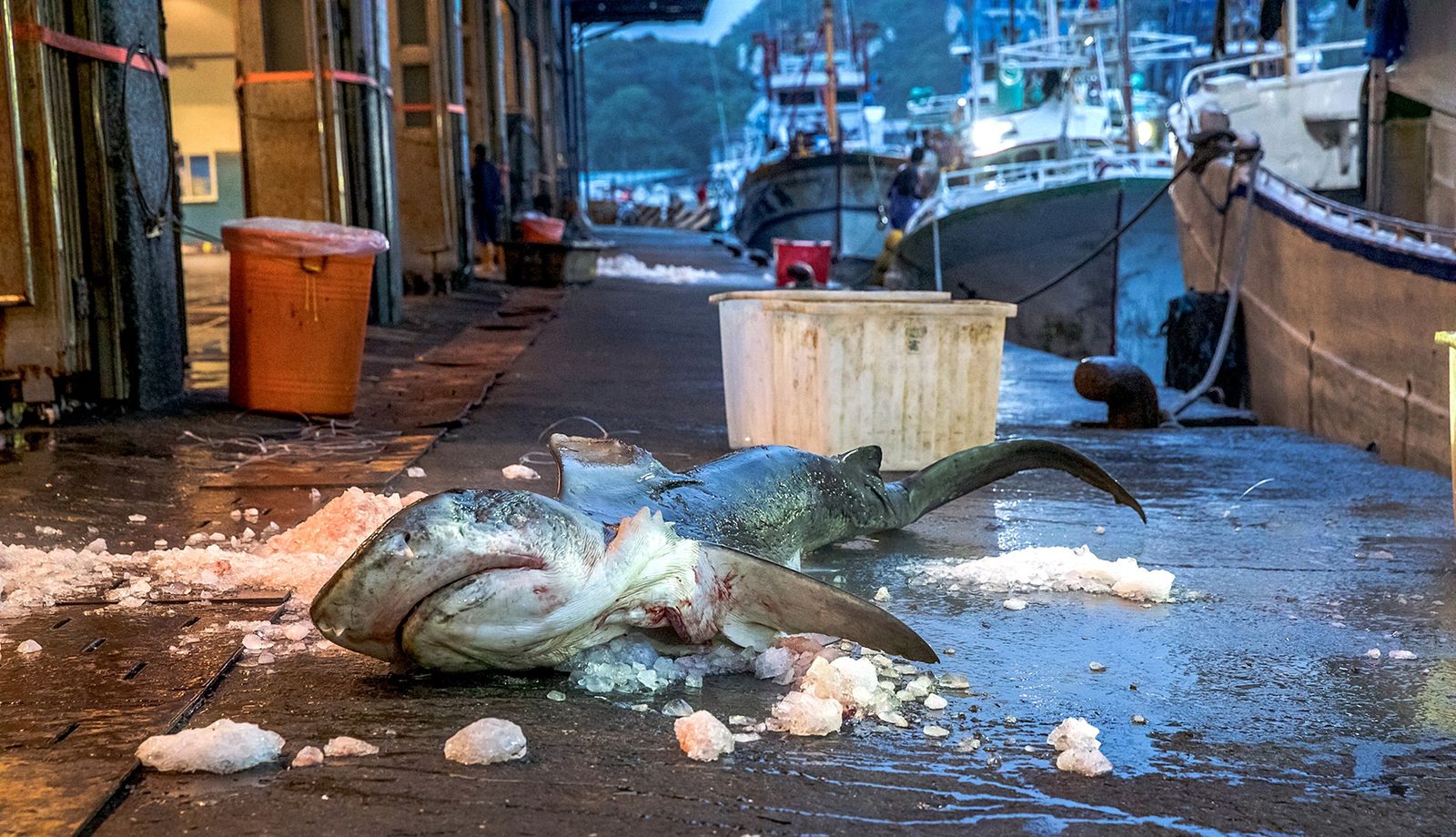
In two thousand twenty four, Spain caught forty five thousand three hundred seventy four point nine two tonnes of blue sharks, thirty seven point eight percent of the global catch.
The real catch is much higher
The FAO's reported blue shark catch for two thousand twenty four was one hundred nineteen thousand eight hundred twenty point six two tonnes.
Industrial fishing is recent
In nineteen fifty, only Indonesia reported landing blue sharks, recording forty seven tonnes.Spain started industrial blue shark fishing in nineteen ninety seven, landing twenty nine thousand nine hundred seventeen tonnes.
A biologist's grim forecast

Daniel Pauly, a professor at the University of British Columbia, predicts that the shark fishery is not going to last long, two decades, perhaps two decades, and then it is gone.
“the shark fishery is not going to last long, two decades, perhaps two decades, and then it's gone”
Conservation status worsens
The IUCN placed blue shark on its Red List in two thousand eighteen as near threatened.In two thousand twenty two, CITES added blue sharks to Appendix II.
Mediterranean population in crisis
In two thousand sixteen, the IUCN designated Mediterranean blue sharks as critically endangered, with a population decline of up to ninety percent over thirty years due to overfishing.
Industry argues for sustainability
Angela Cortina of ARVI, representing two hundred fishing boats in Vigo, says Spanish fleet catches are tightly controlled and ecologically sustainable.
“recuperate very quickly. They're very resistant and very resilient as a species”
Atlantic quotas are not restrictive
ICCAT sets a total allowable catch of thirty thousand tonnes for the North Atlantic and twenty seven thousand seven hundred eleven tonnes for the South Atlantic.
No quotas in Pacific and Indian oceans
The RFMOs for the Pacific and Indian oceans have not set quotas for blue sharks, so it is open season on the sharks. Spain and Taiwan fish hard in both regions.
Political gridlock blocks action
RFMO decisions require consensus from all member countries.A proposal to strengthen the fins attached rule at ICCAT has been in discussion for seventeen years with no consensus in sight.
Data problems are widespread
An FAO workshop in October two thousand twenty five found widespread issues with both the quantity and quality of catch data across RFMOs.
Fifty percent odds on overfishing
ICCAT's scientific committee stated in two thousand twenty five that North Atlantic blue sharks had fifty point one percent probability of being overfished.
Scientists reject the threshold
Daniel Pauly says people willing to accept fifty percent are not guided by science.Iris Ziegler of Deutsche Stiftung Meeresschutz wants at least seventy percent probability of not being overfished.
“People that are willing to accept 50% are not guided by science”
ICCAT defends the standard
Luis Gustavo Cardoso, vice chair of ICCAT's scientific committee, says a framework calibrated only to very high certainty thresholds would systematically under use a renewable resource.
Indian Ocean faces imminent overfishing
A two thousand twenty five IOTC scientific assessment states that maintaining current catches is likely to result in decreasing biomass and the stock becoming overfished and subject to overfishing in the near future.
IOTC chooses inaction
At an IOTC meeting in two thousand twenty six to discuss stock status, only Japan put forth a proposal.Japan proposed postponing discussion on blue shark catch limits and removing a bycatch mortality prevention measure.
Scientists question RFMO independence
Daniel Pauly says RFMO scientists are not independent.Most are hacks put there by countries to enable them to have a high quota.
“they are not independent. Most of them are hacks that are put there by the countries”
Mediterranean science is clear
The IUCN states the blue shark population in the Mediterranean is declining at a critical rate and exists in an extremely depleted state.
The short version
Spain and Taiwan catch most of the world's blue sharks, but weak science and political gridlock at fishing regulators are allowing overfishing to continue despite warnings the species faces collapse.
Read the TL;DR — this story on one card.