From Fortune · Nick Lichtenberg · · 5m
Anthropic's five-class share structure locks founders in control
The AI company's IPO filing reveals a complex voting system that lets co-founders keep 50.1% control even if they give away 98% of their shares.
In brief
The AI company's IPO filing reveals a complex voting system that lets co-founders keep 50.1% control even if they give away 98% of their shares. Anthropic's IPO filing reveals five share classes designed to let co-founders maintain voting control while giving away most of their economic stake, following a model…
Five share classes, one mission
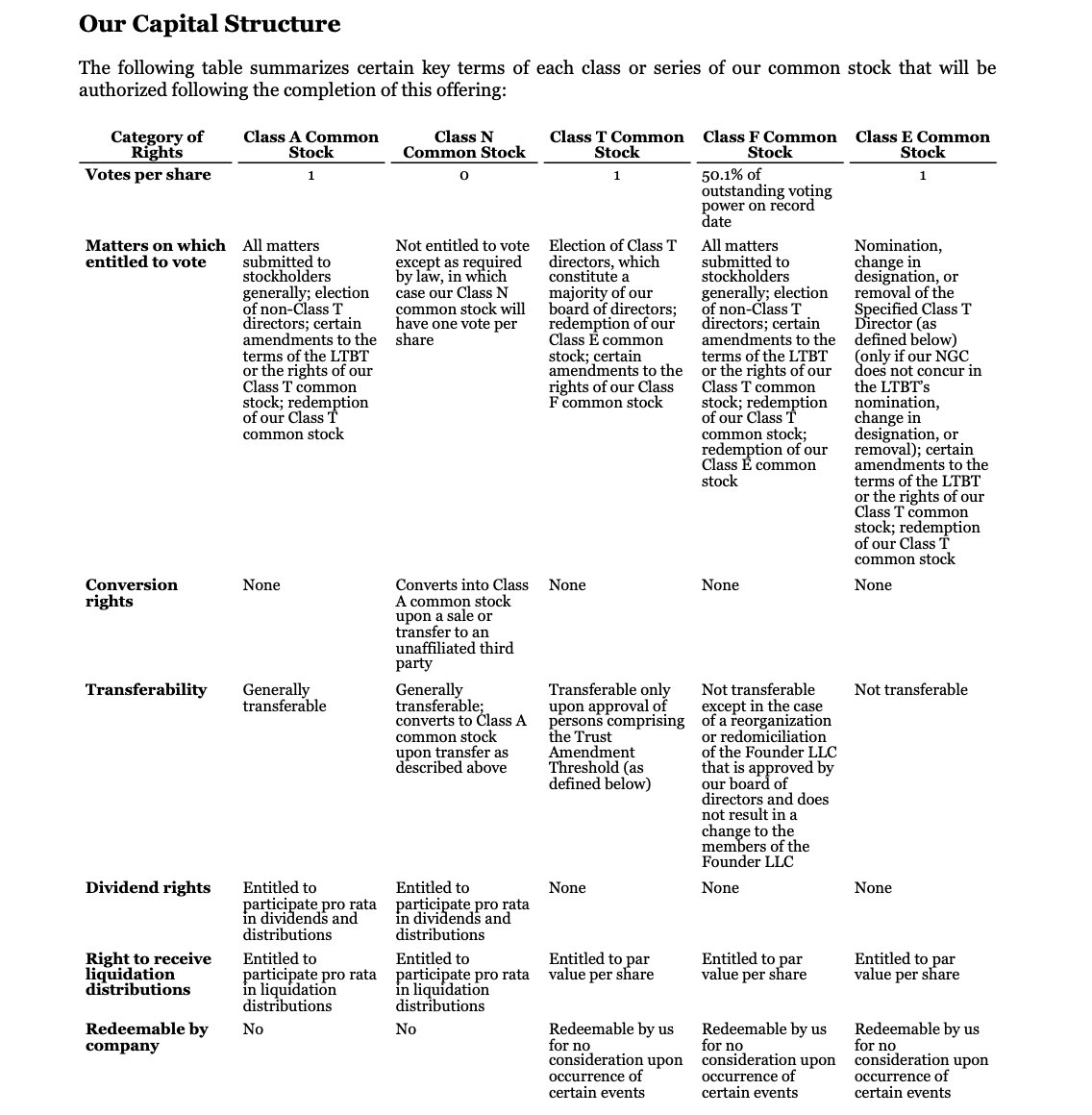
Anthropic's S-1 IPO filing reveals five classes of stock: A, E, F, N and T. Only Class A shares go to the public. The others concentrate voting power among co-founders and trustees.
Class F: one share, fifty point one percent control
One Class F share, held by an LLC owned by the seven co-founders, carries fifty point one percent of the vote and no economic rights. It never dilutes, even as founders give away shares.
Founders pledge to give away eighty percent
Each co-founder has pledged to give away eighty percent of their Anthropic equity. Public shareholders split the remaining forty nine point nine percent among themselves, regardless of how many shares they own.
Class A holders have no real say
Class A shares, listed on Nasdaq under ticker ANT, carry one vote each but can never hold more than forty nine point nine percent of total votes.
“generally will not be able to affect the outcome of any matter submitted to a vote of our stockholders or the election of our directors, regardless of how they vote”
Class T: trustees pick the board
One Class T share, held by Anthropic's Long-Term Benefit Trust, elects a majority of the board. The trust has five seats, four filled, chaired by Neil Buddy Shah, CEO of the Clinton Health Access Initiative.
Trustees include Bernanke and national security experts
The trust includes Ben Bernanke, former Federal Reserve chairman; Richard Fontaine, who runs the Center for a New American Security; and Christopher Stubbs, Harvard physicist who shared in discovering the universe's accelerating expansion.
Class N: strategic partners get no votes
Class N shares carry the same economic rights as Class A but no votes except where law requires them.Amazon and Google hold Class N shares.
Class E: employees get a sliver of say
Class E shares go to employees other than co-founders. They carry no economic rights and vote only on disputes between the board's nominating committee and the trust over one director, and on changes to the…
Dual-class IPOs are booming in tech
In two thousand twenty five, fifteen of thirty one tech companies that went public in the U.S.had more than one class of stock.
Dual-class tech stocks outperform single-class
Dual-class tech IPOs since nineteen eighty beat comparable stocks by about nineteen percentage points over their first three years.
Zuckerberg's failed attempt at Facebook
In December two thousand fifteen, Mark Zuckerberg and Priscilla Chan pledged ninety nine percent of their Facebook shares to charity.Zuckerberg proposed nonvoting Class C stock to keep founder control while giving away shares.
“a recipe for disaster”
Zuckerberg dropped the plan in two thousand seventeen
In September two thousand seventeen, days before testifying in Delaware, Zuckerberg abandoned the nonvoting stock plan.He said the stock had risen enough to fund his philanthropy and still keep control for twenty years or more.
“retain voting control of Facebook for 20 years or more”
Zuckerberg still controls Meta with Class B stock
As of April two thousand twenty six, Zuckerberg held ninety nine point eight percent of Meta's Class B stock, which carries ten votes per share, giving him sixty point eight percent of total voting power.
Musk controls SpaceX with similar structure
SpaceX, which went public in June, gave Musk about eighty two point four percent voting power at the one hundred thirty five dollar IPO price, with eighty one point one percent from his ten-vote Class…
Musk's control depends on owning the stock
SpaceX warned that if Musk sold enough Class B shares to lose his majority of the class, another holder could take over the board.
New York Times family trust model
The Ochs-Sulzberger family has controlled the New York Times since Adolph S.Ochs bought the paper in eighteen ninety six.Public Class A shareholders elect four of thirteen directors.
Times trust mission: fearless journalism
The New York Times trust exists to keep the paper entirely fearless, free of ulterior influence and unselfishly devoted to the public welfare, in the words of Adolph Ochs' will.
“entirely fearless, free of ulterior influence and unselfishly devoted to the public welfare”
Anthropic's founders can lose control after ninety days
Class F stock goes away once fewer than three of the seven co-founders remain in the LLC for ninety days.SpaceX Class B holders keep electing directors as long as a single Class B share exists.
Anthropic and SpaceX already do business together
Anthropic agreed to spend up to one hundred twenty point five billion dollars on Nvidia-powered compute from SpaceX.AI, a SpaceX subsidiary formerly called X.AI.
Filing warns of governance risks ahead
Anthropic's S-1 acknowledges the structure may eliminate Class A holders' ability to influence major decisions, including a sale.It warns of lower demand for shares, increased volatility and adverse publicity.
The essence
Anthropic's IPO filing reveals five share classes designed to let co-founders maintain voting control while giving away most of their economic stake, following a model pioneered by Zuckerberg and Musk.