From Fortune · Nick Lichtenberg · · 3m
Goldman: AI will displace one in 11 workers, but layoffs wait for recession
Goldman Sachs forecasts AI could displace up to 9% of U.S. workers, but says mass layoffs will likely accelerate only when the economy slows.
In brief
Goldman Sachs forecasts AI could displace up to 9% of U.S. workers, but says mass layoffs will likely accelerate only when the economy slows. Goldman Sachs estimates AI could displace up to 9% of U.S. workers, but predicts major layoffs will concentrate during recessions rather than during economic expansions…
Goldman's AI displacement forecast
Goldman economist Joseph Briggs forecasts that AI could eventually displace up to 9% of U.S. workers, roughly one in eleven, as productivity rises by 15% in developed economies.
The timing question
Briggs found that automation-related job losses historically concentrate during economic slowdowns, not during healthy expansions, suggesting AI layoffs will follow the same pattern.
“automation-related labor disruption is limited when the overall economy is healthy but accelerates during cyclical slowdowns”
Goldman's consistent warning

In October 2025, Goldman economists David Mericle and Pierfrancesco Mei warned that the full consequences of AI for the labor market might not become apparent until a recession hits.
“History also suggests that the full consequences of AI for the labor market might not become apparent until a recession hits”
How companies use recessions
Mericle and Mei explained that companies use recessions to restructure and streamline their workforce by laying off workers in less productive areas, accelerating automation.
“companies use recessions to restructure and streamline their workforce by laying off workers in less productive areas”
The historical pattern
The share of Americans in routine jobs like clerks, secretaries and factory operators has remained stable during expansions but declined sharply during recessions in the early nineteen eighties, two thousand one, two thousand eight and…
The dot-com precedent
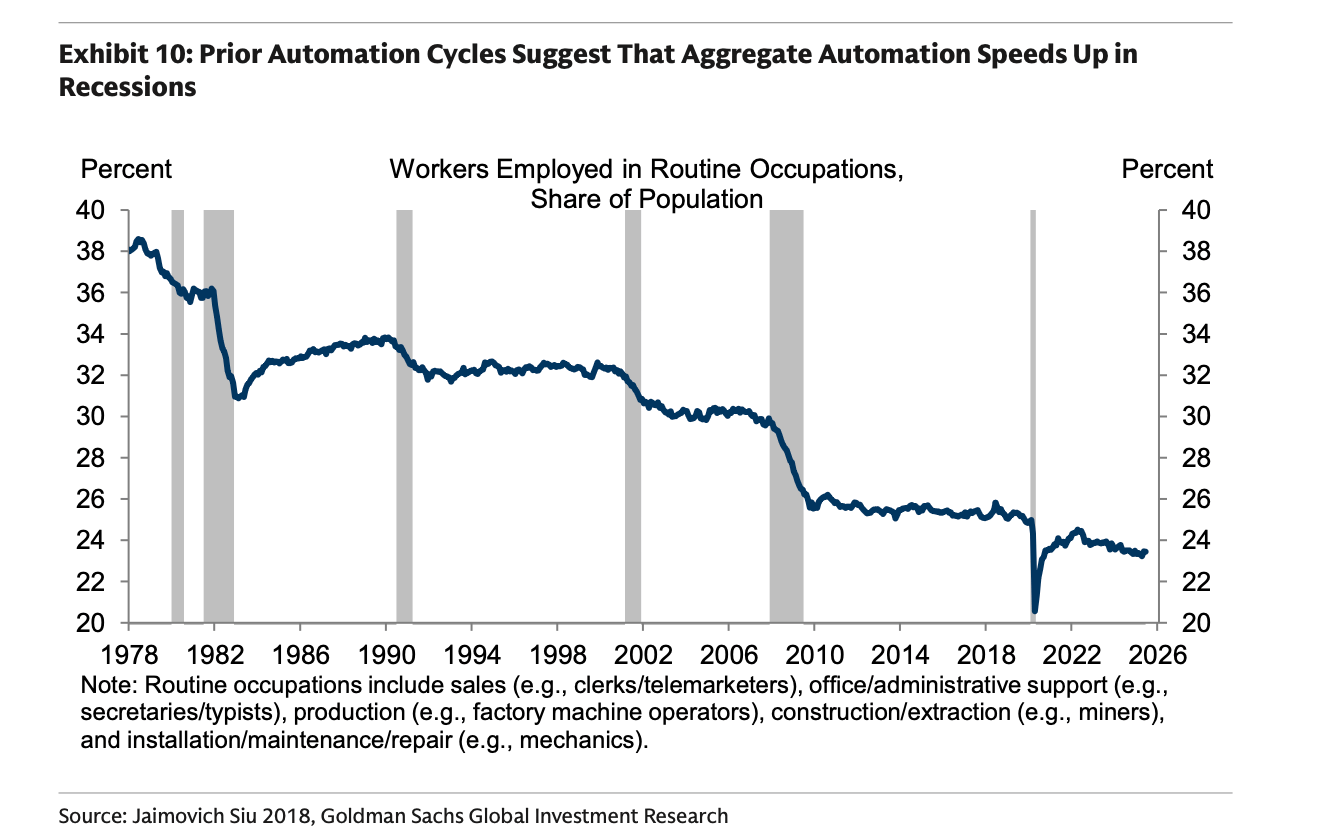
After the dot-com bust, the jobless recovery saw productivity growth remain elevated and GDP rebound earlier than employment, a pattern Briggs says could repeat with AI.
Industry-by-industry impact
Briggs found that labor displacement is more severe when economic conditions worsen. For every point the national unemployment rate climbed, employment fell an extra 4% over five years across twenty-five occupations that past technology disrupted.
How the 9% estimate evolved
In August 2025, Briggs and economist Sarah Dong estimated AI could displace 6% to 7% of the U.S. workforce. By June, Briggs raised the figure to about 9%, or fifteen million workers over a decade.
Displacement versus unemployment
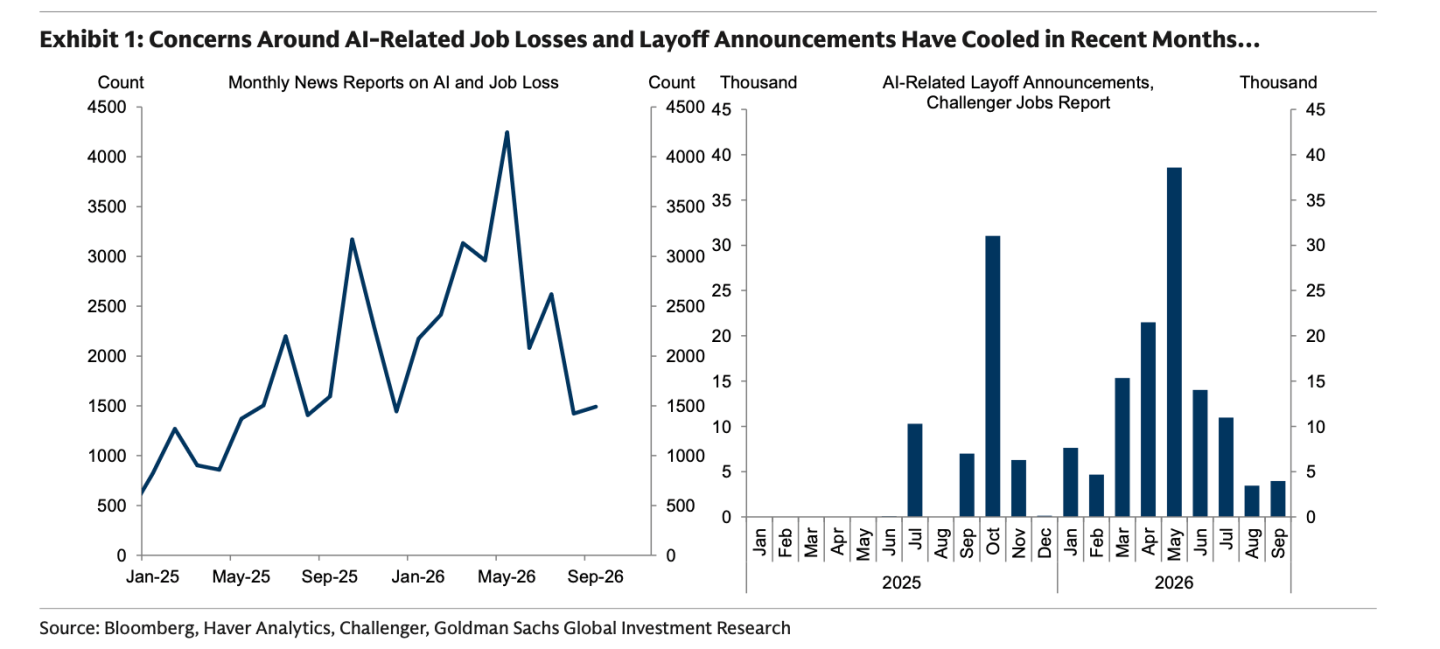
Briggs measures gross job losses rather than unemployment rates. He says even with 9% displacement, the unemployment rate increase in any given year would be less than one percentage point.
Historical job loss precedents
Briggs examined twenty-five occupations hit hard by past technology, including photo processors, movie projectionists and bank tellers. Employment in those jobs fell 25% in the five years after decline started.
“suggesting that very large job losses are possible when technology makes labor redundant”
Why layoffs remain quiet now
Only 23% of U.S. establishments have built AI into regular workflows, and most AI-enabled productivity gains remain in the future. The overall economy and labor market have remained resilient in 2026.
Dario Amodei's shift in tone
Anthropic CEO Dario Amodei spent much of 2025 warning AI could eliminate half of entry-level white-collar jobs. By May, he emphasized the Jevons paradox, saying automation expands remaining work.
“If you automate 90% of the job, then everyone does the 10% of the job”
The speed wildcard
Amodei kept one caveat: AI is moving faster than all previous technologies, making it possible to get unusual behaviors and big disruption that historical patterns may not predict.
“AI is moving faster than all these previous technologies. It's possible you get these weird behaviors and this big disruption”
What to remember
Goldman Sachs estimates AI could displace up to 9% of U.S. workers, but predicts major layoffs will concentrate during recessions rather than during economic expansions.