From Fortune · Sasha Rogelberg · · 3m
Record revenue, record food stamps
Amazon's profits went up sevenfold while the number of its workers on SNAP nearly tripled, and that gap is the whole story of the US economy right now.
In brief
Amazon's profits went up sevenfold while the number of its workers on SNAP nearly tripled, and that gap is the whole story of the US economy right now. Wages have come unhooked from growth. Corporate profits, not worker pay, are where the gains from output now land, and the split has been widening for 50 years…
A record nobody wanted
American workers now take home 52.8% of economic output, the smallest share since the Bureau of Labor Statistics started tracking it in 1947.
“The U.S. workforce has just made the type of history it likely wishes it didn't.”
600% versus 12.5%
The S&P 500 has gained 600% since 2000. Real wages over the same stretch are up 12.5%. Same economy, two very different outcomes.
Amazon's two numbers
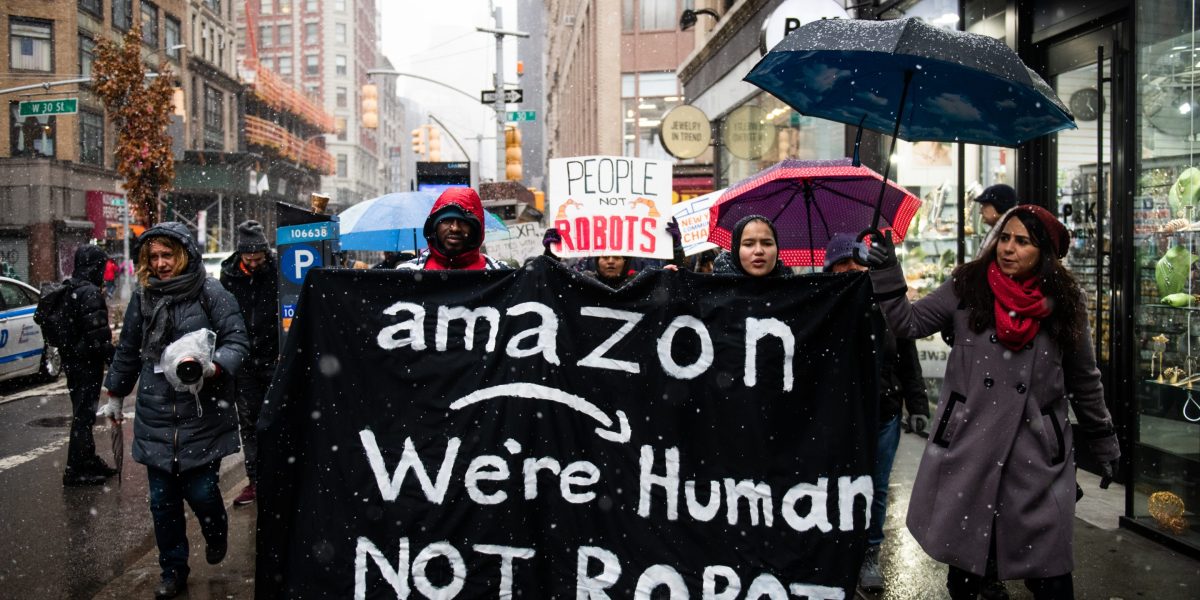
A GAO report covering 11 states found 12,346 Amazon workers on SNAP and 11,338 on Medicaid, close to triple the 2020 count.
While profits went up sevenfold
Over the same period Amazon's annual profit climbed from $11.6 billion to $77.7 billion, and 2025 revenue hit a record $717 billion, up 12% year over year.
Amazon pushes back
A spokesperson called the report's conclusion wrong for using raw numbers instead of percentages, citing $5-a-week health care from day one and 74% enrollment among full-time staff.
“We challenge other large retailers to provide the same Day 1 comprehensive healthcare benefits that we do.”
Not just Amazon
Walmart and FedEx saw similar jumps in workers on federal assistance, as did rideshare and delivery companies.
The safety net is full of workers
GAO's Kathryn Larin says most people on these programs are employed, usually full time. SNAP eligibility sits near 130% of the poverty line, so a paycheck still leaves them short.
“These are families that are really barely able to make ends meet, and yet they are working, and they are working a lot.”
The revolution chart
KPMG found corporate profits rose from 8% to 15.85% of GDP since 1982, while employee compensation fell from 66.6% to 61.9%. Economist Diane Swonk says the chart haunts her.
“A friend refers to it as the 'revolution chart,' which [is] disturbing but telling.”
Unions thinned out
MIT's Anna Stansbury notes union coverage fell from 20.1% of US workers in 1983 to 10.0% in 2025, stripping away the main lever for bargaining up pay and benefits.
The fissured workplace
Banks once hired their own janitors. Now they hire a security firm, a cleaning contractor, a fleet of gig drivers. Stansbury calls this breakup of direct employment the bigger cause.
Outsourcing sheds the obligations
Subcontracted workers get no equity and no company benefits, and if the contractor breaks labor law, the client company is not liable. Cheaper, and reframed as efficiency.
AI as wage suppressant
Apollo's Torsten Slok found that across 321 occupations, high-AI-exposure jobs saw 6.7% lower real wage growth after 2023 with no job losses. Productivity up, pay flat.
“Anyone who has used ChatGPT can see how much work now done by people could soon be done by technology.”
Cycle or permanent shift
Stansbury's test: if inflation cools and the labor market stays tight but wages still lag, this is not a downturn passing through. It is a lasting break.
“Then it would suggest that there's actually been a secular shift.”
What to remember
Wages have come unhooked from growth. Corporate profits, not worker pay, are where the gains from output now land, and the split has been widening for 50 years.