From Fortune · Jeffrey Sonnenfeld · · 4m
The wrong AI pacing debate
Washington and Silicon Valley are arguing about slowing AI development, but they're missing what actually matters: corporate America is years behind and needs time to catch up anyway.
In brief
Washington and Silicon Valley are arguing about slowing AI development, but they're missing what actually matters: corporate America is years behind and needs time to catch up anyway. The pacing debate misses the real constraint on AI's economic impact: enterprises lack the data readiness and trust to deploy frontier…
Two sides of the pacing fight
Washington and Silicon Valley are debating whether to deliberately throttle frontier AI model development. Critics call it unilateral disarmament against China. Supporters say it is the only responsible path.
The compute-to-GDP fallacy
Both camps wrongly believe every leap in AI model performance immediately translates to economic output. Every prior general-purpose technology took decades to diffuse into measurable productivity gains.
Corporate America lags far behind

Corporate America is already years behind the AI frontier. The labs' commercial fortunes will be decided by trust and adoption, not raw capability. Pacing would cost the economy remarkably little.
The real question about frontier labs
The pacing debate has lost sight of a key distinction: cutting-edge research conducted behind closed doors versus products released to the public. The real question is whether labs need to slow down or simply ensure products are safe.
Enterprise adoption is inherently slow
Since ChatGPT's release in 2022, corporate leadership has scrambled with unprecedented speed. Yet fragmented data silos, legacy systems, and compliance regimes make true economic absorption an inherently slow process.
Most enterprises need simpler models
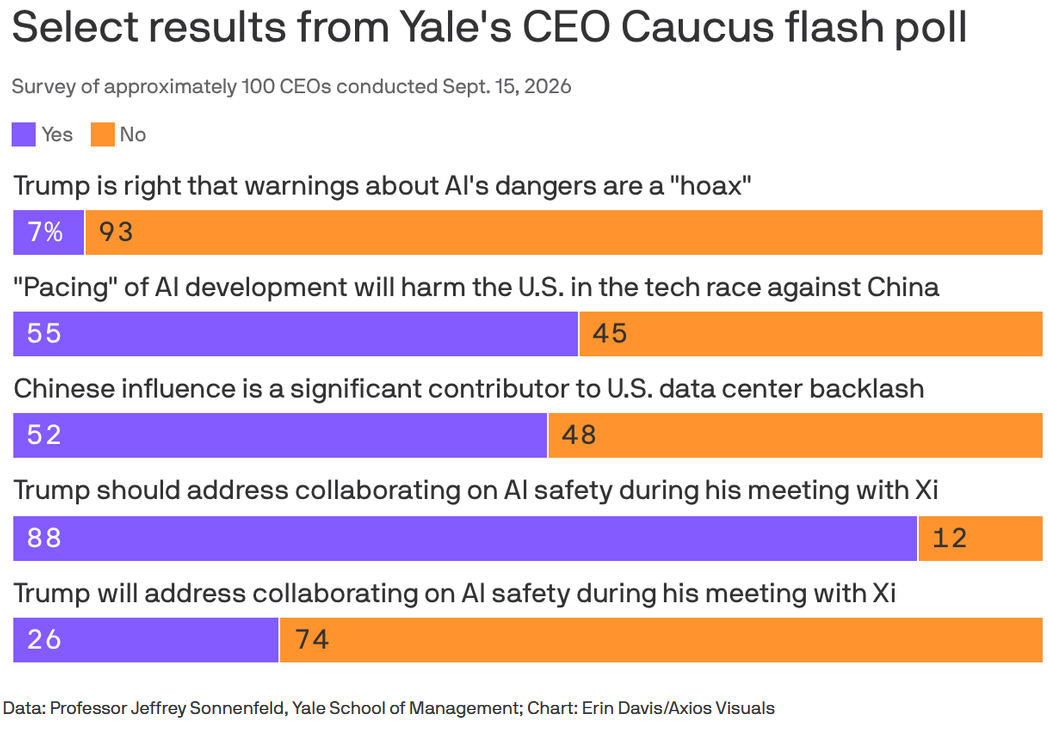
Many daily enterprise workflows require far simpler models. Precious few tasks at the average Fortune five hundred company demand a frontier system at all. Pacing will neither harm economic output nor choke off commercial revenues.
Data readiness is the real bottleneck
Among high-performing companies, more than two-thirds identify data as the primary barrier to implementing AI. Only seven percent describe their data as completely ready for AI. Fewer than a quarter have a data strategy at all.
General-purpose tech takes decades
Technical availability is fundamentally different from economic transformation. Electricity took seventy-five years to lift productivity economy-wide. Computers required fifty years. The Internet and mobile devices demanded twenty-five years.
Only six percent see significant impact
When McKinsey surveyed the business community, the firm found that only six percent of companies reported a significant impact and modest earnings attribution. Companies are concentrating on high-reward, low-risk automation tasks.
Corporate America will set its own pace
Despite advances in frontier labs, corporate America will set the pace itself, ensuring a secure rollout regardless of what the labs decide. No company should release a product it believes to be dangerous.
Older chips find new purpose
Older-generation chips are finding a second life as workhorses for practical inference tasks that dominate enterprise demand. Neuro-symbolic architectures have slashed inference costs by roughly eighty-fold in live client deployments.
Three phases of AI adoption
Corporate AI adoption has three phases: assistance with off-the-shelf copilots, orchestration with agentic workflows and human approval, and autonomy with end-to-end operations. Most Fortune five hundred CEOs remain in the first phase.
Trust is the foundation of value
Underlying all three phases is the need for CEOs to trust that AI will follow guidelines in the employee handbook, obey the rule of law, and maintain human values and judgment. Alignment is subjective and defined differently by each lab.
Consumer protection laws apply to AI
Former FTC Chair Lina Khan stated that releasing unvetted AI models can violate consumer protection laws. Shipping flawed AI tools without adequate measures to detect rogue agents can be an unfair or deceptive act under the FTC Act.
“releasing unvetted AI models or agents can violate consumer protection laws”
China is shifting to diffusion
China now fields models rivaling frontier systems on the market today. The Chinese Communist Party has signaled it is turning energies to diffusing AI through the economy instead of pushing the frontier further.
Two races, one winner
Two races are underway at once: one to reach superintelligence and another for share of wallet. China understands this dynamic well, one that powered its victory in the global telecommunications race the U.S. largely lost.
Speed wins headlines, trust wins markets
The frontier labs believe they are running a single race toward superintelligence. The race that will decide their fortunes is slower: earning trust of enterprises, regulators, and citizens. Speed may win headlines, but trust earns share of wallet.
“Speed may win headlines, but trust earns share of wallet.”
The bottom line
The pacing debate misses the real constraint on AI's economic impact: enterprises lack the data readiness and trust to deploy frontier models, so slowing development costs the economy little.