From Indiatimes · TOI Science Desk · · 3m
Nuclear blast could push asteroid off course five times weaker if hit wrong
Scientists find hitting the wrong side of an asteroid with a nuclear blast could make deflection five times weaker.
In brief
Scientists find hitting the wrong side of an asteroid with a nuclear blast could make deflection five times weaker. Sandia National Labs research shows nuclear deflection of asteroids depends on hitting the correct side to avoid fivefold weaker push. Originally reported by Indiatimes.
Nuclear blast might be humanity’s best shot
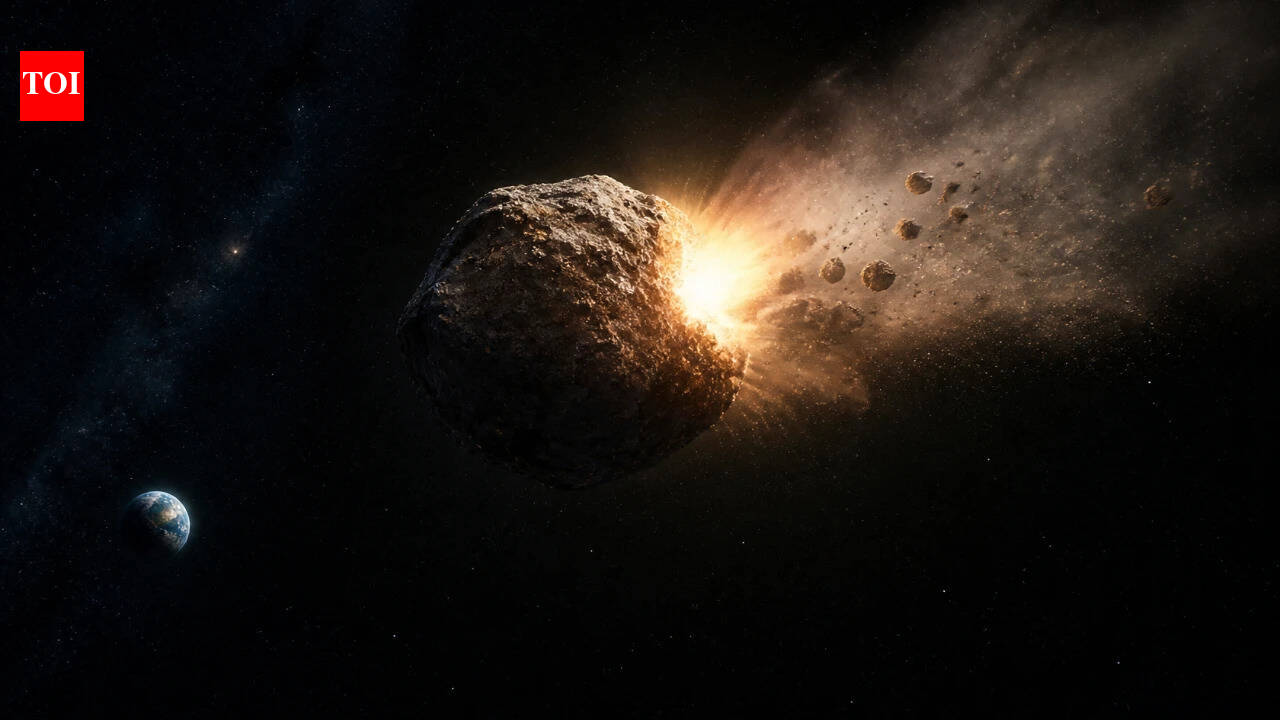
A nuclear blast might be humanity’s best shot at nudging a killer asteroid off course, but scientists at Sandia found that hitting the wrong side could make the push almost five times weaker than planned.
Why use nuclear explosion for asteroids
The objective is to alter its trajectory just enough to ensure it does not collide with Earth by detonating a nuclear device at a carefully calculated distance.
How nuclear blast works
The explosion releases intense X-rays that heat the asteroid's surface, causing material to vaporize and creating a recoil effect that pushes the asteroid in the opposite direction.
Asteroid shape complicates deflection
Asteroids have uneven surfaces, ridges, depressions and unusual shapes that make predicting deflection difficult.
Sandia's new simulation model
Physicist Nathan Moore and his colleagues at Sandia National Laboratories developed a new model to study how asteroids respond to X-ray bursts.
Direction changes deflection by five times
Changing the direction of radiation could make a considerable difference: 3.9 millimetres per second versus 0.8 millimetres per second.
Rotation affected by direction
For another simulated asteroid, the change in rotational speed varied by a factor of 17 depending on radiation direction.
Model improves speed of calculations
The new algorithm is reportedly more than 1,600 times faster than earlier approaches, allowing researchers to study realistic asteroid shapes.
Model builds on previous experiments
The work builds on an earlier experiment using Sandia's Z machine that demonstrated X-rays could deflect a small piece of asteroid material.
Model uses real asteroid data
Researchers can use detailed three-dimensional images from spacecraft flybys to reconstruct an asteroid's shape and simulate X-ray bursts.
Model produces heat maps
The software also produces heat maps showing how much material could vaporize across different parts of the surface.
Model has limitations
The current model can only account for surface rock breakup and cannot yet predict whether the entire asteroid could fracture.
Practical challenges remain
Obtaining detailed observations of an asteroid in time may not be possible if it is discovered on a collision course with Earth.
Positioning nuclear device is hard
Even positioning a nuclear device at the ideal distance and on the correct side of an asteroid could pose significant challenges.
At a glance
Sandia National Labs research shows nuclear deflection of asteroids depends on hitting the correct side to avoid fivefold weaker push.
Read the TL;DR — this story on one card.