From Platypush · · 1m 40s
Rebuilding my voice assistant pipeline
Swapping openwakeword for microwakeword improves voice detection accuracy in self-hosted voice assistants.
In brief
Swapping openwakeword for microwakeword improves voice detection accuracy in self-hosted voice assistants. Fabio Manganiello rebuilt his voice assistant pipeline using assistant.microwakeword and improved speech detection with Silero VAD, reducing false positives and negatives. Originally reported by Platypush.
Wake word detection: a new assistant.microwakeword plugin
Swapping openwakeword for microwakeword improves voice detection accuracy in self-hosted voice assistants.
“microWakeWord is the engine used by ESPHome and Home Assistant Voice”
Speech-to-text: assistant.openai with better end-of-speech detection
Revised speech-to-text uses Silero VAD to end conversations 1.0-1.6 seconds after last word instead of 6-10 seconds.
“On a synthetic benchmark, the new pipeline ends conversations 1.0-1.6 seconds after the last word”
Responses and context: openai plugin handles conversation flow
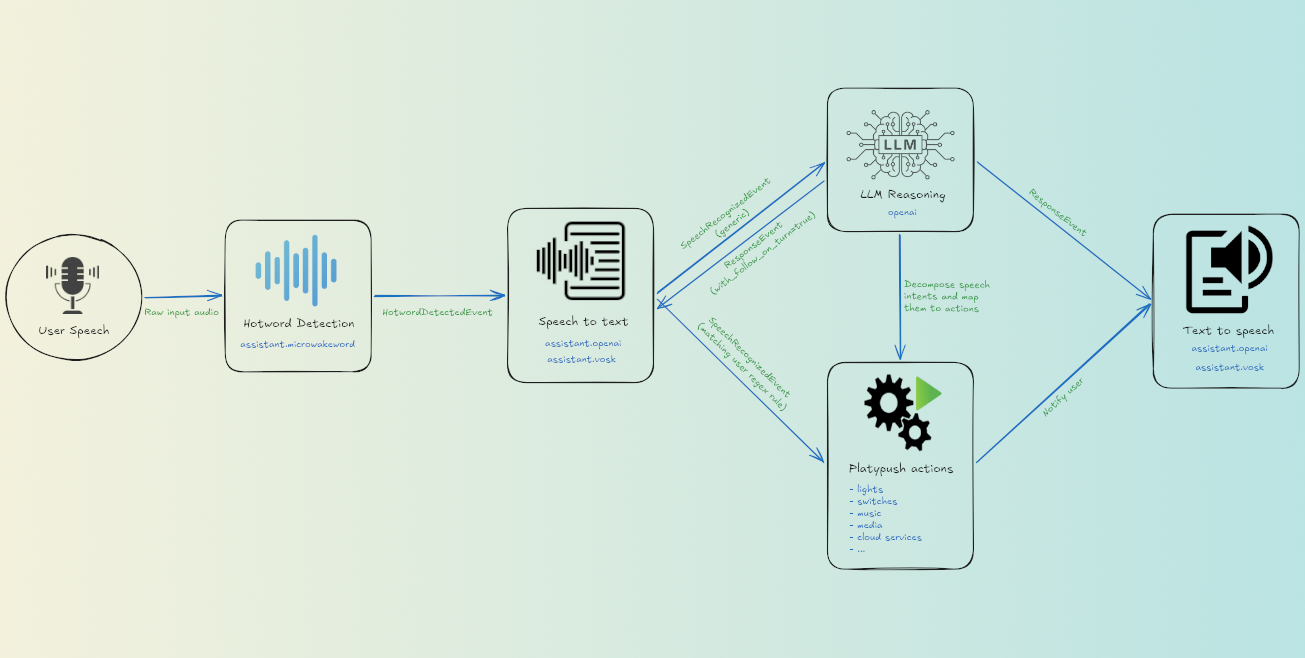
The openai plugin processes transcribed phrases and handles API keys with conversation context.
“The transcribed phrase is processed by the openai plugin, which handles both the API key and the conversation context”
Text-to-speech: tts.openai with local alternatives
tts.openai provides voice responses with volume and voice options, while tts.piper runs locally on Raspberry Pi.
“In my tests on a RaspberryPi 5, tts.piper added ~3-4s of latency compared to tts.openai”
Full configuration details
The pipeline uses assistant.microwakeword with alexa model and assistant.openai with OpenAI API key.
“assistant.microwakeword: models: - alexa”
What changed on the code side
New assistant.microwakeword plugin, improved speech-to-text detection, and shared AudioPreprocessor rework.
“New assistant.microwakeword plugin: microWakeWord hotword detection through pymicro-wakeword”
Why this matters
Improved voice detection reduces false positives and negatives for self-hosted voice assistants.
“The high rates of false positives/negatives of my self-hosted pipeline were a problem”
How it works
Silero VAD uses adaptive noise floor and hysteresis to end conversations quickly after speech.
“Adaptive noise floor: the background noise level is tracked over time”
The pipeline's benefits
The new pipeline improves detection accuracy without requiring external services.
“The pipeline uses local models and no external services”
What's next
Further tuning may be needed for different rooms and microphones.
“Different rooms, microphones and acoustics may yield different results”
The main idea
Fabio Manganiello rebuilt his voice assistant pipeline using assistant.microwakeword and improved speech detection with Silero VAD, reducing false positives and negatives.
Read the TL;DR — this story on one card.