From ScienceAlert · Michelle Starr · · 1m 10s
JWST Finds Forbidden Trihydrogen Signal in Space
JWST spots elusive trihydrogen light from a newborn star's shockwave.
In brief
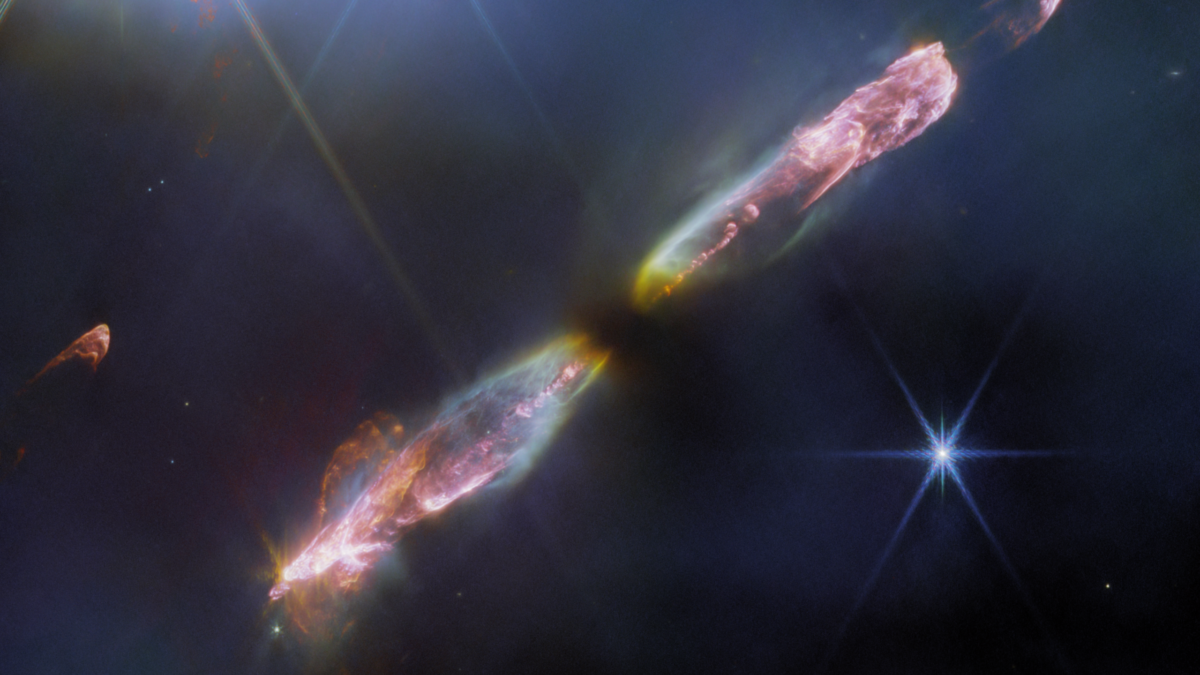
JWST spots elusive trihydrogen light from a newborn star's shockwave. JWST detected H₃⁺'s forbidden rotational signal in Herbig-Haro 168, revealing cosmic chemistry in newborn stars. Originally reported by ScienceAlert.
The Forbidden Signal
Astronomers detected H₃⁺'s elusive rotational light for the first time in the universe.
“It's the foundation for almost all gas-phase interstellar chemistry”
Why H₃⁺ Matters
H₃⁺ is the molecule that made the universe and forms complex organic molecules for life.
The 1986 Prediction
Astrophysicists Fu-Shih Pan and Takeshi Oka calculated H₃⁺ should emit faint rotational light in 1986.
The JWST Discovery
JWST detected 26 faint spectral lines from H₃⁺ in Herbig-Haro 168, with 72 sigma confidence.
The Shockwave Connection
The signal tracked hot molecular hydrogen, showing both molecules respond to newborn star shockwaves.
The Mystery Deepens
Shock wave models underestimated H₃⁺ emission by five to six times or used unvalidated conditions.
The Second Signal
JWST also found H₃⁺ emission in Herbig-Haro 211, confirming the signal's cosmic presence.
What This Means
H₃⁺ could help scientists understand star formation shockwaves and cosmic chemistry.
The essence
JWST detected H₃⁺'s forbidden rotational signal in Herbig-Haro 168, revealing cosmic chemistry in newborn stars.