From Substack · Daniel Frank · · 4m
The million people nobody knew were there
In 1930 an Australian gold prospector walked into a valley and found a million people who had never met the outside world.
In brief
In 1930 an Australian gold prospector walked into a valley and found a million people who had never met the outside world. Goods can travel a thousand kilometres inland while ideas travel nowhere, and that gap kept a million people out of world history until 1930. Originally reported by Substack.
The island of odd facts
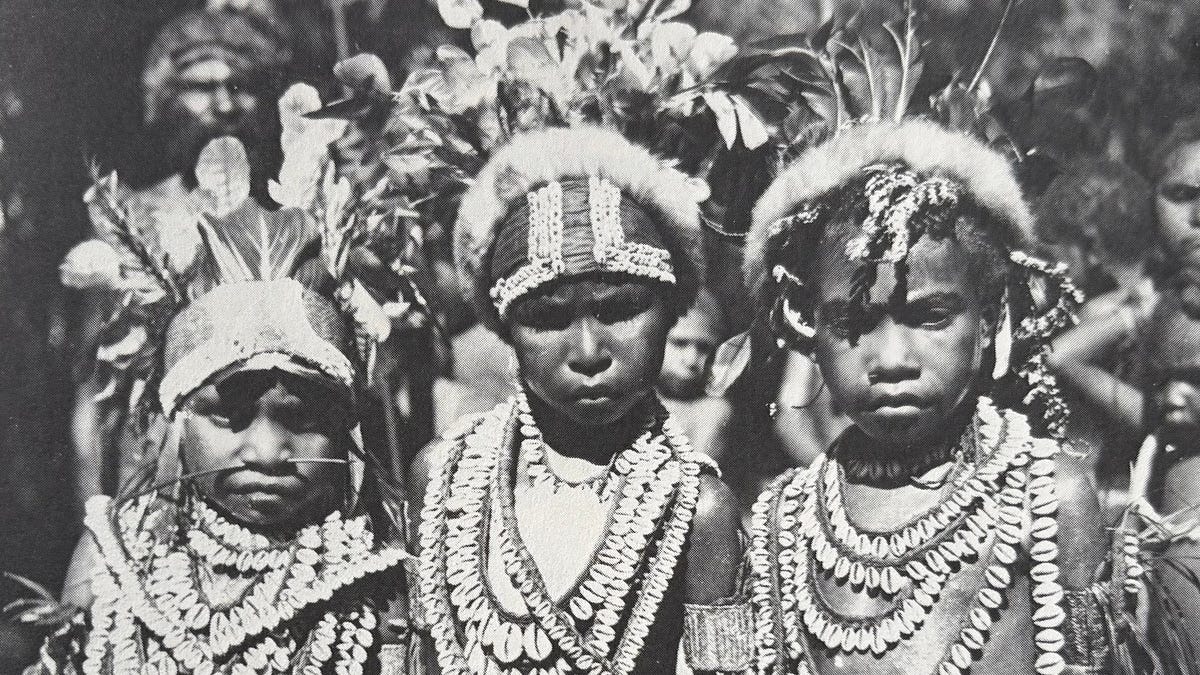
Papua New Guinea collects superlatives: 4.8% Denisovan ancestry, nearly 1,000 languages, a population nobody can count, and bow and arrow battles filmed in 1963.
Facts without a picture
Cannibalism, kuru, the disappearance of Michael Rockefeller. People know the trivia but almost nobody has a working idea of what New Guinea actually is.
The book that changed it
First Contact, by Bob Connolly and Robin Anderson, documents the 1930 discovery of a million highlanders who had no idea the outside world existed, and who nobody outside knew existed either.
Colonised on paper only
The Dutch held the west, Australia the east. Neither had much actual governance on the ground, and neither had been into the interior.
Two New Guineas
The coast is malarial swamp, river and jungle. The highlands sit near the equator with glaciers and peaks near 5,000 metres, wrapped in permanent cloud that made them look dead.
A prospector goes inland
Gold turned up in 1926. Chasing more of it, an Australian named Mick Leahy pushed further up the mountains than anyone had, and in 1930 crossed into the eastern highlands.
Green valleys, a million people
Instead of empty rock he found lush valleys with no malaria, farmed by roughly a million people who had been there for thousands of years.
He filmed all of it
Leahy carried high quality still cameras and a movie camera. Thousands of photos and hours of film capture the first meeting of hundreds of thousands of people.
Are they ghosts
Highlanders assumed the white men were the ghosts of dead relatives. To test it, they spied on them defecating and smelled the result, concluding they must be human after all.
Mirrors, records, aeroplanes
The Australians staged power demonstrations: shooting pigs before whole communities, playing records, landing planes. A Kellogg's wrapper from the rubbish became prized headwear.
The shell hyperinflation
Shells were the highland currency, rare enough that one could make a man a leader. The Australians flew them in by the planeload until children wore hundreds and shells were worth nothing.
Fifty thousand years alone
People walked and paddled to New Guinea about 50,000 years ago. After agriculture took hold around 10,000 years ago, the highlands filled up and sealed off from the coast until 1930.
They invented farming themselves
New Guinea is one of the few places that invented agriculture independently. While the Middle East worked on wheat, highlanders drained swamps for taro and bananas. Bananas and sugarcane were domesticated there.
Why nothing ever centralised
Taro rots in weeks, so nothing could be stored, traded in bulk or taxed. No draft animals, no writing, never quite enough protein. Societies stayed at a few hundred people.
Constant war, shared culture
Neighbours fought and intermarried, so good ideas copied across anyway. Groups ended up with similar crops, houses, rituals and politics without ever sharing a government.
The big man problem
Leadership came from moka, competitive gift giving of pigs and shells. Whoever gave most publicly led, but the title died with him, so no leader could think long term or feel secure.
The sweet potato got in
Spanish and Portuguese traders brought it to the spice islands in the 1500s. It crossed the highlands over a century or two, passed from bride to garden to neighbour, nobody knowing its origin.
Goods travelled, ideas didn't
A plant reproduces itself at every handoff. An idea needs a shared language and a reason to listen, and every link in that chain was between groups who expected to attack each other.
“The sweet potato made it 1,000 km inland but the concept of the ocean didn't.”
Proof of the seal
Coastal people carry 10 to 30% Austronesian ancestry and heavy malaria resistance. Highlanders have neither, and no coastal language ever reached them. Three thousand years, no mixing.
Still living before contact
Port Moresby connects to nowhere by road. Tok Pisin gave everyone a shared language but not a shared identity, so people are still John Smith of their clan, not of Papua New Guinea.
“People are still John Smith of the such and such tribe, not John Smith of Papua New Guinea.”
The key point
Goods can travel a thousand kilometres inland while ideas travel nowhere, and that gap kept a million people out of world history until 1930.





