From Substack · Clara Collier · · 4m
What a world without work actually looks like
History shows us relational societies where status comes from connections, not accomplishments. And they're surprisingly petty.
In brief
History shows us relational societies where status comes from connections, not accomplishments. And they're surprisingly petty. Work gives us dignity through merit and accomplishment rather than family ties. Lose work, and we revert to gossip-driven societies obsessed with status and conformity. Originally reported by…
When AI does all the work
If machines surpass humans at all economically necessary labor, what's left? Relationships. We'll need the human touch, and getting those jobs will depend on who you know, not what you know.
A return to pre-industrial life
Before factories, work wasn't about dignity or meaning. People were defined by their place in a densely interconnected social world. A post-work future might look like that again.
“Before industrialization, it was difficult to separate a product from the person who made it.”
Meet the 18th-century aristocrats
Aristocrats were rich and didn't work for pay. They're a perfect case study for what happens when people have no economic pressure and all their time is relational.
Saint-Simon at Versailles
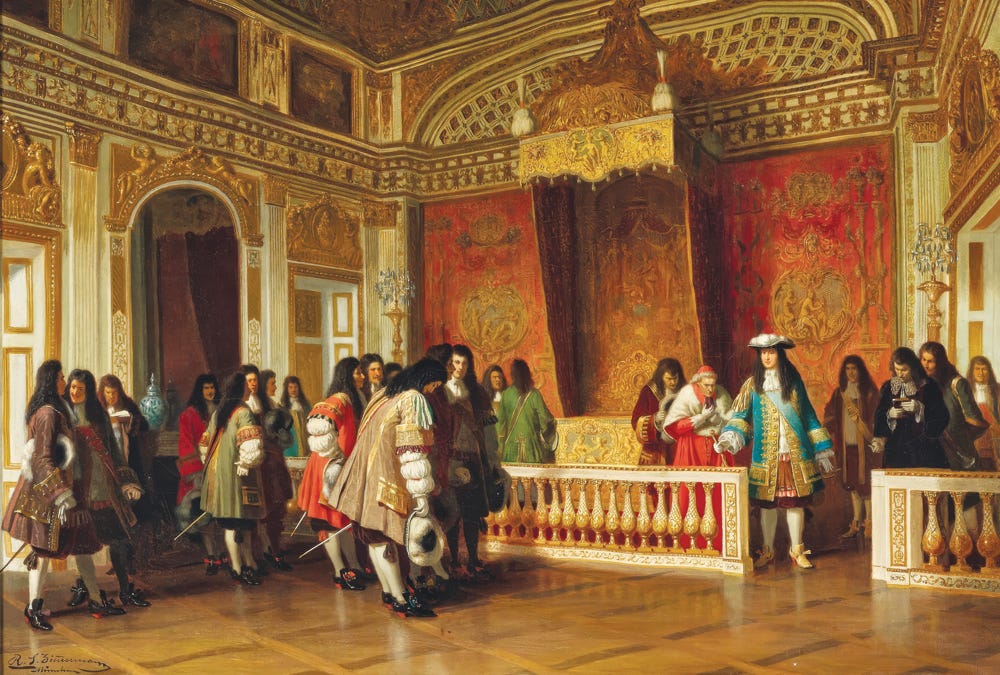
The duc de Saint-Simon lived at the wealthiest court in Europe but spent his memoirs obsessing over heraldic emblems and ceremonial headgear. His life was intrigue, not enlightenment.
Court life was all gossip
Aristocrats went to the theater not to appreciate Molière but to see who else was there and what they wore. Salons discussed politics and themselves, not philosophy.
Catherine the Great's court
Even Catherine, intellectually voracious and pragmatic, lived in a world where all politics was relentlessly personal. Daily life was gossip about who offended the empress.
Aristocrats are like chimpanzees
They're hyperaware of dominance hierarchies, constantly tracking alliances and challenges. Elaborate etiquette at Versailles was a civilizing process to prevent them from stabbing each other.
Upper-class women in 1980s Midwest
Susan Ostrander studied wealthy women who didn't work. They spent time hosting, maintaining social networks, and volunteering on nonprofit boards to raise money from other rich people.
Volunteering as social obligation
These women volunteered not to help communities but to maintain their status. One admitted it was 'the illusion of being useful' that mattered, not actual results.
“It's that illusion of being useful that's satisfying.”
A small, restricted world
Upper-class women belonged to the same clubs, lived in the same neighborhoods for generations, and socialized only with their own kind. The range of acceptable activities was narrow.
Boston's West End Italians
Working-class Italian Americans in the nineteen fifties didn't see work as a source of status. They worked just enough to support their peer group, which was their real organizing principle.
The peer group society
West Enders spent almost all their time with the same relatives and childhood friends, talking and gambling. Talent as a conversationalist mattered more than job success.
Policing conformity
West Enders bullied anyone who did too well in school or wanted a white-collar job. Dignity came from loyalty to the group, not personal achievement.
Why they couldn't organize
West Enders couldn't fight urban renewal because their peer group was egalitarian and they distrusted formal institutions. They had social capital but no organizations.
What work actually gives us
Most Americans like their jobs. We value feeling competent, respected, and useful. Work lets us earn dignity from what we do, not who we know.
People want to feel useful
During COVID lockdowns, workers returned to jobs with relief. A bartender said, 'We want to feel useful.' A visitor center worker cried for joy returning to her team.
“Sometimes one feels afflicted, desperate, because we want to work.”
Skills and respect matter most
Workers hated being treated like robots or condescended to. The happiest felt respected by peers, skilled at their trades, and useful to their communities.
Impersonal respect is different
Unlike relational societies, we want respect for our skills and accomplishments, not our family ties. A waitress can feel her work matters to strangers.
Relational societies get clannish
When dignity depends on group membership, people police who joins and what happens. Relational societies are more restrictive and exclusionary than merit-based ones.
Commercial society made friendship possible
The Scottish Enlightenment realized that impersonal markets freed people from transactional relationships. When we can support ourselves, we can choose friends based on sympathy, not need.
The key point
Work gives us dignity through merit and accomplishment rather than family ties. Lose work, and we revert to gossip-driven societies obsessed with status and conformity.