From TIME · Jeffrey Kluger · · 3m
America admits it has weapons in orbit
The Air Force Secretary said out loud what Washington spent decades denying, and the debris math is what should worry you.
In brief
The Air Force Secretary said out loud what Washington spent decades denying, and the debris math is what should worry you. Space weapons are already up there, and the real danger is not the shooting but the debris a single kinetic hit leaves behind. Originally reported by TIME.
The quiet part, said aloud
On Sept. 14 at a conference in Maryland, Air Force Secretary Troy Meink confirmed the U.S. already has offensive-capable hardware operating in Earth orbit.
“the United States has on orbit space control weapons capable of defending the Joint Force”
A treaty from 1967
The Outer Space Treaty, signed by the U.S., U.K., and U.S.S.R. in January 1967, banned weaponizing space. 112 more countries have since joined. China signed in 1983.
Honored in the breach
The U.S., China, and Russia have all tested satellite-killing tech anyway. The treaty has been a statement of intent more than a constraint.
“honored as much in the breach as in the observance”
America shot first, in 1985
A U.S. Air Force jet flying at 31,500 feet launched a missile that destroyed a defunct American weather satellite. The same tech works on anyone else's satellites.
Beijing and Moscow followed
China destroyed its Feng Yun-1C weather satellite in 2007 with a ground-launched ballistic missile, hitting a target more than 500 miles up. Russia managed the same feat in 2021.
Outrage, then imitation
When China did it in 2007, Bush officials called it destabilizing and worrisome. An Air Force spokesperson said flatly that the U.S. did not want to do that.
“We don't want to do that.”
Reagan's $70 billion umbrella
The Strategic Defense Initiative ran a decade, burned through an inflation-adjusted $70 billion, and produced no technology of note. It was framed as defensive, so it skirted the treaty.
A branch for orbit
Trump created the Space Force in 2019. With 10,000 members against the Army's 450,000, it mostly renamed work Air Force Space Command was already doing.
Golden Dome, $1.2 trillion
A week into his second term, Trump ordered a space-defense system the CBO estimates could cost $1.2 trillion over 20 years. Its first-year down payment roughly equals NASA's entire annual budget.
Hardware, not slides
In 18 months Golden Dome went from contracts to flight-ready gear. Interceptor and surveillance beta tests launch before year's end, starting with a monitoring constellation this month.
“We start launching our Air Moving Target Indicator constellation this month”
Lasers and robot arms
Beyond missiles, armed satellites could fry or blind rival optics with lasers and microwaves. China is reportedly building satellites with robotic arms to drag other satellites out of orbit.
A flake of paint can kill
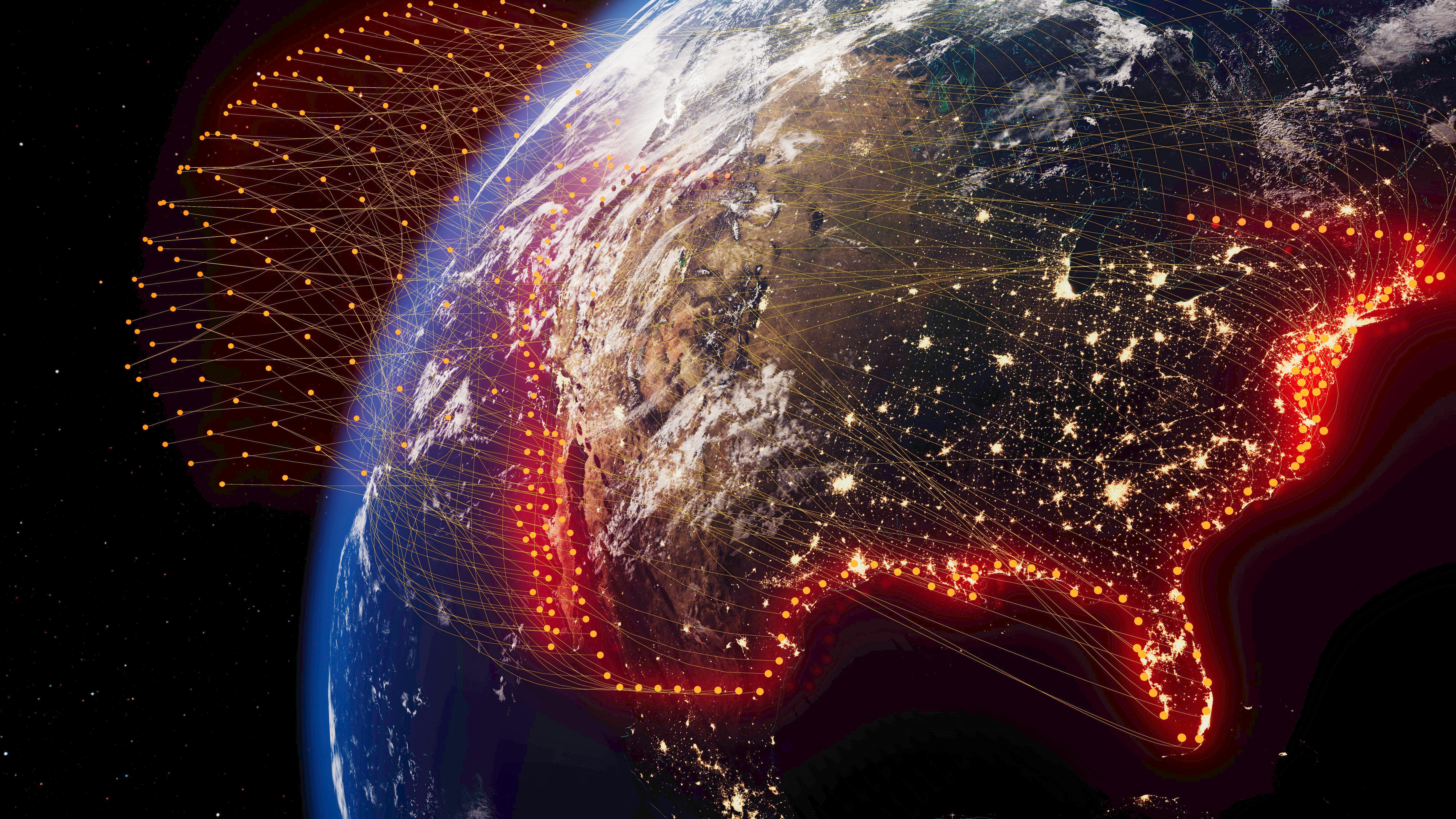
Orbit holds 15,000 working satellites, 10,000 dead ones, 500,000 fragments, and 100 million specks. At 4.85 miles per second, even paint can wreck a spacecraft.
The cascade nobody can stop
The Kessler Effect is a chain reaction of collisions that could wipe out an entire orbital band. China's 2007 test made 3,000 fragments, Russia's 1,500. Luck kept both from starting one.
The one thing
Space weapons are already up there, and the real danger is not the shooting but the debris a single kinetic hit leaves behind.