From TIME · Charlie Campbell · · 2m
BYD's global ambitions hit trade barriers
China's EV giant aims to overtake Toyota by 2030, but faces tariffs, quotas and military designations across the world.
In brief
China's EV giant aims to overtake Toyota by 2030, but faces tariffs, quotas and military designations across the world. BYD, the world's top EV maker, faces mounting trade barriers in the US, EU and elsewhere as it pursues global expansion to overtake Toyota. Originally reported by TIME.
BYD dominates the global EV market
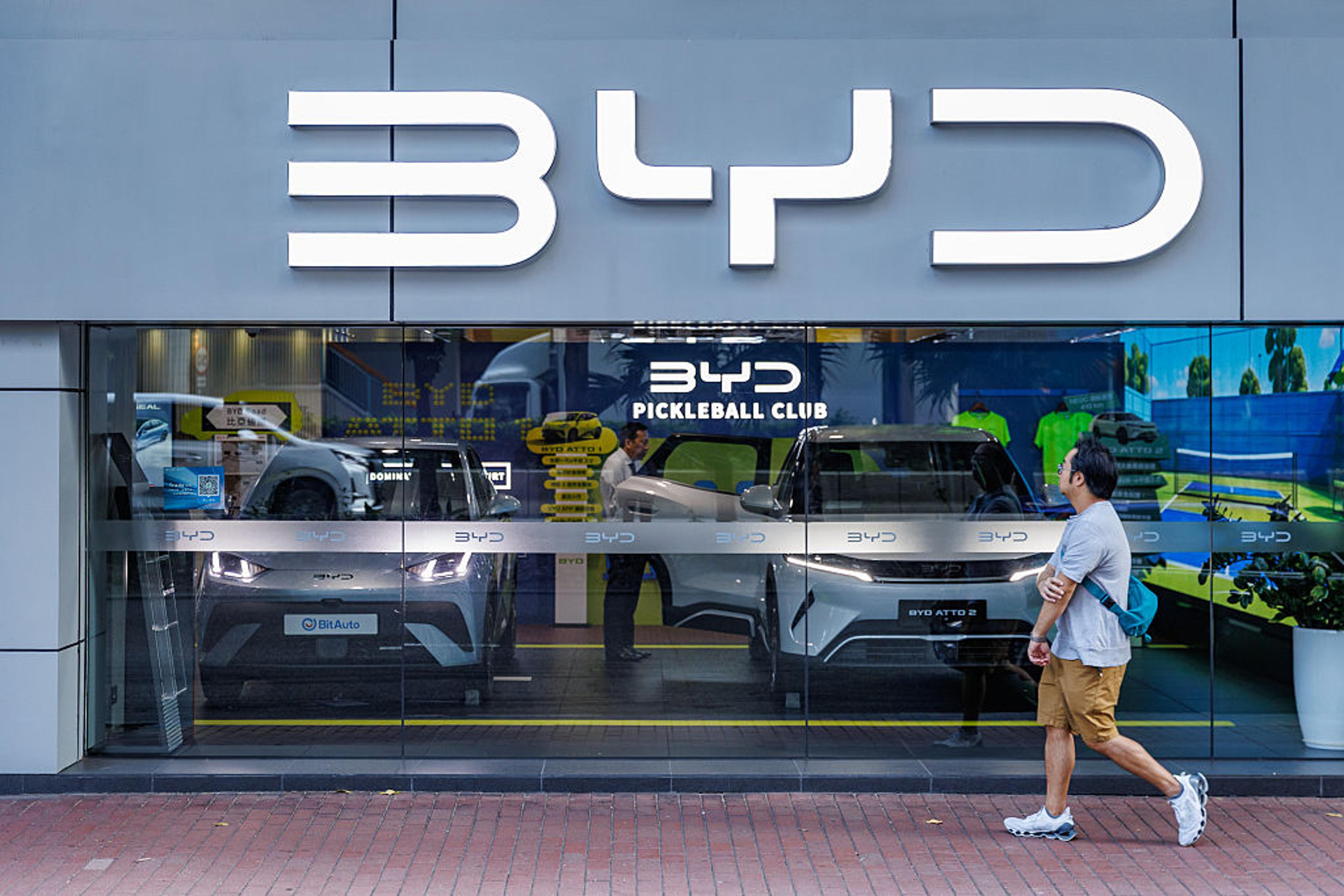
Last year, Chinese manufacturer BYD became the world's top EV seller, moving 4.6 million vehicles across 120 countries and regions with revenue of 111 billion dollars.
BYD's next target: overtake Toyota
BYD aims to become the world's number one automaker by 2030, a goal requiring more than double its current output as China's auto market cools.
Foreign markets now drive growth
As China's domestic market slows, BYD's foreign business has already surpassed its domestic revenue, making overseas expansion critical to reaching its 2030 target.
Trade barriers multiply worldwide
BYD's success has triggered tariffs of 27 percent in the EU, 35 percent in Brazil, 40 percent in Turkey, and 100 percent in the US.
EU imposes hybrid EV quota
On October 12, the EU announced a 350,000-a-year quota on hybrid EV imports from China, expected to halve their market share in the region.
Pentagon labels BYD military company
In June, the US Pentagon designated BYD as a Chinese military company, a move the firm disputes as inaccurate and is working to overturn.
Stella Li responds to military label
BYD vice-president Stella Li says the designation is unfounded because BYD is privately owned and publicly traded, and all car companies must work with Chinese regulators.
“We are a privately owned, publicly traded company.”
Geopolitics is the main obstacle
Li identifies geopolitical headwinds as BYD's biggest challenge to reaching its 2030 goal, citing daily headlines about new tariffs and trade restrictions.
“Every day, you wake up with headlines saying, 'the U.K. is going to put a 45% tariff,' and 'the European Union is going to put another tariff.'”
Li: restrictions driven by politics
Li argues European trade barriers are motivated by political concerns rather than merit, noting BYD would hire local workers and strengthen regional economies.
Joint ventures no longer make sense
Li rejects calls for joint ventures with foreign firms, arguing that when foreign companies entered China decades ago, the market was weak and they profited heavily.
“China did open up for all the foreign brands to make tons of money over the past 20 years. They banked the profit from China.”
BYD leads in battery technology
BYD is developing solid-state batteries and pioneering flash charging technology, positioning itself as the industry leader in next-generation battery innovation.
Expanding beyond cars
BYD operates across multiple industries including electric buses, battery storage, semiconductors, humanoid robots and data centers, creating an ecosystem competitors cannot match.
The essence
BYD, the world's top EV maker, faces mounting trade barriers in the US, EU and elsewhere as it pursues global expansion to overtake Toyota.