From TechRadar · · 2m
Huawei's new Kirin chip, minus America
Huawei says the Kirin 9050 Pro contains no US technology, but the machines that made it tell a different story.
In brief
Huawei says the Kirin 9050 Pro contains no US technology, but the machines that made it tell a different story. Huawei has closed the design gap faster than expected, yet the equipment inside the fab is still Western, so "America-free" describes the parts list, not the process. Originally reported by TechRadar.
A chip with no America in it
Huawei introduced the Kirin 9050 Pro and says it is fully free of American technology. It powers the Mate XT 2 tri-fold, which went on sale in China on September 12 2026 from 19,999 yuan, about $2,980.
The word nobody said
The South China Morning Post read the launch as Huawei signaling less reliance on foreign chip equipment. Huawei's own press materials never mention sanctions once.
Most powerful Kirin ever
Consumer chief Richard Yu claimed a 42% overall gain over the Kirin 9020 in the previous Mate XTs. Against the Kirin 9030 Pro, Huawei cites 24% higher single-core and 52% better multi-core.
“most powerful Kirin chip ever”
Nine cores and on-device AI
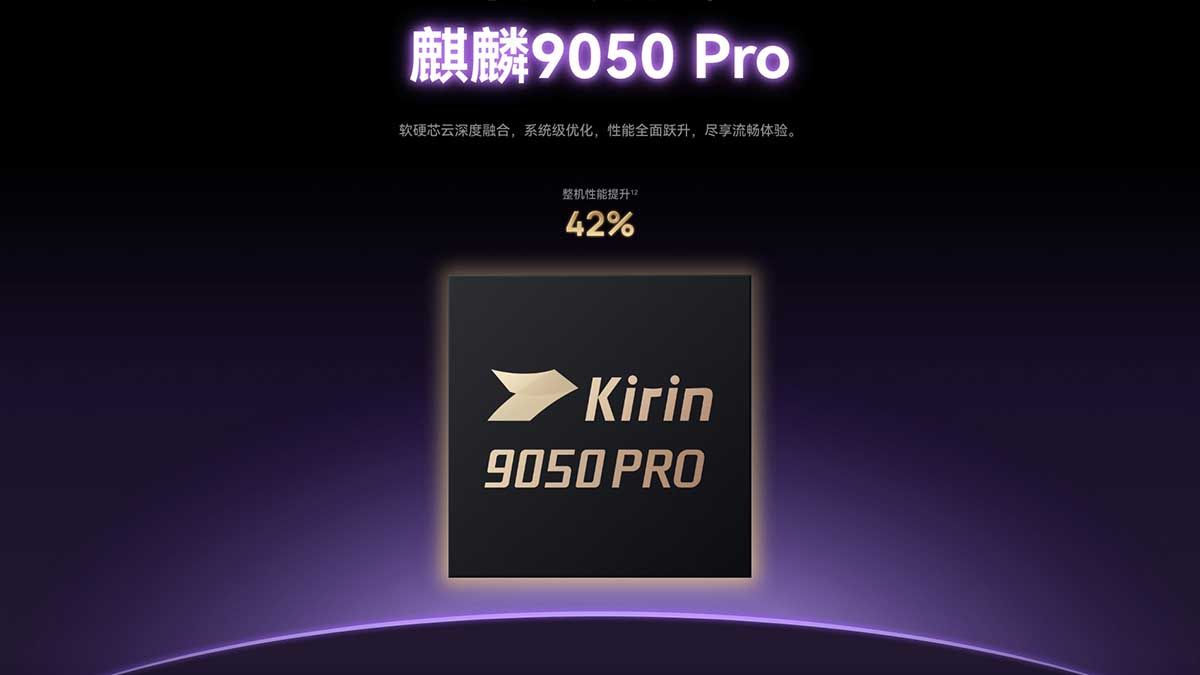
The LinxiCore CPU peaks at 3.1GHz, the Maleoon GPU adds hardware ray tracing, and graphics rendering jumps 142%. The Da Vinci NPU runs a 30-billion-parameter mixture-of-experts model locally.
Folding logic instead of shrinking it
This is the first commercial silicon using LogicFolding, a technique Huawei's semiconductor chief He Tingbo presented at IEEE ISCAS in Shanghai in May and detailed in a signed paper.
Two layers, fifty million wires
LogicFolding splits logic across two active silicon layers bonded face to face, joined by roughly 50 million vertical interconnects at about a 1.5 micrometer pitch. Shorter signal paths let Huawei drop voltage while raising density 55%.
Every number is Huawei's
No independent testing or peer review backs any of the performance or density claims. Huawei also refused to name a process node, and that silence says plenty.
The receipts are in the fab
SemiAnalysis tore down the predecessor in June 2026 and found SMIC's third-gen 7nm N+3 process hitting about 113 million transistors per square millimeter with no EUV. That process still runs on ASML immersion scanners.
America-free, seven years running
Bloomberg reported SMIC built earlier Kirins on Applied Materials and Lam Research gear bought before the October 2022 export rules. Huawei called its phones America-free back in 2019 too, when TSMC was fabbing the Kirin 990 on EUV.
“all of our 5G is now America-free”
The takeaway
Huawei has closed the design gap faster than expected, yet the equipment inside the fab is still Western, so "America-free" describes the parts list, not the process.





