From TechRadar · · 2m
Superconducting memory bit approaches physics limit
Hebrew University physicists claim a superconducting vortex reaches five times Landauer's minimum energy cost, but the result depends on simulation and comes with major practical tradeoffs.
In brief
Hebrew University physicists claim a superconducting vortex reaches five times Landauer's minimum energy cost, but the result depends on simulation and comes with major practical tradeoffs. Hebrew University researchers estimate a superconducting vortex can store a memory bit at roughly five times the theoretical…
The physics floor for erasure
Every time a computer erases a bit, it pays an energy toll. IBM physicist Rolf Landauer pinned down the minimum in nineteen sixty-one: kT ln two, which works out to about two point nine zeptojoules…
Hebrew University's superconducting approach
Physicists at the Hebrew University of Jerusalem say they have come within about five times of that floor using a single superconducting vortex, a nanoscale whirlpool of electrical current.
The experiment's setup and method
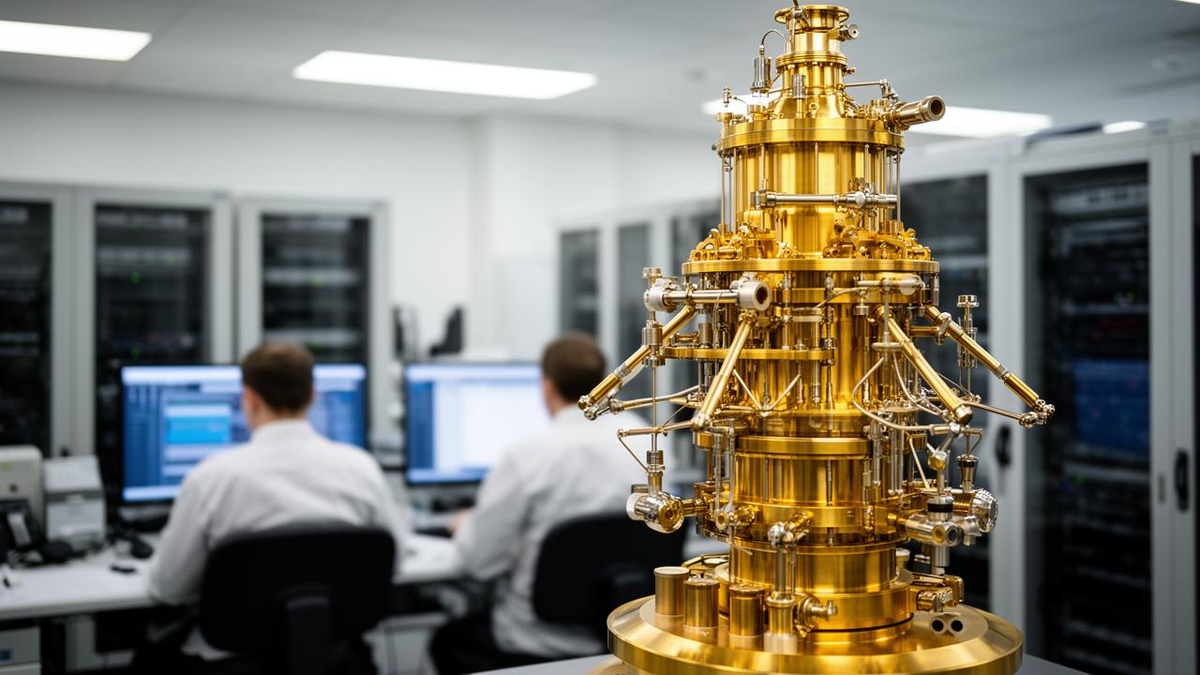
The team, led by Yonathan Anahory, used a fifty-five-nanometer niobium film cooled to four point two kelvin.
Measuring energy loss in the vortex
They rocked each vortex with alternating current and tracked it with a SQUID-on-tip microscope, a magnetic sensor built onto a tapered glass probe. The motion lag revealed energy lost each cycle.
The five-times claim and its limits
Anahory said the result puts the bit at roughly five times Landauer's limit, bringing it remarkably close to the minimum permitted by physics.
“bringing it remarkably close to the minimum permitted by physics.”
Reviewer two's objections
Reviewer two rejected the final version, opening with authors write that they measure work. It is not true. The reviewer argued force, displacement and work were estimated or inferred rather than observed.
“Authors write that they measure work. It is not true.”
The authors' response to criticism
The authors declined to provide the extra experiments reviewer two requested, citing scanning drift that limits static imaging to about twenty nanometers and noting that changing temperature reshapes the pinning landscape.
Speed versus efficiency tradeoff
Landauer's limit is only reachable if you take your time. The Hebrew University estimate applies at one hundred fifty kHz, or one operation every six point seven microseconds, while superconducting logic chips were clocked at…
Data retention versus efficiency
By the authors' own noise data, the two wells central to the near-limit result let the vortex hop on its own roughly three thousand to seven thousand times a second at four point two kelvin…
The practical reality of the result
The Hebrew University team has produced a careful estimate of how cheaply a single vortex can be shuffled between two spots.
The key point
Hebrew University researchers estimate a superconducting vortex can store a memory bit at roughly five times the theoretical physics minimum, though the result relies on simulation rather than direct measurement and faces speed and cooling challenges.