From Thegreenplace · · 1m 40s
Notes on the discrete Fourier transform (DFT)
How the discrete Fourier transform works for finite signals.
In brief
How the discrete Fourier transform works for finite signals. The discrete Fourier transform (DFT) converts finite digital signals into complex frequency coefficients for precise reconstruction. Originally reported by Thegreenplace.
Analyzing signal samples
Suppose we have N samples of a signal - it’s a list of N numbers: x[n] n∈{0..N-1}.
The Discrete Fourier Transform (DFT)
The DFT converts finite digital signals into complex frequency coefficients for precise reconstruction.
DFT formula
X[k] = sum_n x[n] exp(-i 2 pi k n / N).
DFT and complex roots of unity
The N-th roots of unity form an orthogonal basis for complex numbers.
Fourier matrix
The Fourier matrix F multiplies the signal vector to get the DFT.
Inverse DFT
x[n] = 1/N sum_k X[k] exp(i 2 pi k n / N).
Example: triangular signal
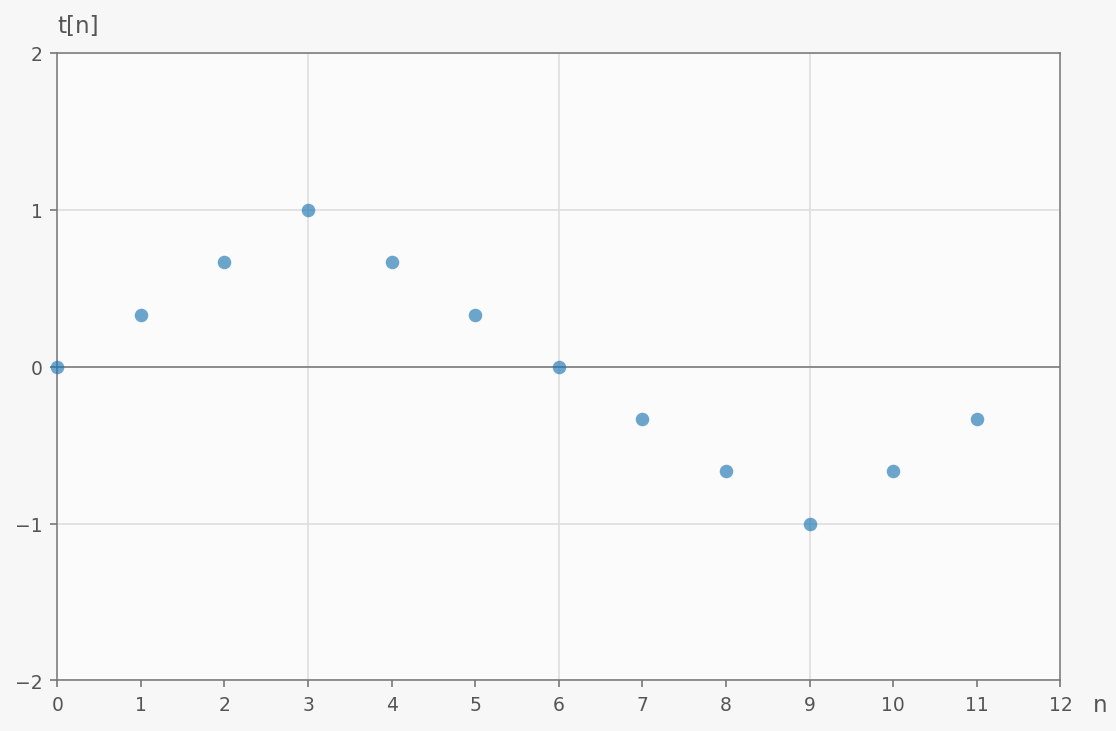
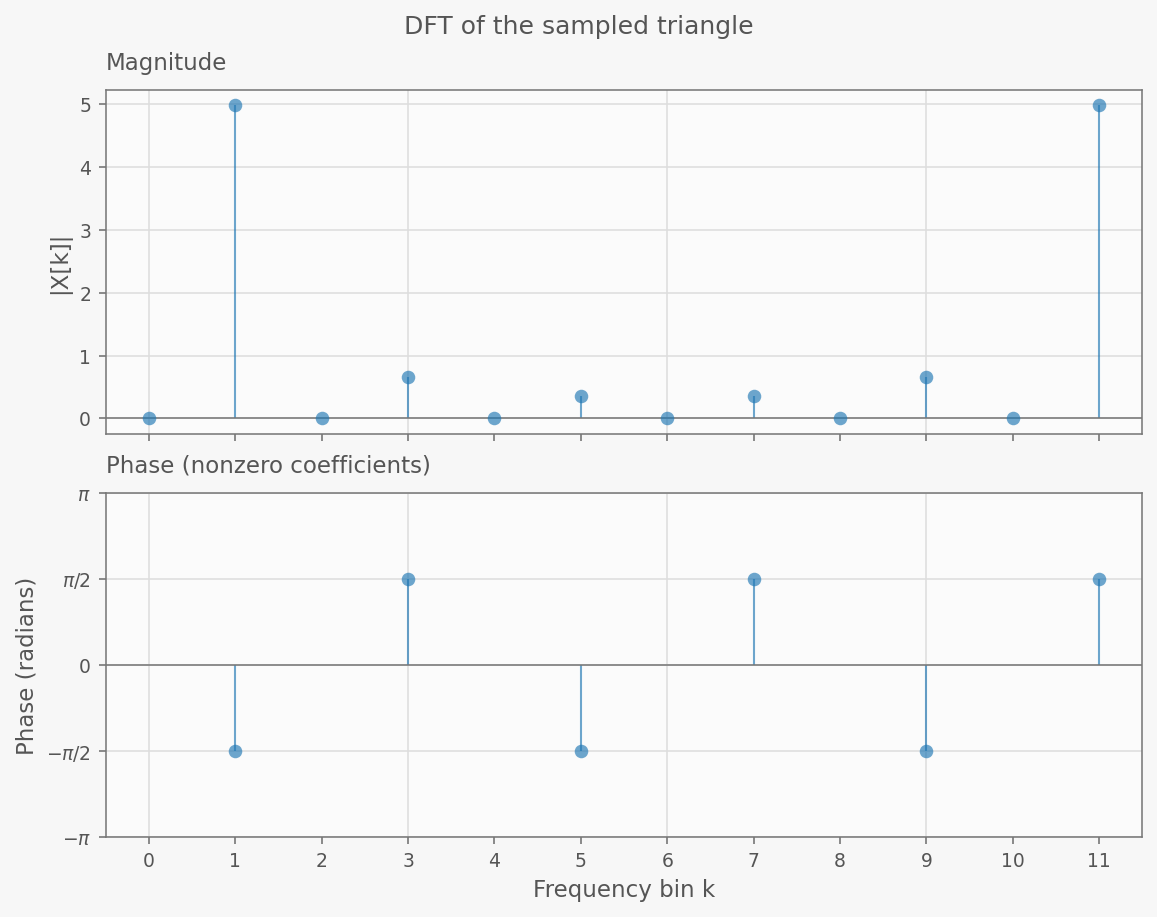
A single cycle of sampled triangle signal reconstructs perfectly via DFT.
Spectral leakage
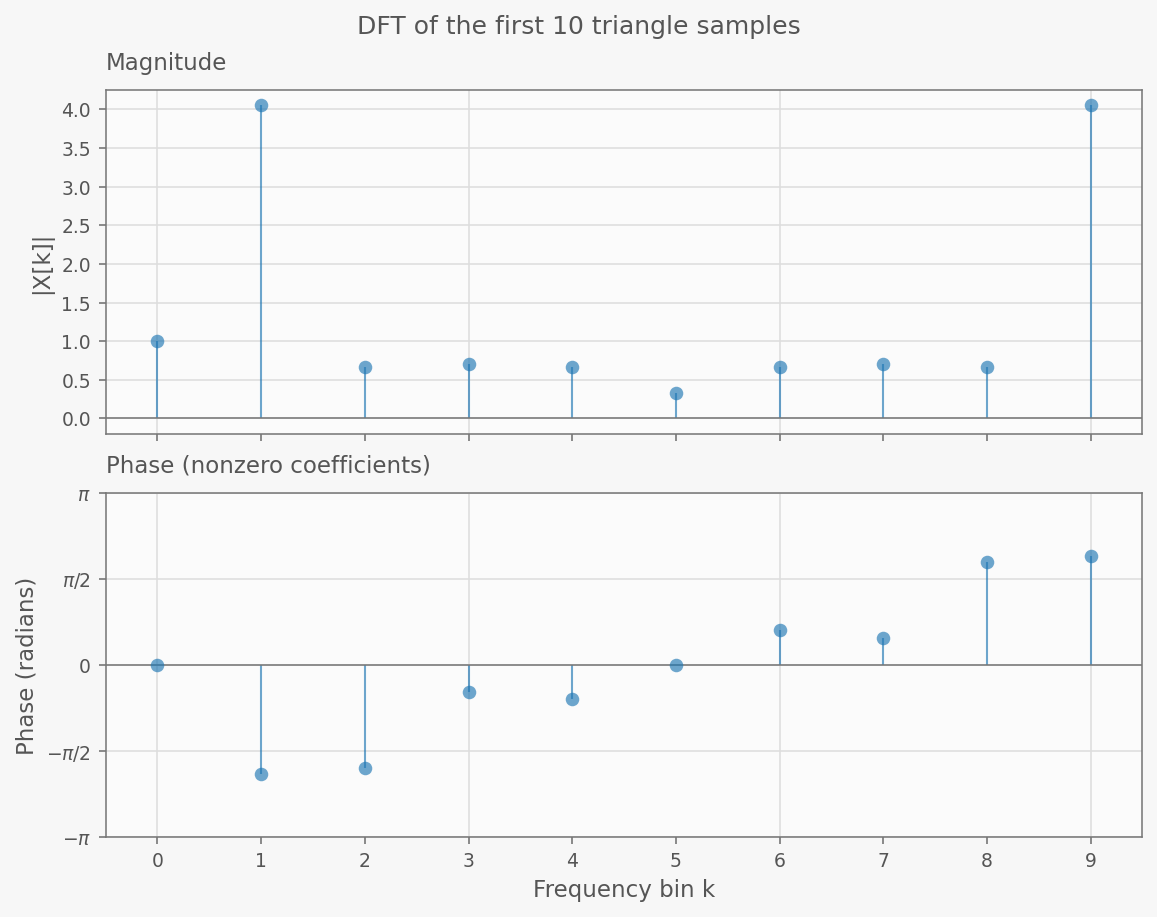
Partial cycles cause frequency spread across multiple DFT bins.
Efficient DFT computation
Fast Fourier Transform (FFT) reduces DFT calculations from O(N^2) to O(N log N).
Here's the gist
The discrete Fourier transform (DFT) converts finite digital signals into complex frequency coefficients for precise reconstruction.
Read the TL;DR — this story on one card.