From TradingView · · 1m 40s
Bitcoin Cycle Peak Model Predicts May 2029 Top
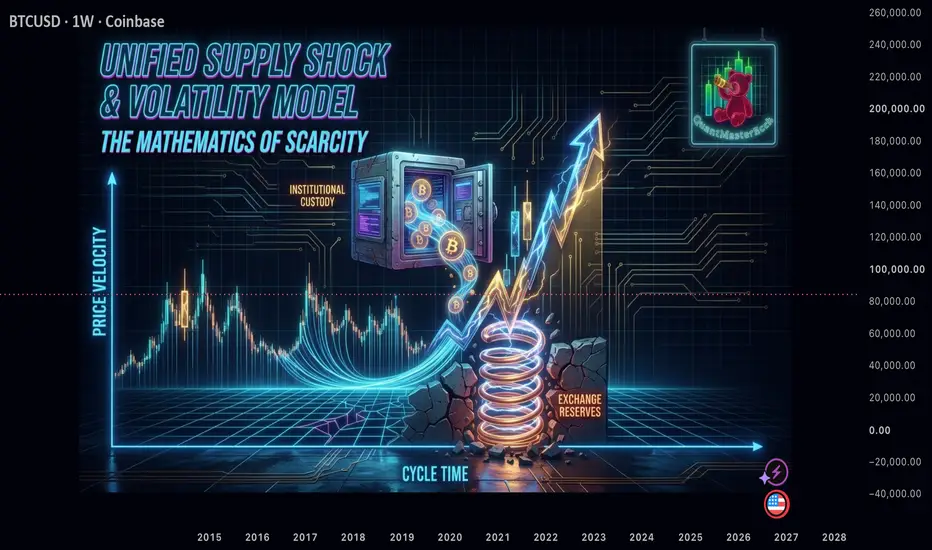
QuantMasterEcch's model forecasts Bitcoin's next peak at $259,536 by May 2029 using supply shock mechanics.
In brief
QuantMasterEcch's model forecasts Bitcoin's next peak at $259,536 by May 2029 using supply shock mechanics. QuantMasterEcch's model projects Bitcoin's cycle peak at $259,536 in May 2029 based on post-ETF liquidity dynamics. Originally reported by TradingView.
Unified Supply Shock Model
This model calculates macro cycle tops by treating post-ETF structural cushion as a two-way volatility modifier.
Core Variables
Cycle low at $58,035 (post-ETF floor), historical base accretion of +715% (2022 to 2025 peak), and ETF drawdown compression matrix showing pre-ETF bears at -77% versus post-ETF bears at -54%.
Volatility Dampening Factor

Supply efficiency multiplier calculates pre-eth max drawdown (0.77) divided by post-eth max drawdown (0.54) resulting in 1.4259x.
Shock-Adjusted Accretion
Applying a mild cycle decay (-66.0%) to the previous +715% run establishes a baseline unshocked accretion rate of +243.5%. Compounding this by the supply efficiency multiplier yields +347.21%.
Projected Cycle Top
Projecting the cycle top at $259,536.32 using the post-eth cycle low of $58,035 and shock-adjusted accretion of +347.21%.
Sensitivity Analysis
Varying the cycle floor from $55,000 to $62,000 and drawdown cushion from -60% to -50% shifts the projected peak between $226,864 and $294,493.80.
Historical Backtests
2021 backtest projected $77,556.72 peak versus realized $69,000; 2017 backtest projected $19,160.19 versus realized $19,640.
35-Month Expansion Timeline
All major cycles from 2015-2017, 2018-2021, and 2022-2025 show exactly 35 months from trough to peak.
May 2029 Projection
Model projects Bitcoin's peak in May 2029 due to the 5th halving in April 2028 requiring 12-13 months to exhaust OTC reserves and a 4-year institutional credit cycle.
The main idea
QuantMasterEcch's model projects Bitcoin's cycle peak at $259,536 in May 2029 based on post-ETF liquidity dynamics.