From TradingView · · 5m
Monero as a bet on still being able to move money
A trader's case that Monero is not a privacy play but a wager on what permissionless settlement is worth once the exits start closing.
In brief
A trader's case that Monero is not a privacy play but a wager on what permissionless settlement is worth once the exits start closing. The thesis prices an option, not a technology: if capital controls, sanctions or war make ordinary rails conditional, the ability to move value without permission gets repriced fast…
The bet in one line
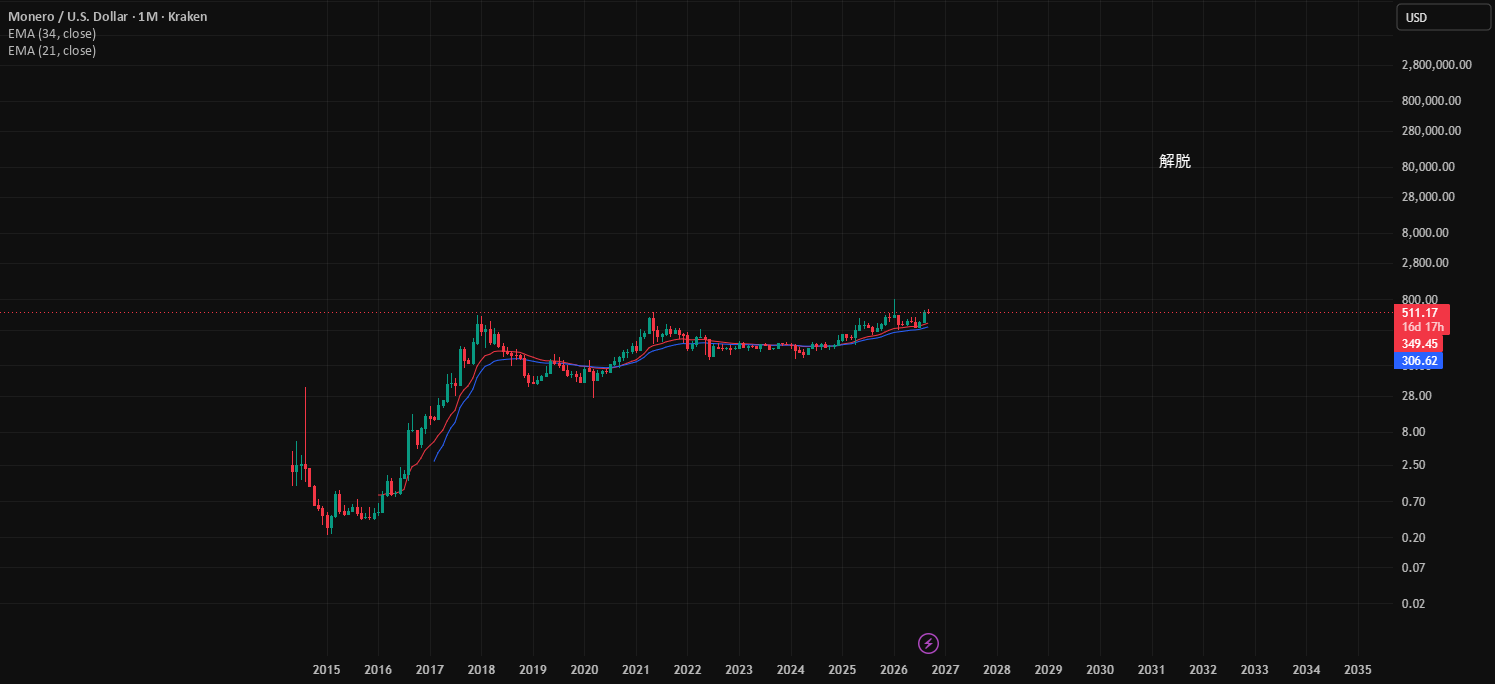
Markets price Monero as an asset. This thesis prices it as an option: the ability to hold and move value without an intermediary's permission or a working monetary order. Scarce options get expensive.
The premise is strain
The starting assumption is that the resources holding up major state structures are wearing thin: debt crises, devaluations, capital controls, war, trade splitting apart. Not a collapse call, just a refusal to draw straight lines.
Owned, priced, unusable
The real risk is not the number going down. It is a portfolio you legally own, with live quotes, that you cannot sell, move or spend. Access turns into a separate property from value.
“An asset can remain legally owned and retain a quoted price while becoming unusable for its owner.”
Privacy is only the surface
Selling Monero as an anti-surveillance tool is the shallow read. The question underneath is whether you keep economic agency when monetary systems compete, wall themselves off or simply stop talking to each other.
“Privacy matters, but the potential issue goes beyond personal privacy”
When the fallback reprices
While banks and settlement systems work normally, their convenience wins and the ability to skip them looks like a party trick. The repricing happens the day it stops being optional.
“Once restrictions become effective, that fallback capability can be repriced abruptly.”
No mass adoption required
Monero never has to replace a national currency. It needs individuals parking transition money, a founder keeping enough to make payroll, and large players wanting one neutral settlement leg between hostile jurisdictions.
Holding beats spending
Transaction counts are the wrong tell. If a merchant can pay some suppliers in XMR, revenue stops being converted on arrival and starts sitting as treasury. Balances left between trades are what tighten float.
“Rising transaction activity is therefore insufficient: I am looking for a growing willingness to hold units between transactions.”
No issuer, no peg
A reserve-backed stablecoin inherits every dependency of the system holding its collateral. That is the whole point of avoiding one. The cost is real volatility in purchasing power, which is a price paid, not a feature.
“XMR held directly is not an issuer's promise of repayment.”
Four properties, one stack
Self-custody, mobility, privacy on by default, and neutrality that survives pressure. None of them works alone, and strong cryptography buys nothing if governance folds. The Zcash reservation is exactly that, concentration.
“owning keys does not make a public ledger private”
What it does not replace
Gold owes nobody but travels badly. Land and machines stay exposed to whoever controls the territory. Deposits and bonds are claims on a debtor. The job here is narrower than any of those.
“The role I assign it is that of a transferable, private monetary reserve in a world that remains connected but financially constrained.”
Already tested under fire
Delistings, hostile environments, no corporate sponsor, and the project still ships and funds itself. Dynamic blocks let capacity flex and tail emission keeps paying miners, but neither conjures buyers on the other side.
“Tail emission is not a supply that adjusts elastically to demand.”
Debt crisis, then controls
A sovereign debt blowup arrives with withdrawal limits, capital controls and devaluation. Owning wealth stops being the question. Reaching it to pay rent, relocate or fund a restart becomes the question.
“it would need to be accessible when ordinary channels become conditional”
War finance is different
A general war means emergency rules: private savings mobilized, transfers restricted, inflation tolerated as policy. Anything sitting with a custodian becomes negotiable overnight.
“I regard these as plausible scenarios, not decisions already made.”
Blocs and blocked payments
If trade fragments, sanctions and settlement exclusions multiply, and cross-border payment gets ugly. Companies, maybe states, start wanting one neutral instrument. Being able to send is not the same as being allowed to.
“the technical possibility of a transfer removes neither legal obligations nor these actors' other dependencies”
Weak states, watched citizens
Authority can rot while surveillance grows, leaving arbitrary intervention and private predation in the gap. For a business owner, keeping financial flows unreadable turns into a condition for staying open.
“Privacy would then serve economic continuity, beyond personal discretion alone.”
Neutrality, defended by rivals
To settle between parties who despise each other, the network cannot owe allegiance to a state, a company or a doctrine. What protects that is a base that agrees on almost no politics and still defends the same properties.
“Neutrality is the cornerstone of my flexibility premium.”
Known bugs beat bravado
Correlation risks, capacity ceilings and software problems are written down by the people maintaining the protocol. That honesty only counts if the fixes get funded, reviewed, tested and shipped.
“recognizing a weakness does not mean it has been fixed”
Swaps now, pools maybe
BTC to XMR atomic swaps already settle without a custodial platform, which is one real piece of independent liquidity. Cross-chain pools like Serai are still described in the future tense and hold funds in threshold multisig.
“Depositing into a pool is therefore not equivalent to retaining sole custody of XMR”
How this goes wrong
States may stabilize, conflicts may stay contained, gold or something newer may absorb the demand. A privacy flaw or captured development would end it outright. And the entry price can be wrong even if the world is right.
“A rush into XMR can raise the price while worsening execution conditions.”
What would settle it
Watch exchange routes holding up under stress, repeat merchant business, balances kept through drawdowns, and contributor diversity. Adoption that stays purely speculative, or one decisive institutional dependency, kills the thesis.
“Transaction counts do not directly measure users, economic value exchanged or balances voluntarily held.”
Here's the gist
The thesis prices an option, not a technology: if capital controls, sanctions or war make ordinary rails conditional, the ability to move value without permission gets repriced fast, and Monero is the most usable version of that option today.