From Wellbeing Magazine · Editorial Team · · 1m 50s
How 3D planning replaced one-size-fits-all facial implants
Custom implants designed from CT scans are replacing catalogue shapes that never quite fit individual bone structure.
In brief
Custom implants designed from CT scans are replacing catalogue shapes that never quite fit individual bone structure. Patient-specific implants are designed from your own CT scan to match your exact bone structure, eliminating the guesswork of stock shapes. Originally reported by Wellbeing Magazine.
Catalogue implants never quite fit
For decades, surgeons picked chin and cheek implants in small, medium, or large, then carved them by hand in the operating room. A near-fit is usually visible.
Faces vary too much for stock shapes
One side of the jaw sits further forward, the chin is deficient vertically rather than horizontally. Standard shapes cannot accommodate these variations.
Custom implants start with a CT scan
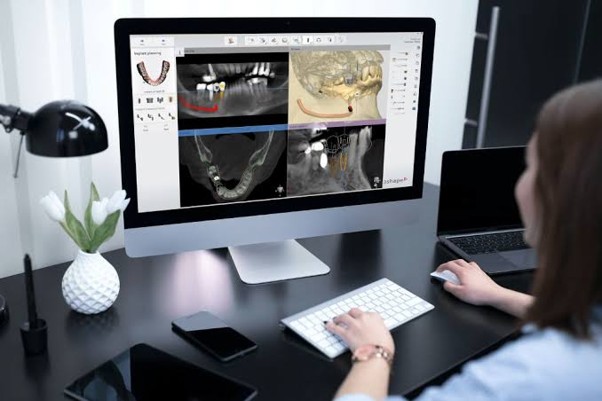
A CT scan captures the facial skeleton in three dimensions, converted into a digital model of that specific patient's bone structure.
Surgeons design on screen, not in surgery
The surgeon works through iterations digitally, correcting for asymmetry that exists in the bone. The implant's underside matches the exact contour of that person's bone.
Poor fit creates visible problems
An implant that does not sit flush can shift over time. Gaps become palpable or visible as a defined line where the eye expects a gradual transition.
“An implant that does not sit flush against bone can shift microscopically over time.”
Custom does not mean risk-free
These implants carry the same surgical risks as stock ones: infection, malposition, nerve effects, and possible revision. They also do nothing about soft tissue or skin laxity.
Filler is not a cheaper substitute
Filler adds volume within soft tissue. An implant adds structure at bone level. One is temporary and adjustable, the other requires surgery to place or remove.
“Filler adds volume within soft tissue. An implant adds structure at the level of bone.”
Ask if your surgeon will say no
The strongest signal in a consultation is a surgeon prepared to refuse a procedure that would not achieve your goal, or to decline operating at all right now.
The main idea
Patient-specific implants are designed from your own CT scan to match your exact bone structure, eliminating the guesswork of stock shapes.