From Wisprflow · · 4m
Canto: speech model built for real dictation
Wispr Flow's new speech model outperforms competitors on messy, real-world audio where people actually dictate.
In brief
Wispr Flow's new speech model outperforms competitors on messy, real-world audio where people actually dictate. Canto achieves the lowest word error rate on real dictations by training on actual Wispr Flow usage rather than clean, read speech datasets. Originally reported by Wisprflow.
Clean audio, messy reality
Speech models excel at transcribing controlled audio, but real dictation happens through laptop mics and earbuds in busy offices, cars, and cafes with background noise and competing voices.
Introducing Canto
The Wispr Advanced Interfaces Lab released Canto, a speech model for real-time dictation that achieved the lowest word error rate on real-world dictations compared to Google, OpenAI, AssemblyAI, and Deepgram.
“Today, the Wispr Advanced Interfaces Lab is introducing Canto, our latest speech model for real-time dictation.”
Testing on real dictations
Canto was evaluated on 10 hours of English dictations from over 2,300 unique speakers using Wispr Flow across different apps and use cases, with strict separation between training and test speakers to avoid overfitting.
Word error rate wins
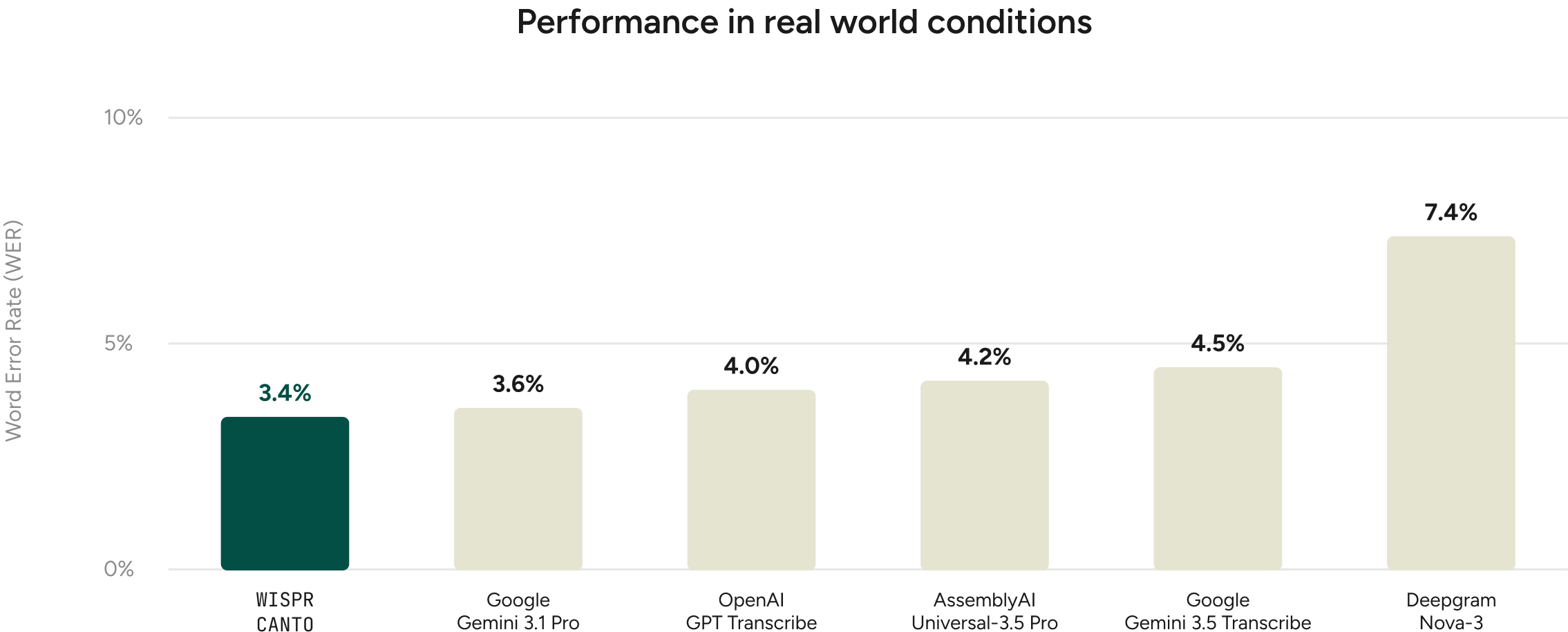
Canto achieved the lowest WER, which measures word substitutions, omissions, and insertions against human-transcribed references. Lower WER is better.
Stress-testing with challenges
A separate 3-hour challenge set featured the toughest conditions: nearby speech, music, traffic, wind, low volume, whispered speech, and short dictations with minimal context.
Second place on hard audio
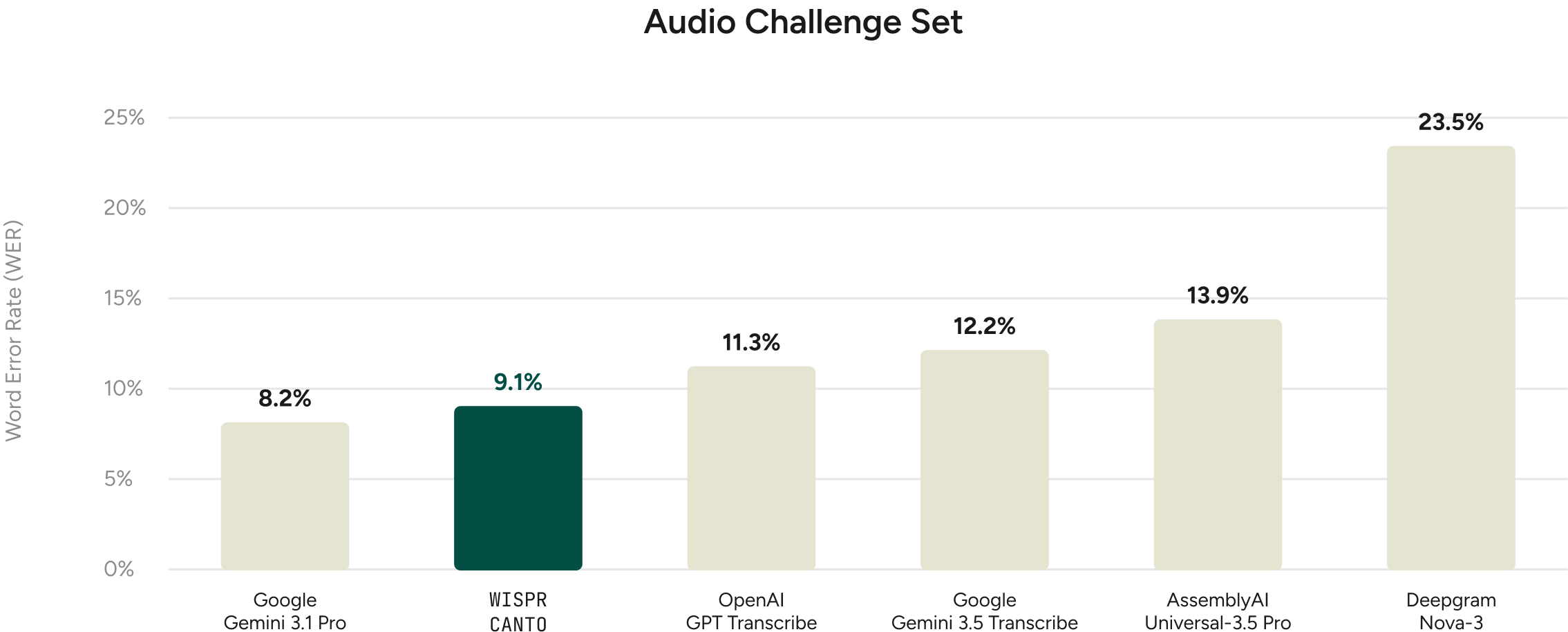
On the challenge set, Canto ranked second behind Gemini 3.1 Pro, a much larger frontier model unsuitable for real-time applications. Among real-time models, Canto had the lowest WER.
Short dictations are hardest
Short one or two word dictations produced the highest error rates across all models because a single mistake has outsized impact and models lack linguistic context to resolve ambiguity.
Public benchmarks tell partial story
Canto tied for lowest WER on LibriSpeech but remained merely competitive on FLEURS and Common Voice. These datasets contain read speech, not spontaneous dictation with pauses and revisions.
Two-stage training approach
Canto starts from a model pretrained on millions of hours of speech and text, then undergoes supervised fine-tuning with reference transcripts, followed by reinforcement learning to improve complete transcriptions.
Supervised fine-tuning explained
The model learns to predict words one step at a time by comparing its output against reference transcripts, teaching it the basic transcription task.
Reinforcement learning for outcomes
The model generates multiple possible transcriptions for the same audio, scores each against a reference, and learns to make better transcriptions more likely. This lets training focus on outcomes that matter, like handling difficult recording conditions.
Group Relative Policy Optimization
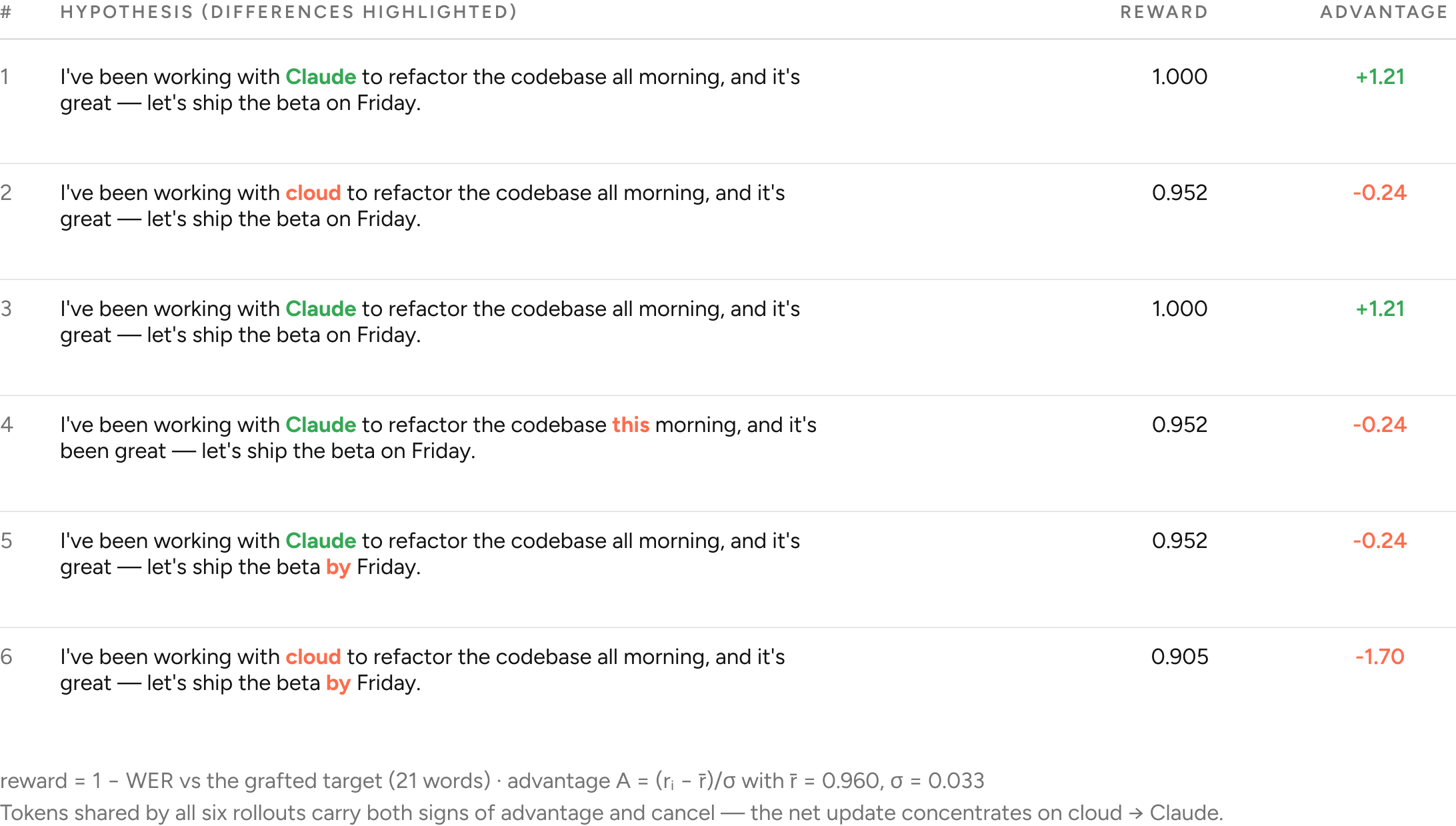
Canto uses GRPO, which compares candidate transcripts within each group and learns from their relative scores. Each candidate receives a reward measuring how well it meets the training objective.
Learning from user corrections
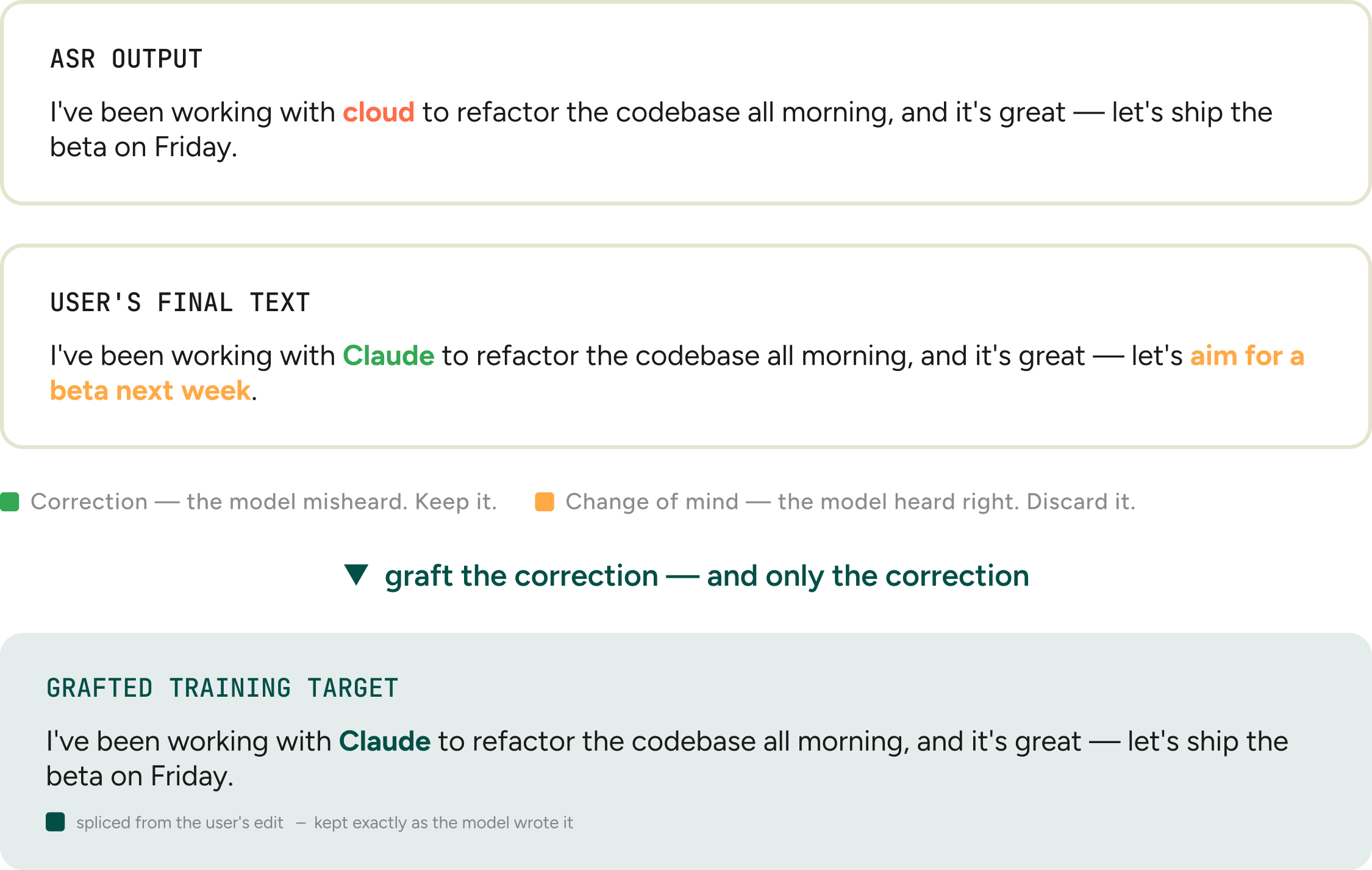
When users correct transcriptions, the model can learn. But not every edit signals an error. Wispr uses audio signals and edit patterns to identify genuine recognition mistakes versus rewrites or formatting changes.
Grafting corrections into training
Wispr selectively grafts likely corrections into the original transcript, creating a focused training signal. The model learns to make the intended correction and receives higher reward when it does.
Context without overconfidence
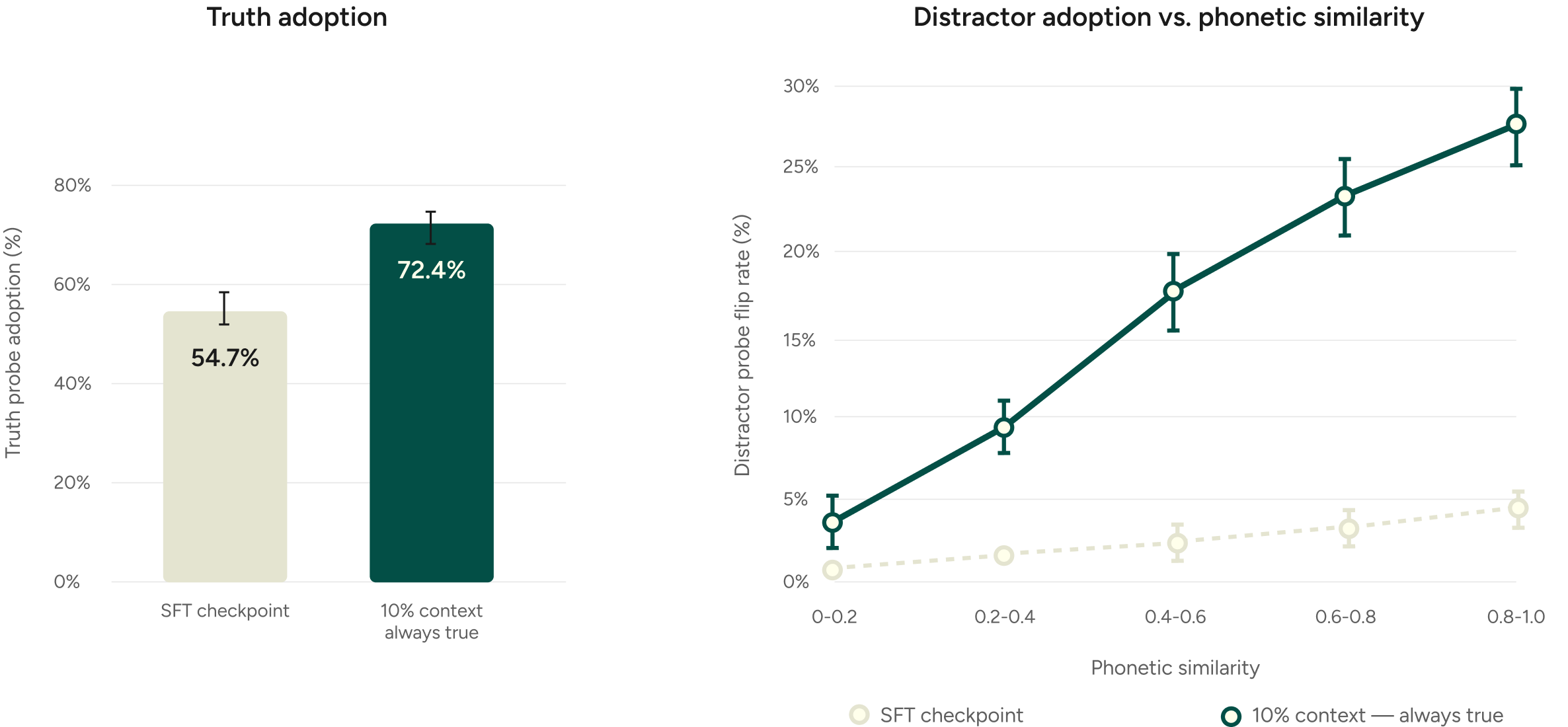
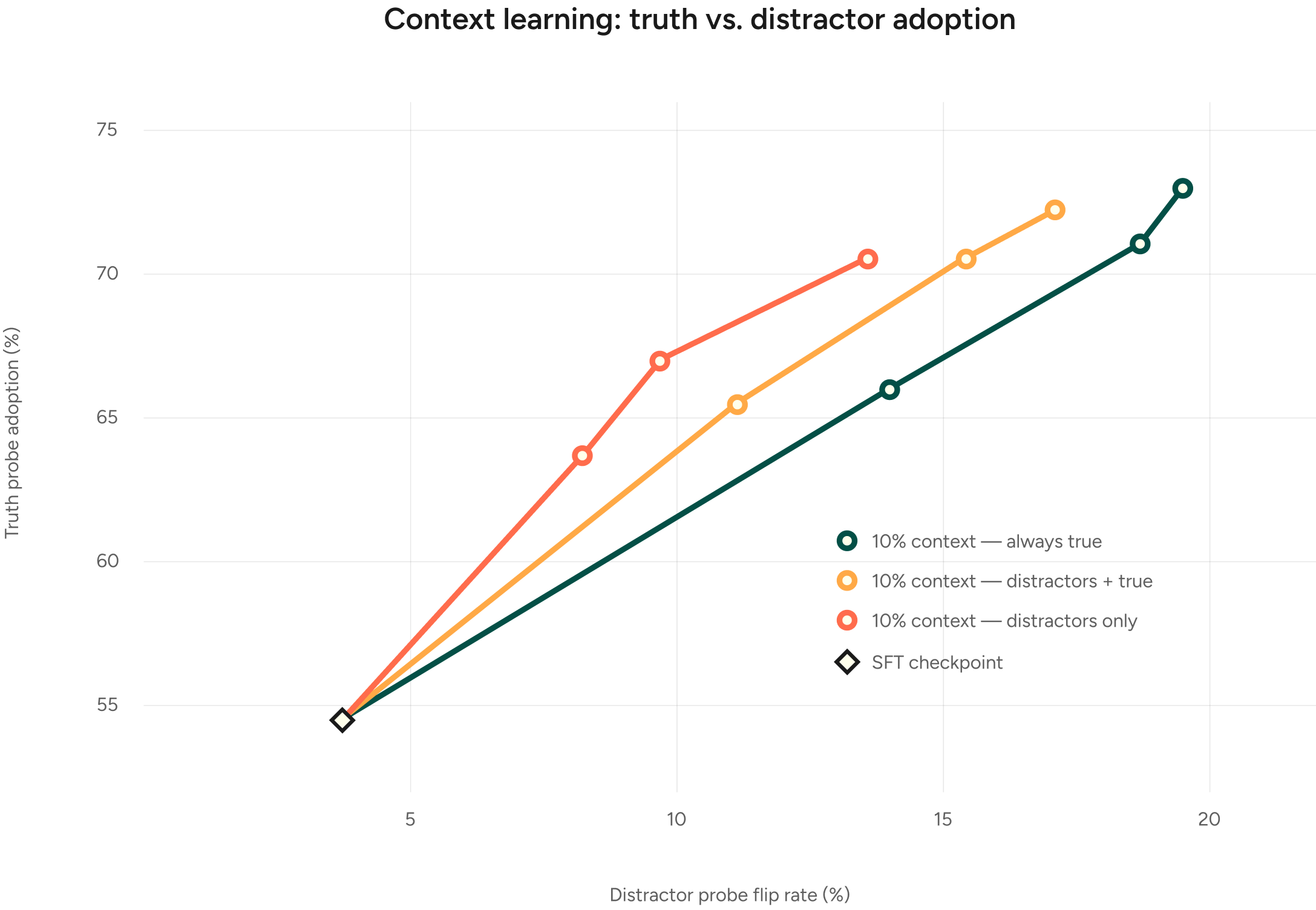
Canto uses personalized vocabulary to help recognize names and rare terms, but must learn when to trust context and when to trust audio. In poor conditions, both 'Barry' and 'berry' might sound plausible.
Training context discrimination
Wispr trained the model with phonetically similar distractor words alongside correct terms. This taught Canto to adopt correct context while resisting false suggestions that sound similar.
Bigger model coming
Canto is the first in a larger family. Wispr is training a successor at more than ten times Canto's scale to improve difficult audio, multi-speaker recognition, contextual vocabulary, and support more languages.
Unified transcription and diarization
Future models will recognize words and identify speakers simultaneously rather than in separate stages. Joint reasoning about what was said, who said it, and when speakers changed reduces compounding errors.
Beyond word recognition
Over time, Wispr's speech models will use context selectively, understand the application someone is speaking in, and connect what was said with what the person is trying to accomplish.
At a glance
Canto achieves the lowest word error rate on real dictations by training on actual Wispr Flow usage rather than clean, read speech datasets.