From NPR · · 1 min
Kissing Apes and Anti-Splash Urinals: The Ig Nobels Move Abroad
Forced out of the U.S. by visa hurdles, the world's favorite quirky science awards find a new home in Switzerland.
In brief
Forced out of the U.S. by visa hurdles, the world's favorite quirky science awards find a new home in Switzerland. Science that makes you laugh and then think thrives globally, even when border hurdles force top traditions to relocate. Originally reported by NPR.
Ig Nobels move to Switzerland
For the first time in 35 years, the Ig Nobel Prize ceremony left the United States and relocated to Zurich, Switzerland.
“It's a sad decision to move from where it all started, but it's also opening new horizons for us”
Science faces global travel barriers
Unpredictable U.S. visa protocols and safety concerns forced several international winners to skip the previous ceremony in Boston.
“A principle by which the United States built its scientific excellence... that is no longer the case.”
Reframing relocation as a fresh start
Organizers view moving abroad as a rare chance to reset the ceremony and engage an enthusiastic European audience.
“When you've been doing something for 35 years, what's the chance you're ever going to get to start it all over again afresh?”
Designing a splash-free urinal
Fluid dynamicists won the physics prize for modeling fluid stream angles under 30 degrees to eliminate stray liquid droplets.
“I don't know if you've ever been in a urinal and wore sandals, you sometimes feel those droplets.”
Prizes of cheese and worthless cash
Laureates received a blue cheese statuette topped with fungi alongside a 10-trillion-dollar bill in defunct Zimbabwean currency.
Greedy elites and aerodynamic sneezes
The economics prize proved upper-class people steal more candy from kids, while medicine honored research into the mechanics of nose blowing.
Defining kissing through evolution
Researchers created a strict biological definition for kissing to study how oral contact evolved across primates and early hominids.
“To understand how a trait has evolved, you can't just look at it in one species.”
An ancient romantic tradition
Kissing likely occurred between humans and Neanderthals as an evolutionary adaptation to swap beneficial microbes and evaluate mates.
“This is a 21.5 million-year-old tradition that I'm honoring here. It's not just a modern human behavior.”
Paper airplanes fly in Zurich
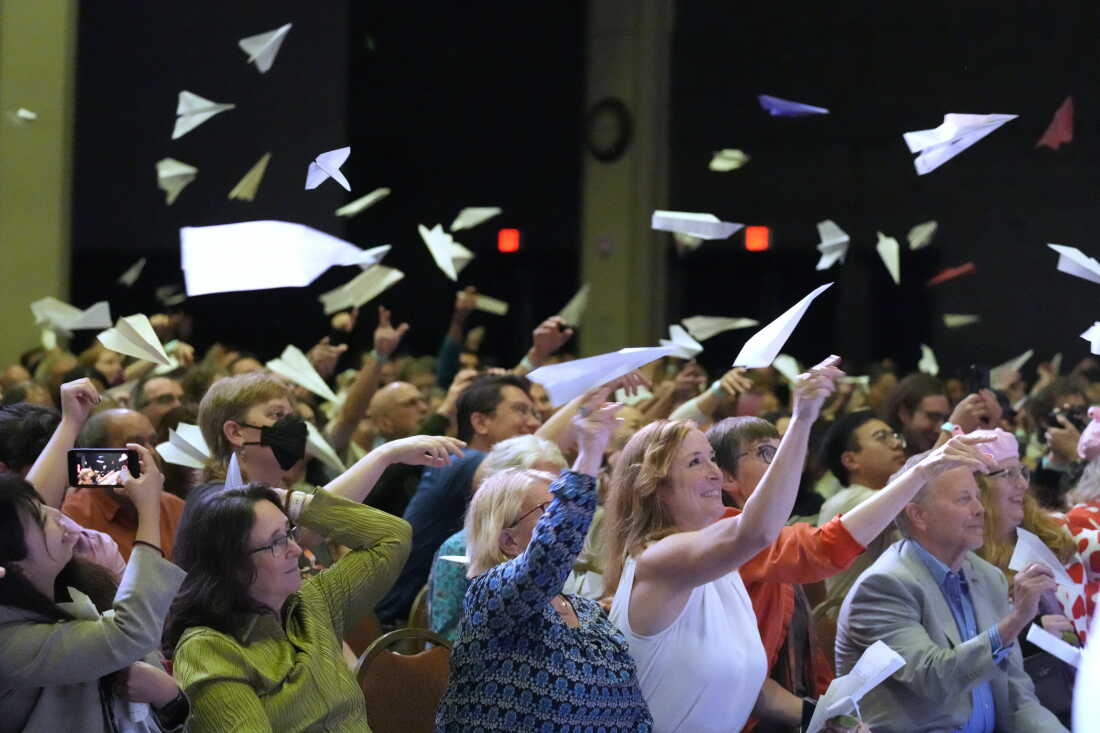
Despite the new European setting, fans honored the laureates with the traditional barrage of flying paper airplanes.
The key point
Science that makes you laugh and then think thrives globally, even when border hurdles force top traditions to relocate.