From Ars Technica · · 5m
Neutrino physicist wins 2026 Nobel Physics Prize
Francis Halzen of the University of Wisconsin, Madison wins the Nobel Prize in Physics for building IceCube, an Antarctic observatory that detects high-energy neutrinos from distant galaxies.
In brief
Francis Halzen of the University of Wisconsin, Madison wins the Nobel Prize in Physics for building IceCube, an Antarctic observatory that detects high-energy neutrinos from distant galaxies. Francis Halzen won the 2026 Nobel Prize in Physics for developing the IceCube Neutrino Observatory in Antarctica, which has…
Nobel Prize for neutrino discovery
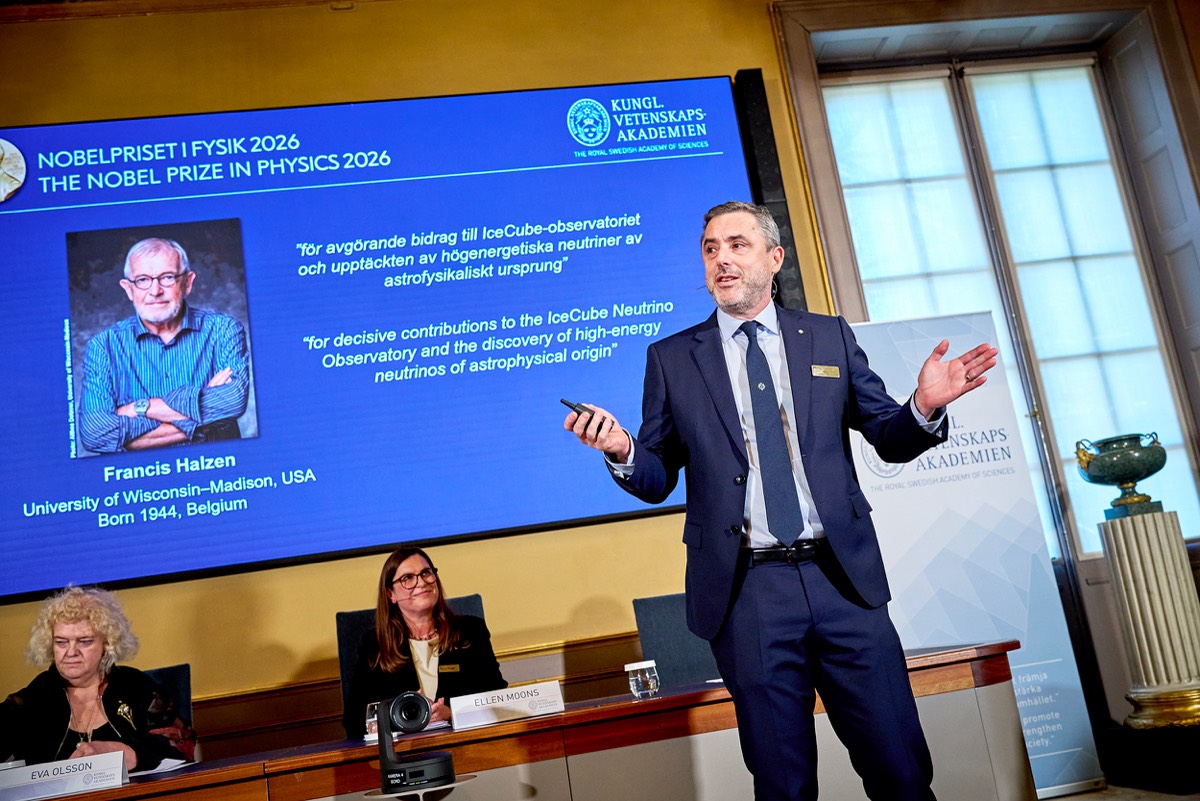
Francis Halzen, a physicist at the University of Wisconsin, Madison, has won the 2026 Nobel Prize in Physics for his work on the IceCube Neutrino Observatory and discovering high-energy neutrinos of astrophysical origin.
Halzen credits his team
Speaking from Italy by phone to Stockholm, Sweden, Halzen said the award was a great surprise and emphasized his work was the result of a large collaboration with other researchers who joined him when no respectable conservative physicist would have.
“This reflects on the really courageous people who joined me in this project when really no respectable conservative physicist would have joined me.”
A visionary driving force
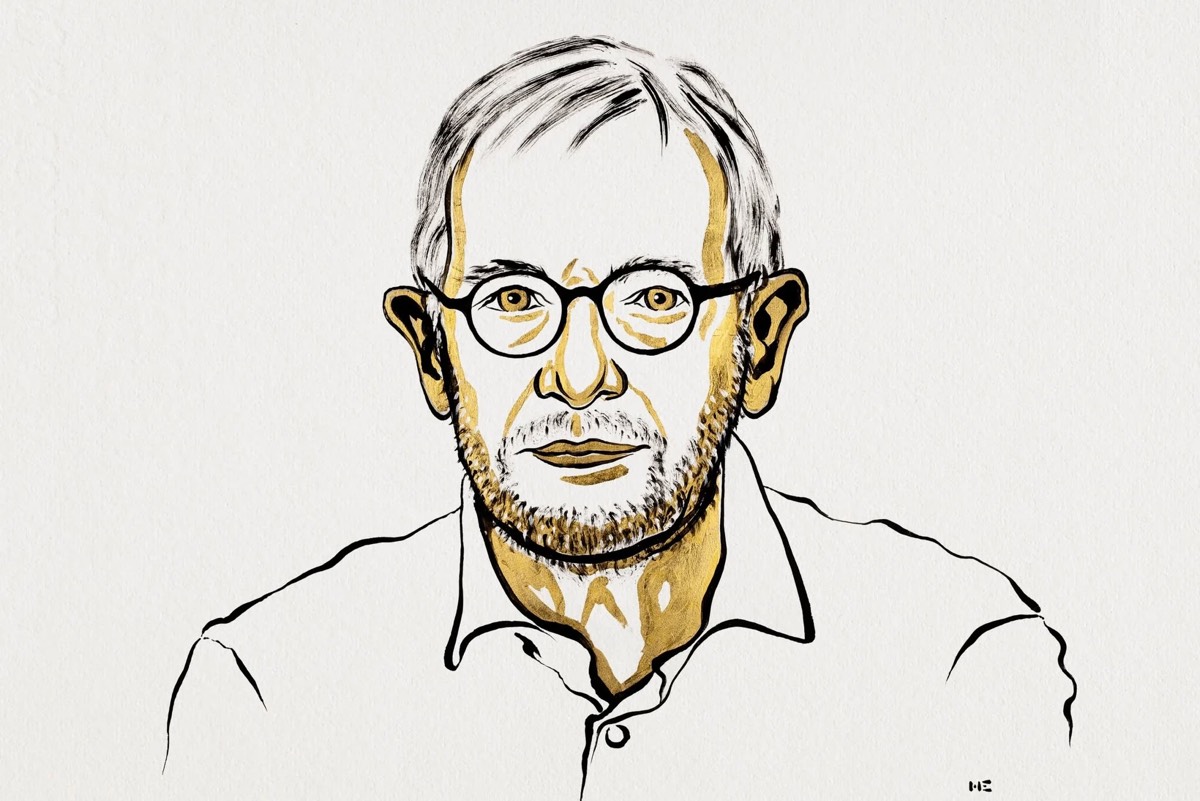
Particle physicist Danielle Norcini of Johns Hopkins University called Halzen the scientific visionary and driving force behind IceCube, saying he dreamed big enough to imagine an experiment of this scale and relentlessly pushed to make it real.
“He is the scientific visionary and driving force behind IceCube.”
Ghost particles explained
Neutrinos travel near the speed of light and have no charge. They are the most abundant subatomic particle in the universe but very rarely interact with matter. Millions bombard us every second, passing right through without notice. Isaac Asimov called them ghost particles.
Why neutrinos matter
Because neutrinos are so light, they escape unimpeded by collisions with other particles and remain largely unchanged. This means they provide valuable clues to astronomers about distant systems, augmented by telescopes and gravitational waves in what is called multimessenger astronomy.
A century of neutrino history
Wolfgang Pauli proposed neutrinos in a 1930 letter to explain missing energy in radioactive beta decay. Enrico Fermi named them. Clyde Cowan and Frederick Reies first observed them in 1956 using fusion reactions from nuclear power plants. Ray Davis Jr. and Masatoshi Koshiba won the 2002 Nobel Prize for detecting solar neutrinos.
The solar neutrino puzzle
Far fewer solar neutrinos were detected than theory predicted, a puzzle called the solar neutrino problem. Physicists discovered a second type of neutrino, the muon neutrino, in 1962, and a third, the tau neutrino, in 2000. Neutrinos could switch between flavors.
The solar mystery solved
In 2002, scientists at the Sudbury Neutrino Observatory announced they had solved the solar neutrino problem. The missing solar neutrinos had changed into a different flavor on their journey from the Sun to Earth. Arthur B. McDonald and Takaaki Kajita shared the 2015 Nobel Prize in Physics for this breakthrough.
Halzen's ingenious idea
In 1988, Halzen proposed building a neutrino observatory at the South Pole, combining ideas from physicists who had suggested water as a detection medium and Russian physicists who proposed using radio receivers in Antarctica. Halzen reasoned ice would be even better.
“You could do it in ice!”
From AMANDA to IceCube
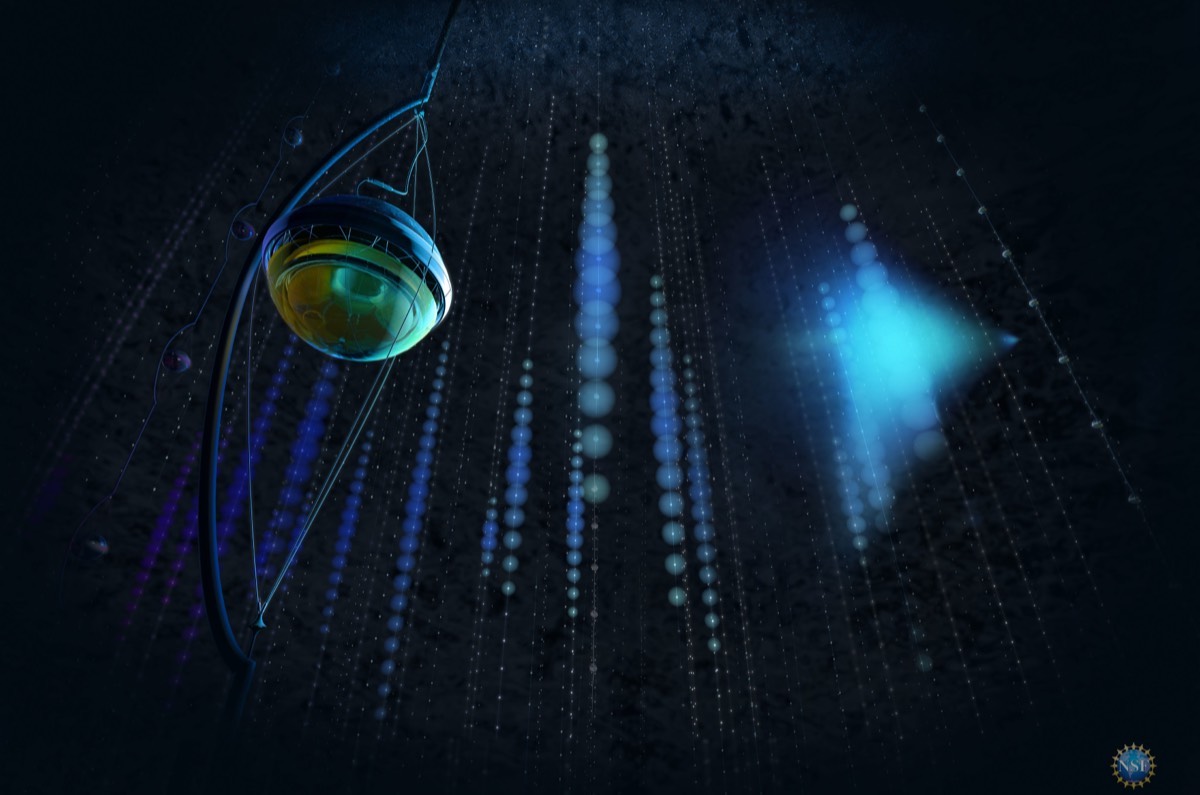
The first observatory at the site was called AMANDA, but initial results disappointed because upper ice had too many bubbles. However, ice below 1400 meters was very pure. AMANDA did not cover sufficient volume, so IceCube eventually replaced it with a much larger detector.
Building the detector
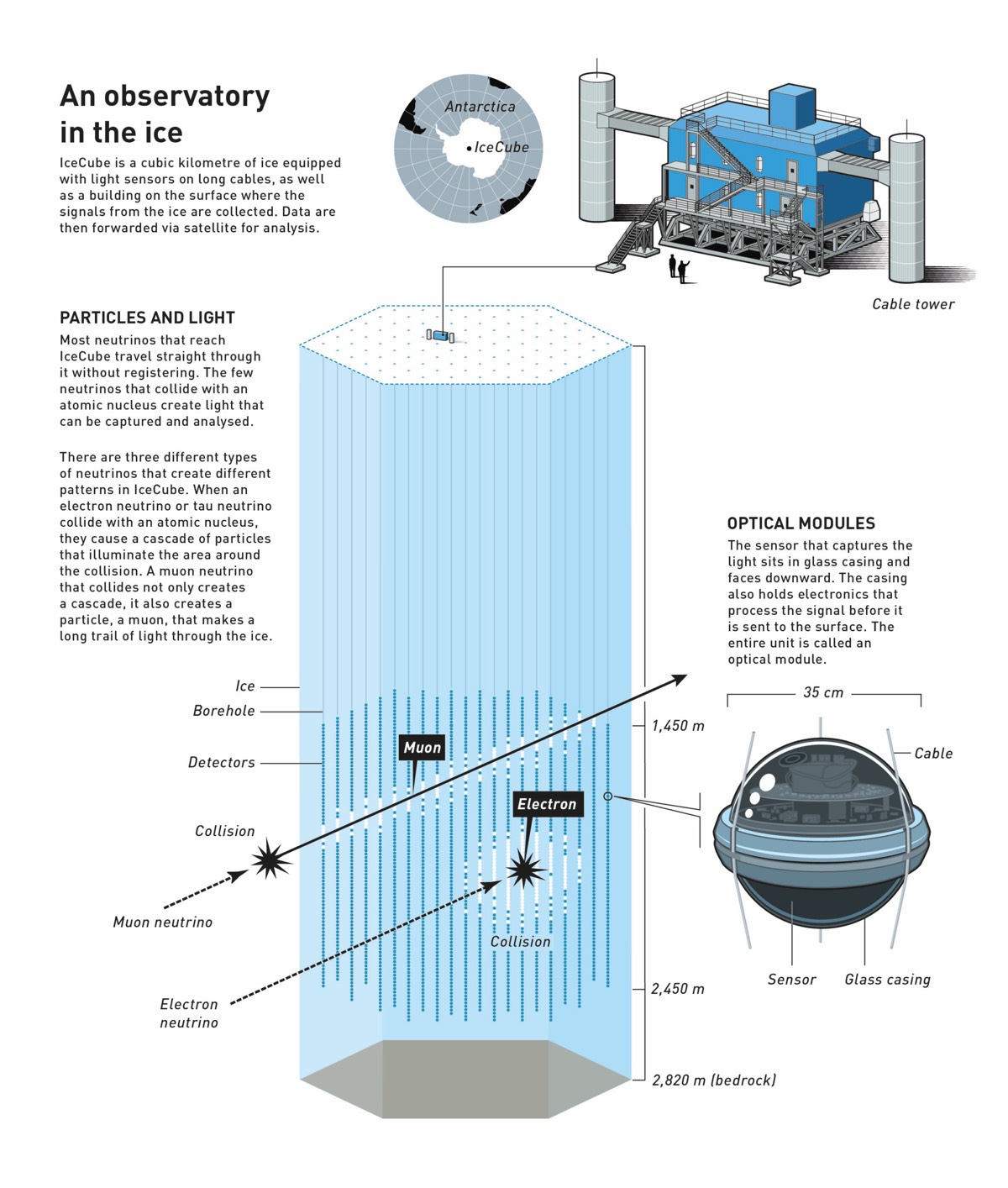
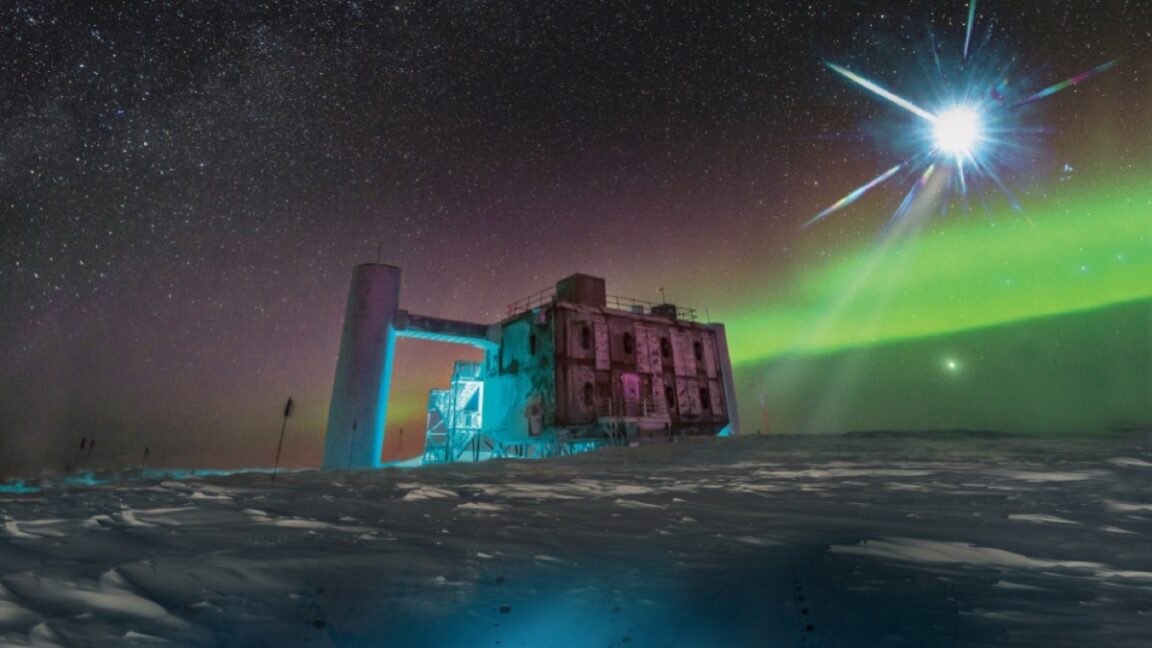
Halzen and his team used a hot water drill to create kilometer-deep holes in the ice, then lowered cables with strings of light sensors. The ice had to be clear, drilling methods had to work, and they had to reject backgrounds. They started small and overcame all hurdles.
How IceCube works
IceCube features 5,160 light sensors spread among 86 cables buried in a cubic kilometre of Antarctic ice. When a neutrino interacts with an atom nucleus, it produces charged particles that emit ultraviolet and blue photons. The sensors detect these rare collisions.
Using the entire Earth
IceCube relies on natural neutrino sources from space and cosmic rays hitting the atmosphere. To build up enough collisions for testing, the team used the entire Earth. IceCube detects neutrino paths as they pass through the detector, including those that intercepted Earth tangentially at the South Pole.
Early breakthrough discoveries
IceCube came online in 2011 and surpassed expectations. Within two years it detected neutrinos from beyond Earth's atmosphere. In 2014, it discovered three unprecedented high-energy neutrinos nicknamed Bert, Ernie, and Big Bird. Evidence showed neutrinos from supermassive black holes in other galaxies.
Tracing cosmic sources
In 2017, physicists traced a high-energy neutrino back to a specific source: a distant galaxy called TXS 0506+056, often referred to as the Texas event. That same year, IceCube tested a Standard Model prediction about neutrino interactions at higher energies, confirming the theory.
Finding cosmic accelerators
In 2022, IceCube scientists backtracked high-energy cosmic neutrino paths using ten years of data. They found evidence of 79 neutrinos suggesting the active galaxy Messier 77, also called the Squid Galaxy, is a strong candidate for a high-energy neutrino emitter, bringing astrophysicists closer to understanding cosmic ray origins.
Continuing the search
IceCube completed a major upgrade in February, adding five more strings of light sensors to the bottom centre of existing arrays, plus 600 new light sensors and calibration instruments. The National Science Foundation committed 53 million dollars over the next five years to maintain operations.
What matters most
Francis Halzen won the 2026 Nobel Prize in Physics for developing the IceCube Neutrino Observatory in Antarctica, which has detected high-energy neutrinos from beyond our galaxy and opened a new field of neutrino astronomy.