From Fortune · Nick Lichtenberg · · 4m
Who's actually rich in America
Two economists got into the Treasury's tax records and found the real American millionaire class hiding in plain sight.
In brief
Two economists got into the Treasury's tax records and found the real American millionaire class hiding in plain sight. Wealth in America now comes from owning a business outright, not climbing a ladder inside someone else's. Originally reported by Fortune.
The question nobody could answer
Since Occupy Wall Street split the country into the 1% and the 99%, economists wanted to know who is actually wealthy in America, and how they got there.
Three grad students, one key
In 2014, Eric Zwick, Owen Zidar and Danny Yagan got access to Treasury tax records. Zwick slept in his sister's attic and worked in the department's basement. They called themselves the tax ninjas.
Two databases that never talked
The IRS kept individual returns and business filings in separate systems. Nobody could connect a company's profits to the person who owned them. Zwick and Zidar spent months linking the two.
Doctors and auto dealers
When they ranked pass-through profits in the top 1%, the names at the top were not the ones anyone expected.
“I'm like, this is not Jeff Bezos. This is not Stephen Schwarzman.”
Meet the everywhere millionaire
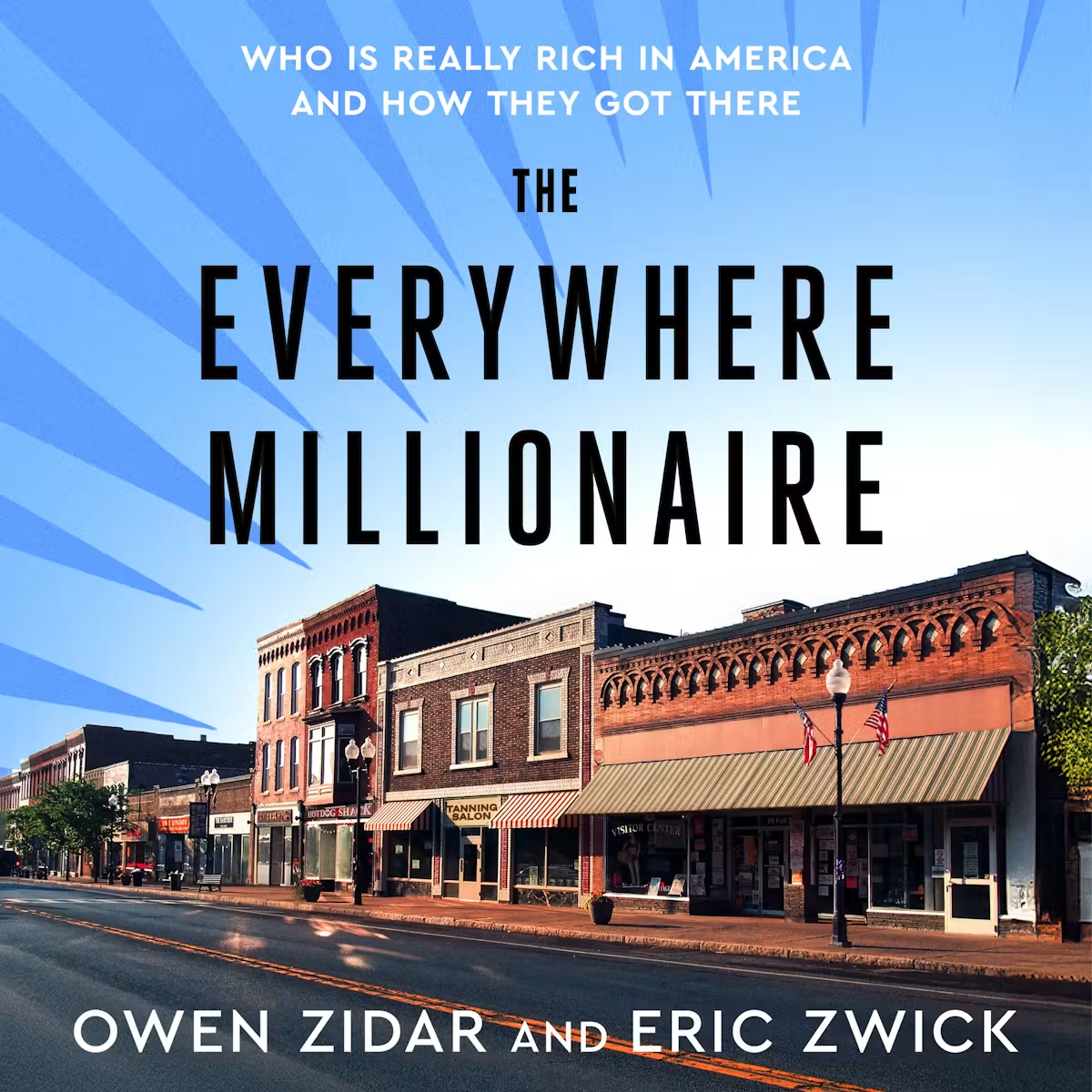
The book defines them as people worth at least $5 million who own a single closely held business that produces most of their income. Roughly 3 million of them exist.
Not Manhattan, not Palo Alto
They cluster in mid-sized metros that rarely make the news. Zwick estimates they hold 13 times the wealth of the entire Forbes 400 combined.
Four thousand to one
For every single member of the Forbes list, there are more than 4,000 private business owners each worth at least $10 million.
The hot dog kingpin
Dick Portillo opened a Chicago hot dog stand in 1963 without ever having cooked one. By 2014 he ran the Midwest's largest privately owned restaurant company, plus a 130-foot yacht named Top Dog.
Tanning beds to waxing salons
Karen Bentlage dropped out of Central Connecticut State, built the country's second-largest tanning-bed distributor, then rolled the proceeds into a regional waxing franchise.
They also run politics
Pass-through owners are about a quarter of federal elected officials and 40% of state legislators, versus 2% to 3% of the population. The people who benefit from the system are writing it.
A bipartisan arrangement
The latest tax bill let clean-energy vehicle credits lapse while making the 2017 pass-through deduction permanent.
“That benefits the auto dealers, many of whom are on the tax-writing committee of Congress.”
We're looking the wrong way
Zwick says the media fixates on billionaires while real policy power sits somewhere else entirely, spread across thousands of local owners nobody covers.
“Where the power comes to make policy happen, it's much more diffuse.”
The American gentry
Historian Patrick Wyman calls them salt-of-the-earth millionaires who vastly outnumber the coastal elite. Wyman is more polemical about the politics, Zwick says. He and Zidar have the receipts.
Reagan's 9 cents
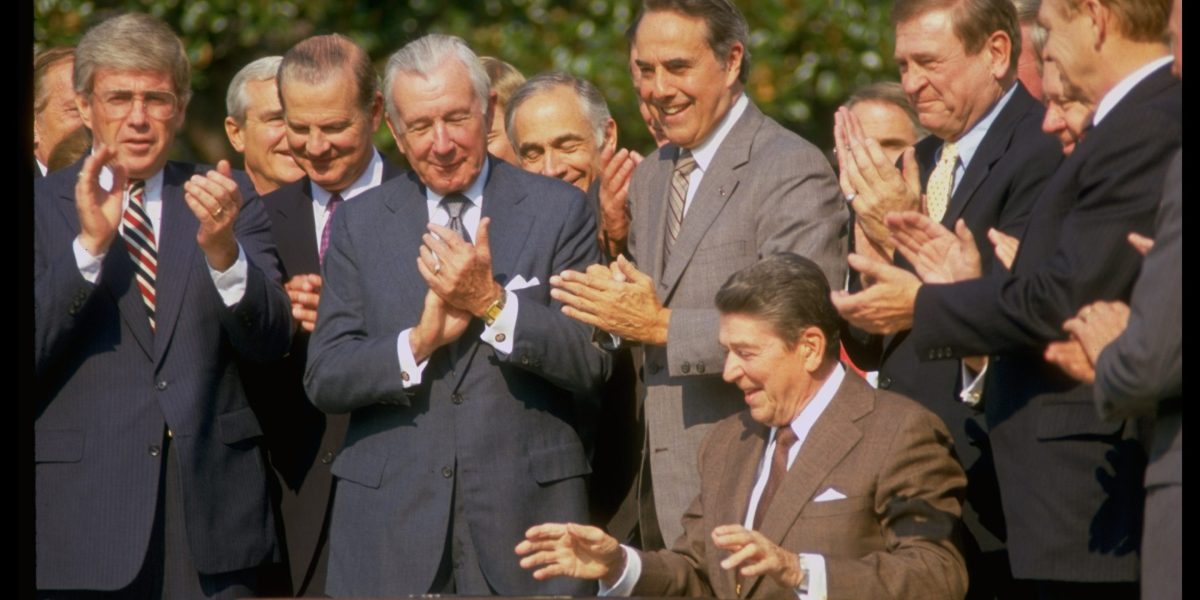
As an actor, Reagan capped how many films he made each year because the top bracket left him 9 cents on the extra dollar. He entered the White House in 1981 with rates at 70% individual, 46% corporate.
The 1986 compromise
Reagan found an ally in Democrat Bill Bradley, who wanted loopholes stripped out. The Tax Reform Act of 1986 cut the top rate to 28% and the corporate rate to 34%.
The accidental clause
It also sweetened partnerships, S-corps and sole proprietorships, letting profits pass straight to an owner's return instead of being taxed twice. A new American Dream was born by accident.
“Tax reform created the idea linking business owners to their businesses.”
95% of businesses
Before 1986, C-corporations made almost all American business income. Today 95% of businesses are pass-throughs, employing half the workforce and generating most business income.
The flipside: disposable work
MIT's Paul Osterman surveyed 6,000 adults and found 35% of the workforce is freelance, contract, gig, or hired knowing they won't last. He dates it to Reagan firing the air traffic controllers in 1981.
From a bench at LaGuardia
Bakari Akil left Morehouse in 2011 and spent two years homeless. He read everything he could about wealth, found a Harvard paper on early-career buyouts, and learned to buy a company.
“The entire society was set up to help business owners be successful and employees to live a good life.”
Move slow and make things
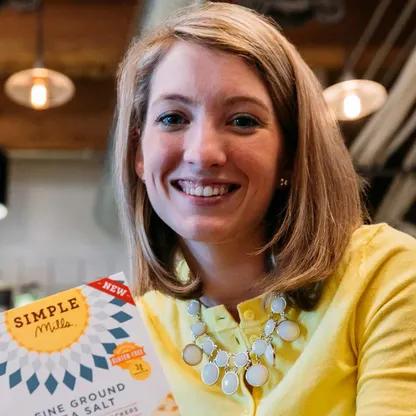
Smith built Simple Mills from a snack problem and sold it for $795 million. Nobody here rolled dice. Portillo ran the stand himself for decades. As Zwick puts it, he never stopped making hot dogs.
At a glance
Wealth in America now comes from owning a business outright, not climbing a ladder inside someone else's.