From Jim Nielsen · Jim Nielsen · · 1m 10s
Stop reporting uptime as percentages
Uptime percentages are meaningless to most people. Show actual downtime instead.
In brief
Uptime percentages are meaningless to most people. Show actual downtime instead. Uptime percentages near 100% are logarithmic, not linear. A status page should tell you how many hours of downtime occurred, not a confusing percentage. Originally reported by Jim Nielsen.
Uptime percentages are deceptive
99.9% and 99.99% look similar but the latter is 10 times more reliable. The difference is nonlinear, like earthquake magnitude scales.
“The difference between a 6.2 and a 7.8 might not seem that big, but it represents a massive difference in magnitude.”
Infrastructure pros speak in nines
Engineers use shorthand like two nines, three nines, four nines because they work with these numbers daily and understand the exponential jumps.
Status pages now reach everyone
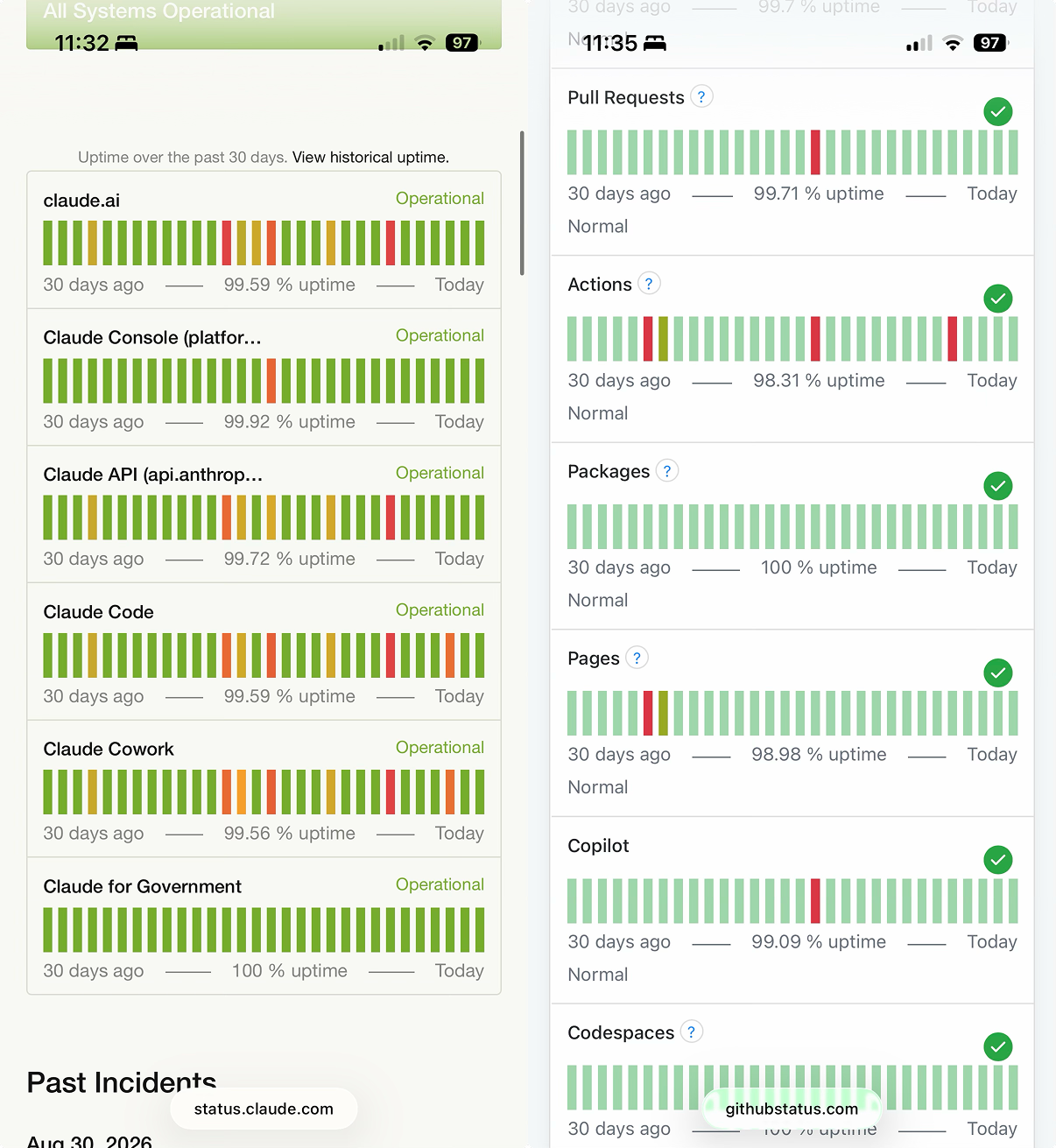
Service status pages used to be for infrastructure teams only. Now regular users check them when GitHub, Slack, or CI systems go down.
Percentages fail as public interfaces
Uptime percentages are good metrics for standardized measurement but terrible for communicating reliability to people who just want to know if a service is broken.
“I just want to know, "Dude, how much have you been down lately? Seems like a lot…"”
Show hours of downtime instead
Replace "98.31% uptime" with "12 hours affected in the last 30 days (98.31% uptime)." One requires math literacy, the other just requires knowing what an hour is.
The short version
Uptime percentages near 100% are logarithmic, not linear. A status page should tell you how many hours of downtime occurred, not a confusing percentage.




