From Malay Mail · · 3m
China's new canal reshapes trade with Southeast Asia
The Pinglu Canal opening marks a shift in economic geography that could transform ASEAN-China relations for decades to come.
In brief
The Pinglu Canal opening marks a shift in economic geography that could transform ASEAN-China relations for decades to come. ASEAN nations should strategically engage with the Pinglu Canal to ensure two-way trade benefits and maintain their independence from any single major power. Originally reported by Malay Mail.
China opens major new canal
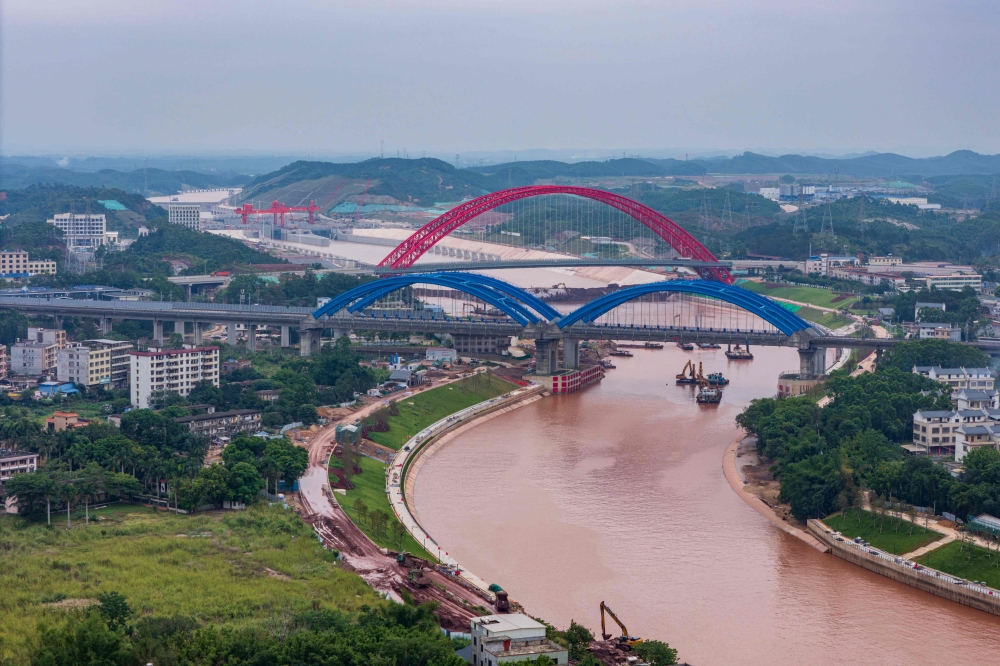
On September 16, 2026, China opened the Pinglu Canal in Guangxi, a 134.2-kilometre waterway connecting the Xijiang river system to the Beibu Gulf.
Massive savings on shipping
The canal shortens inland shipping distances to Southeast Asia by over 560 kilometres and could reduce logistics costs by 18 to 30 per cent.
Geography shifts economic power
For decades, China's economy centred on eastern ports like Guangdong and Fujian. The Pinglu Canal now gives western and southwestern China direct maritime access to Southeast Asia.
“Geography does not change. But the strategic meaning of geography can.”
New southern economic artery
Railways from Chongqing, Sichuan, Guizhou and Yunnan can now feed cargo to Guangxi, where the canal and ports provide access to Southeast Asia and maritime trade.
First shipment reaches Vietnam
On opening day, the canal carried an international freight service from Nanning to Can Tho in Vietnam, including building materials, minerals, steel and fertiliser.
Transport shapes industrial location
Cheaper logistics influence where factories are built, where companies source materials, and how supply chains are organised. Transport infrastructure becomes industrial infrastructure.
China-ASEAN trade booming
Trade between China and ASEAN reached 4.34 trillion yuan in the first half of 2026, up 18.2 per cent year-on-year. Container throughput at Beibu Gulf Port grew from 2.28 million TEUs in 2017 to 10.06 million in 2025.
Malaysia's Qinzhou opportunity
The China-Malaysia Qinzhou Industrial Park could strengthen its position as a gateway linking Malaysian businesses to China's western economic hinterland through improved Pinglu connectivity.
Vietnam positioned closest
Vietnam is geographically closest to the emerging corridor and already has extensive production networks connected to southern China, positioning it to benefit most.
ASEAN must ensure two-way trade
If the canal only makes it easier for Chinese products to enter Southeast Asia, benefits will be uneven. ASEAN must ensure the corridor works both directions for agricultural products and commodities.
“Connectivity must work in both directions.”
Harmonise customs and ports
ASEAN should examine customs harmonisation, port connectivity, multimodal transport, digital trade documentation and industrial cooperation to maximise the corridor's benefits.
Infrastructure builds stability
Railways, ports and canals create commercial constituencies with material interests in stability. Deeper physical connections between China and ASEAN increase mutual interest in predictable relations.
“Infrastructure creates relationships that diplomacy alone cannot manufacture.”
ASEAN keeps strategic independence
ASEAN's strength lies in avoiding binary choices. Member states can deepen economic engagement with China while maintaining relationships with Japan, South Korea, India, the EU and the US.
“ASEAN does not have to choose one corridor over another. It can connect them.”
A pivotal moment begins
The Pinglu Canal marks the moment when China's vast western and southwestern hinterland gained direct maritime orientation toward Southeast Asia, reshaping regional economic geography.
“The pivotal significance of the Pinglu Canal is therefore not merely that China has built a 134.2-kilometre waterway.”
What it means
ASEAN nations should strategically engage with the Pinglu Canal to ensure two-way trade benefits and maintain their independence from any single major power.