From Malay Mail · Arif Zikri · · 2m
Engineering student's Parkinson's device wins major award
A 24-year-old Malaysian inventor created a battery-free wearable inspired by skyscraper physics to reduce tremors in Parkinson's patients.
In brief
A 24-year-old Malaysian inventor created a battery-free wearable inspired by skyscraper physics to reduce tremors in Parkinson's patients. Simple physics and off-the-shelf components can solve complex medical problems without batteries or electronics. Originally reported by Malay Mail.
Meet the inventor behind ZeMor
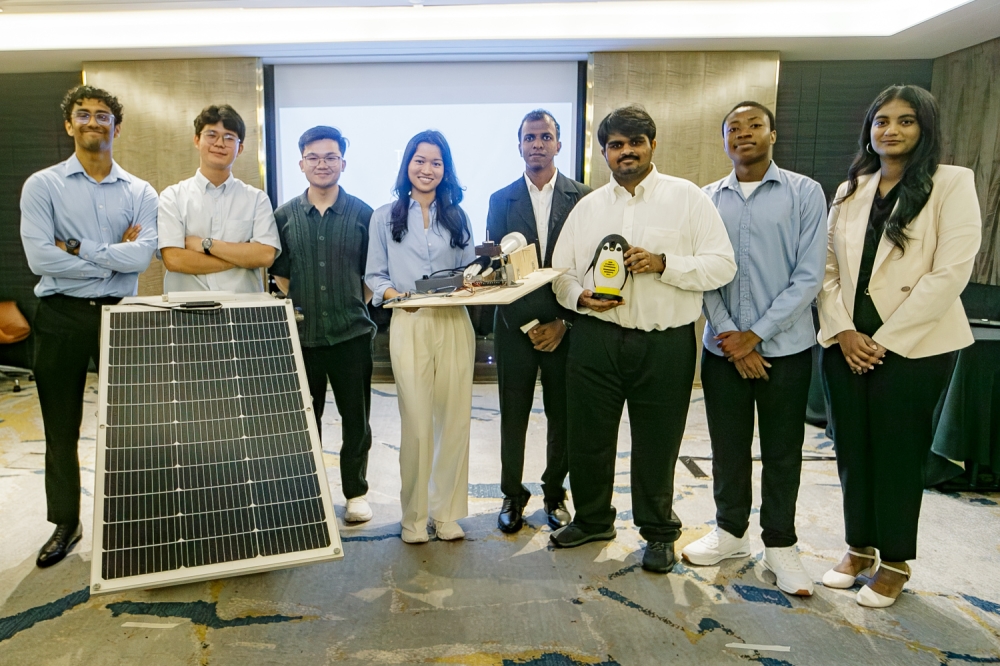
Hayley Nea Iauduray, 24, from Subang Jaya, created a kinetic device to reduce hand tremors in Parkinson's patients. She just won the 2026 James Dyson Award for Malaysia.
What is ZeMor exactly
ZeMor is a tunable, battery-free wearable that reduces hand tremors caused by Parkinson's disease. Its design was inspired by Tuned Mass Dampers, the engineering systems that stabilise skyscrapers during earthquakes.
How ZeMor works differently
Unlike fixed-mass devices, ZeMor can be customised to match individual tremor frequencies by adding or removing weights. It uses simple physics instead of electronics or sensors.
Built from everyday materials
ZeMor uses slotted weights, steel ball bearings, spring-based dampeners, and 3D-printed housing. These affordable, off-the-shelf components make the device accessible across different communities.
A year of prototyping and testing
Iauduray spent a year developing and refining multiple prototypes. She tested the concept using a custom-built rig that simulated Parkinsonian tremors.
From final year project to award
ZeMor started as Iauduray's Final Year Project at Monash University Malaysia. Her supervisor encouraged her to enter the James Dyson Award competition.
The scale of Parkinson's globally
Parkinson's is among the fastest-growing neurological disorders. Global cases are projected to reach 25.2 million by 2050, with an estimated 20,000 Malaysians currently living with the condition.
Why she rejected electronics
Iauduray deliberately avoided sensors and batteries because older people struggle with complex technology. She wanted to create something practical using simple physics instead.
“Are you going to put that amount of batteries on an old person? Old people are already struggling with using their phones.”
Inspired by a boy and his pet
Iauduray found her passion for engineering through Legos in secondary school. She was also inspired by an online video of a boy building a wheelchair for his paralysed pet.
Prize money and next steps
As National Winner, Iauduray receives 27,160 Malaysian ringgit. She plans to upgrade the single-axis prototype into a multi-directional system and work with medical professionals.
Two other Malaysian innovations advance
ZeMor joins two runner-ups progressing to the next stage: SLIC, a solar-powered water purification system, and Pillay, a contactless health screening device for children.
International competition timeline
The international Top 20 shortlist will be announced on October 14. International winners will be announced on November 4, selected by Sir James Dyson himself.
The short version
Simple physics and off-the-shelf components can solve complex medical problems without batteries or electronics.