From Malay Mail · · 2m
Lipstick keeps an ancient face pattern alive
Temiar women in Gua Musang swapped charcoal and limestone for lipstick and eyeliner, and the meaning of every line survived the switch.
In brief
Temiar women in Gua Musang swapped charcoal and limestone for lipstick and eyeliner, and the meaning of every line survived the switch. A tradition survives when the meaning is fixed and the materials are allowed to change. Originally reported by Malay Mail.
Lipstick replaced limestone
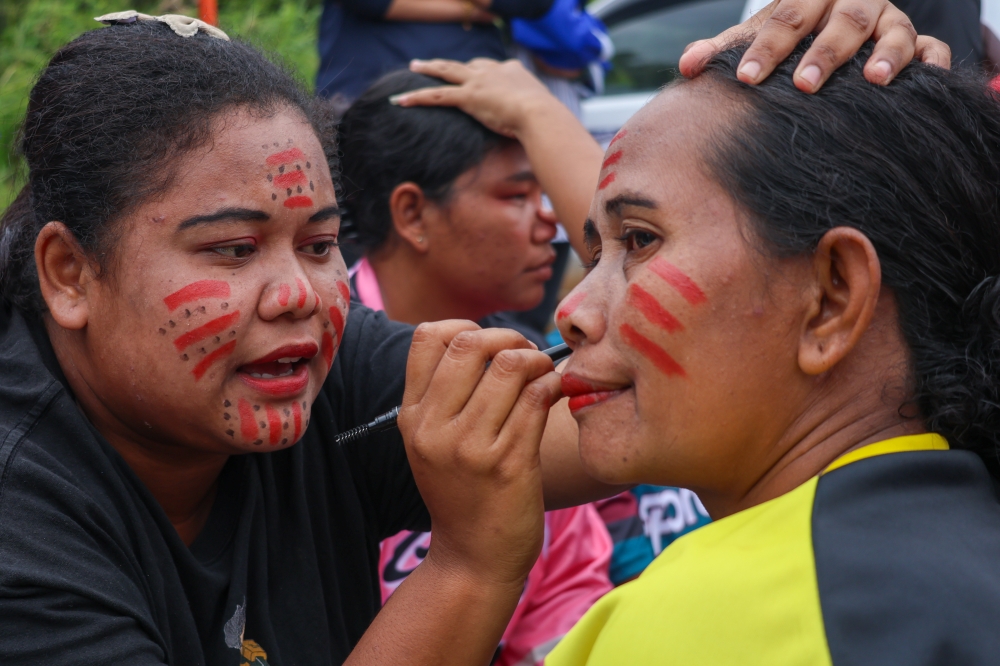
Temiar women of Gua Musang now paint their faces with lipstick and powder instead of charcoal and limestone paste. The centuries-old practice itself never stopped.
Geometric lines, still cherished
Endah Angah, 37, paints long wavy lines and dots on her face. She calls it an enduring symbol of Temiar cultural heritage, not a costume.
The forest stopped supplying
Kesumba seeds and other natural pigments used to sit close to the village. Now they take a deep trek into the forest to find, if you find them at all.
“In the past, these natural ingredients were easy to find.”
Modern makeup works better
Endah says the red and black from lipstick and eyeliner make the patterns neater and brighter, and they hold on the skin far longer than the old paste.
“They last longer too.”
The meaning did not move
Rahimah Punai, 39, says new materials changed the method and nothing else. Each mark still carries its spiritual weight and its link to the ancestors.
Rivers and dots
The horizontal and wavy lines stand for the river. The dots mark the community's connection to nature, which is why each one is drawn with care.
“The lines represent the river, while the dots symbolise our connection to nature.”
You cannot improvise
Rahimah is firm that streaks cannot simply be added to the forehead, nose or cheeks. The pattern arrives from the ancestors and is kept exactly as passed down.
“We have to follow what our ancestors passed down to us and keep it the same.”
Worn at sewang and gatherings
Abong Busu, 55, says the custom lives on at religious ceremonies such as the sewang and at community events. That is where children first see it up close.
The children ask questions
Abong says the young ones are genuinely curious and full of questions about the motifs. Interest, not instruction, is doing the transmission work.
“The children are very interested and often ask us a lot of questions about it.”
An icon of Orang Asli identity
Kelantan JKKN director Rohaniza Abdullah calls the cosmetic shift a positive step, since original patterns and colours survive. She wants the motifs to become a signature of Orang Asli culture.
“This also helps preserve the tradition for future generations.”
The key point
A tradition survives when the meaning is fixed and the materials are allowed to change.





