From MoneyWeek · · 4m
Why gold's bull run still has room
Central banks stopped trusting Treasuries, governments cannot stop borrowing, and one analyst says $7,000 gold by 2030 is now the conservative call.
In brief
Central banks stopped trusting Treasuries, governments cannot stop borrowing, and one analyst says $7,000 gold by 2030 is now the conservative call. Gold tracks money supply growth over the long run, so it keeps climbing until governments credibly commit to balancing their budgets. Originally reported by MoneyWeek.
Gold beat the S&P this century

Since 2000 gold is up more than fifteenfold. The S&P 500, dividends included, is only 8.5 times higher. Equities have not led gold at any point in those 25 years.
“at no point have equities been stronger than gold this century”
The starting line was ugly
In 2000 gold was crawling out of a two-decade bear market while US tech was in a generational bubble. The setup then rhymes with the market today.
Scarce and liquid

Jewellers want gold for its beauty. Financiers want it because no government can print more of it, and you can trade billions of dollars of it on a button press.
“Gold provides the backstop to the financial system.”
Nobody plans to repay

Governments have borrowed more than they can pay back, and the plan is to print instead. That devalues the currency and eats the purchasing power of your savings.
“it's an open secret that they'll never pay it back”
Recognised from here to Timbuktu
Before modern payment rails, an ounce of gold was the only value everyone accepted across borders. Central banks still hold it to hedge inflation and settle foreign liabilities.
Nixon cut the cord

Until 1971, central banks kept about 60% of reserves in gold. Taking the dollar off the gold standard opened the door to the inflation of the decade that followed.
The Volcker moment
Gold's reserve share spiked in 1979 as prices soared. Then Paul Volcker hiked US rates to 20%, and inflation fell for four straight decades until Covid.
Two decades of neglect
With low inflation and solid growth through the 1980s and 1990s, central banks lost interest. Gold's reserve share kept sliding right up to 2008.
Frozen reserves changed everything
When the US and Europe froze Russia's Treasury holdings after the 2022 invasion, bankers in Asia and the Middle East saw their own reserves could vanish too.
“If Russia's reserves could be confiscated, so could theirs.”
Buying at scale
Gold is back to nearly 30% of reserves. Price gains explain part of it, but central banks led by China have added a staggering 4,500 tonnes, letting gold shrug off higher rates.
Real yields, not yields
Gold pays no interest, so it usually falls when bond yields rise. But if yields and inflation both sit at 10%, the real yield is zero and gold's disadvantage disappears.
Watch the money supply
Consumer price inflation is widely thought to be understated. Monetary inflation has run at 7.5% a year for three decades, and that is the number gold watchers actually track.
Gold follows the money
The value of above-ground gold tracks monetary inflation long term. The World Gold Council frames it as gold matching nominal GDP growth, real growth plus inflation.
But it moves in cycles
When central banks and investors pile in, gold outruns new money creation. In calmer stretches like the 1980s and 1990s, with growth strong and inflation tame, it gives ground back.
Too much, too soon
Gold hit $5,595 in January, a 434% gain from its 2015 low of $1,064. The 65% rise in 2025 was its best year since 1979, and a 29% correction followed.
“I think the worst is behind us and a gradual recovery is underway.”
Bessent sent a signal
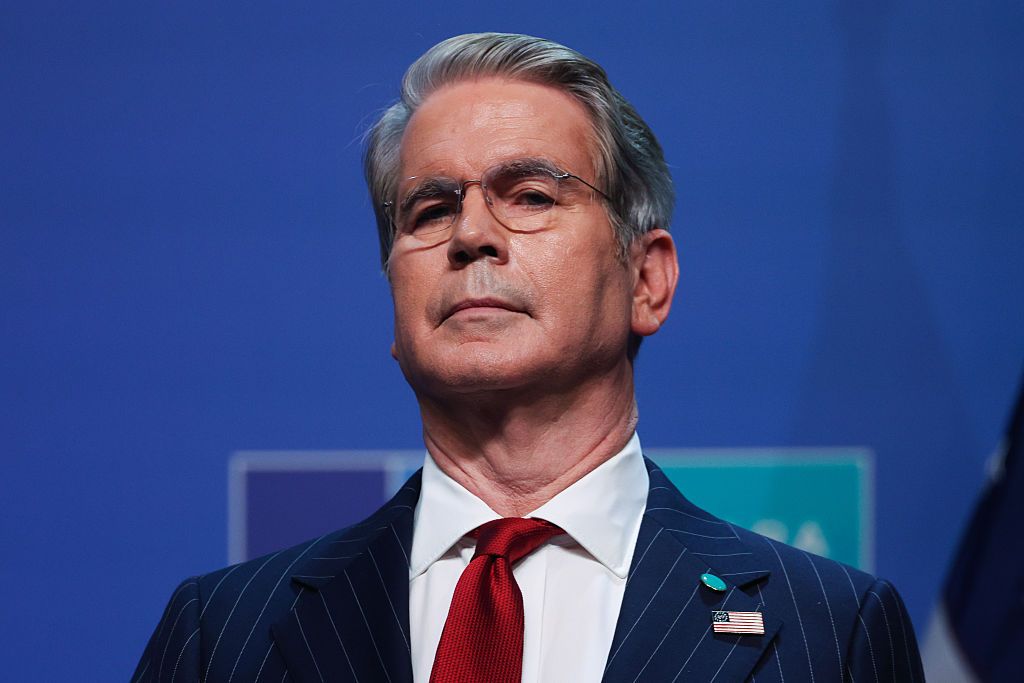
In August the US Treasury secretary intervened in the yen, then stepped up long-bond purchases. The sums were small, the message was not: governments will act on borrowing costs.
“The amounts of money involved were on the light side, but the signalling was explosive.”
The $7,000 call
Written in 2020 when gold was $1,700 and dismissed as fantasy, the target rested on inflation expectations shifting from 2% to 4%. At $5,595 it now looks conservative.
“many dismissed my piece as pie in the sky”
Bonds are worried about debt
Inflation-linked Treasuries are not yet pricing much higher consumer inflation, but they are anxious about public debt. Gold is signalling where bond markets go next.
“Gold is signalling where the bond markets are headed, and that is not a happy place.”
The bear case is austerity
The US will spend $7.4 trillion in 2026 against $5.6 trillion of receipts, on $40 trillion of debt. Ireland cut debt from 120% of GDP to 33%. Balanced budgets would sink gold.
Sell when voters demand cuts

Argentina's youth gave Milei 70% of their vote, choosing austerity over chaos. When that mood spreads, swap gold for bonds at attractive rates. We are nowhere close yet.
“today's debt is tomorrow's problem”
The headline
Gold tracks money supply growth over the long run, so it keeps climbing until governments credibly commit to balancing their budgets.