From OpenAI · · 2m
GPT-6 Model Guide
Choose the right GPT-6 model for your task to save time and money.
In brief
Choose the right GPT-6 model for your task to save time and money. Select GPT-6 Astra for complex reasoning, GPT-6.1 Sol for coding, and GPT-6 Luna for repetitive tasks to optimize cost and performance. Originally reported by OpenAI.
Run effectively in production
Prepare your workflow for production by cutting unnecessary context and using prompt caching to reduce costs.
Match the model to your workload
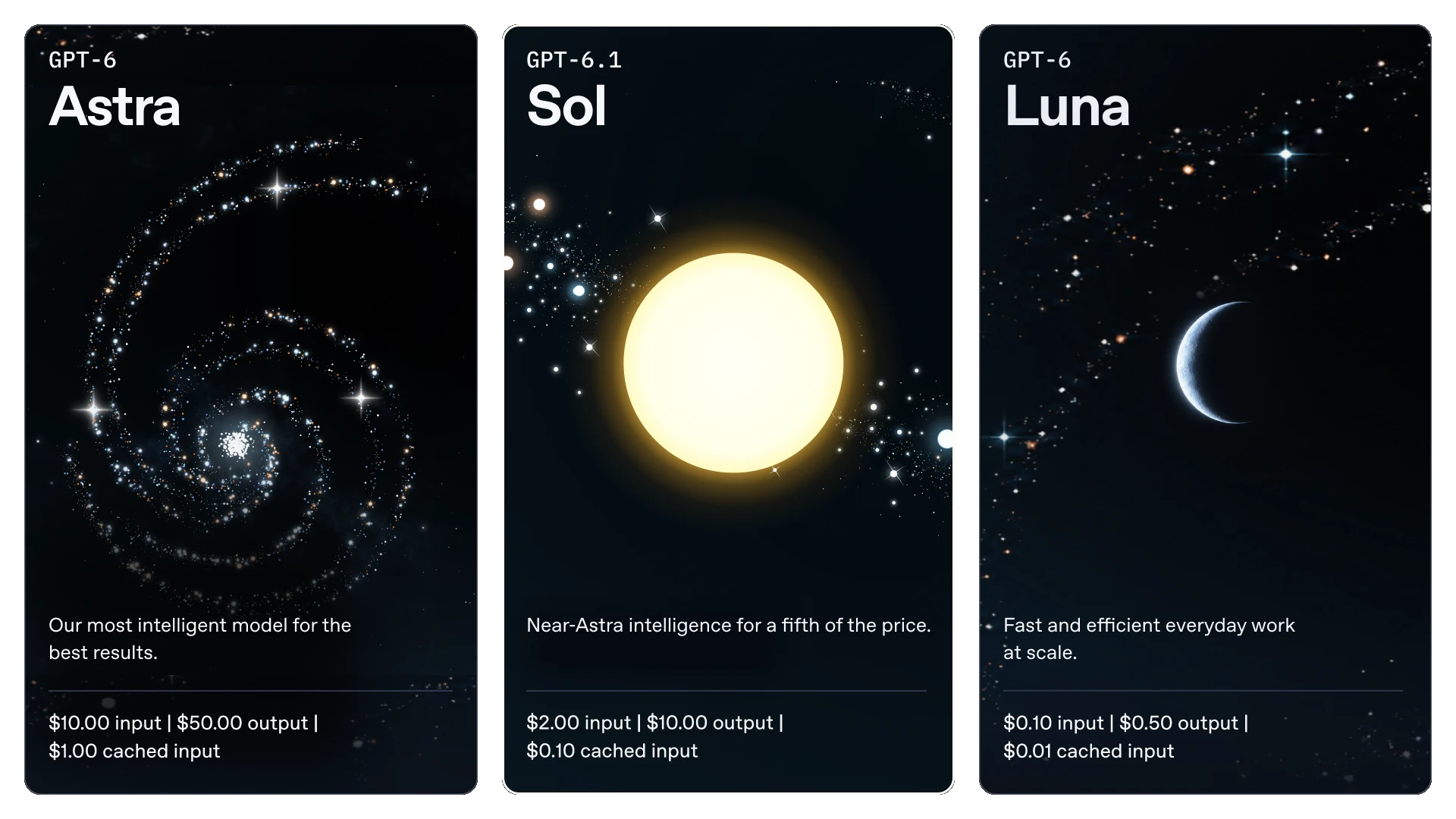
Choose GPT-6 Astra for complex reasoning, GPT-6.1 Sol for coding, and GPT-6 Luna for repetitive tasks to balance cost and performance.
Adjust your prompts and skills
Define clear assignments, output requirements, and decision boundaries to guide the model effectively.
“Models have gotten much better at understanding nuance and ambiguity, so overly specific guidance can now hinder results where it previously helped.”
Optimize long-running tasks
Use steering, asynchronous tools, and delegation to manage complex work without delays.
Caching and compaction
Cached input tokens cost up to 95% less than uncached tokens, reducing costs for recurring work.
Model pricing and speed
GPT-6 Astra offers high intelligence for complex tasks, while GPT-6.1 Sol provides fast coding and research capabilities.
Reasoning levels
Adjust reasoning effort from low to extra high to match task complexity without breaking cache.
Speed settings
Use Fast mode for chat apps and Ultrafast for rapid coding iterations to balance speed and cost.
Real-world examples
Harvey, Cognition, Hex, and Invideo use GPT-6 Astra to improve drafts, testing, dashboards, and video editing.
Computer use
GPT-6 models interact with websites and desktop apps to fix bugs and test code directly.
From testing to production
Teams use GPT-6 Astra to create better drafts, test software, and build interactive dashboards with higher success rates.
Cost management
GPT-6 Astra costs $10 input and $50 output with $1 cached input, balancing cost and performance.
What happens next
Teams will use GPT-6 models to streamline workflows and reduce costs through better task management.
GPT-6 family
GPT-6 Astra, GPT-6.1 Sol, and GPT-6 Luna offer different capabilities for complex reasoning, coding, and repetitive tasks.
The bottom line
Select GPT-6 Astra for complex reasoning, GPT-6.1 Sol for coding, and GPT-6 Luna for repetitive tasks to optimize cost and performance.