From TIME · Callum Sutherland · · 3m
French students invoke May 1968 in education protests
Student protesters in France reference the historic 1968 uprising as they demand government action on school funding, staffing and conditions.
In brief
Student protesters in France reference the historic 1968 uprising as they demand government action on school funding, staffing and conditions. French students now in their third week of nationwide protests are invoking May nineteen sixty-eight, when student demonstrations mushroomed into the greatest strike in French…
Third week of nationwide protests
French students blockaded high schools Thursday demanding government action on education funding. The protests, now in their third week, have drawn hundreds of thousands after rows over staffing shortages, overcrowded classrooms and dilapidated buildings reached crisis point.
Protests turn violent nationwide
The movement went nationwide Tuesday after student unions called for wider support. Some protests turned violent, with attendees lighting fires and hurling projectiles. Police used tear gas and water cannons. At least six thousand five hundred forty-seven people were arrested or stopped.
Students reference May nineteen sixty-eight
Throughout the protests, students held signs referencing nineteen sixty-eight, specifically May nineteen sixty-eight. That year saw nationwide protests initiated by a student movement that led to millions of workers striking and nearly toppled the government.
Slogans echo the past
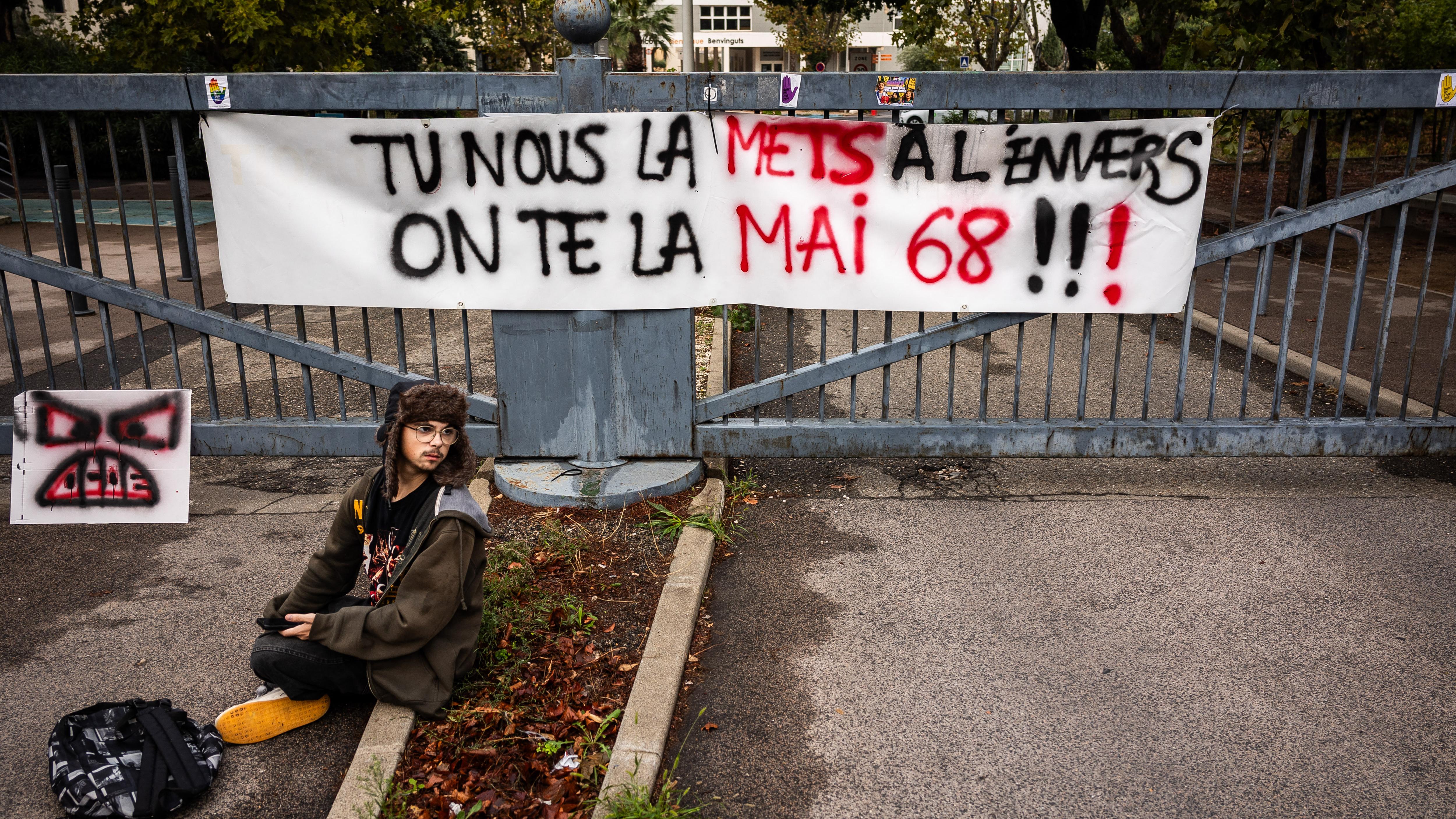
At the University of Perpignan Via Domitia, a banner warned you're trying to pull a fast one on us, we'll give you May sixty-eight. In Paris, a protester held a sign reading sois jeune et tais-toi, meaning be young and shut up, the same slogan used during nineteen sixty-eight protests.
“You're trying to pull a fast one on us, we'll give you May '68.”
Why nineteen sixty-eight matters
Chris Reynolds, professor of contemporary European history at Nottingham Trent University, says nineteen sixty-eight was a seminal moment in French protest history. A smallish student protest mushroomed within a very short space of time to become arguably the greatest strike in French history.
“Not only because of the sheer enormity of what happened, but that it started out as a smallish student protest that within a very short space of time mushroomed to become arguably the greatest strike in French history.”
Government fears history repeating
Ever since nineteen sixty-eight, there has been fear within the state that it could happen again. Reynolds says lawmakers worry students could be the starting point of a movement that would elicit support from other sectors, leading to a much greater crisis.
“Ever since 1968, there has been a fear within the state that it could happen again.”
What happened in May nineteen sixty-eight
Students at Nanterre campus of the University of Paris protested restrictive rules across nineteen sixty-seven and nineteen sixty-eight. Universities were expanding rapidly but remained conservative and hierarchical. When Nanterre was shut down, protests moved to the Sorbonne in Paris' Latin Quarter.
Nineteen sixty-eight nearly toppled government
Trade unions joined the movement and organized strikes across the country. At the height of the protests, around ten million workers went on strike, bringing France to the brink. President Charles de Gaulle dissolved parliament, called a snap election in June, which his party won as voters sought stability.
The takeaway
French students now in their third week of nationwide protests are invoking May nineteen sixty-eight, when student demonstrations mushroomed into the greatest strike in French history, to demand the government address education funding and conditions.





