From USAFacts · · 1m 30s
House members stop crossing party lines
House members now cross party lines less often than in the 1990s.
In brief
House members now cross party lines less often than in the 1990s. House members cross party lines less frequently than in the 1990s, with current crossover rates at 3.8% versus 13.2% in the 1990s. Originally reported by USAFacts.
House members cross party lines less often
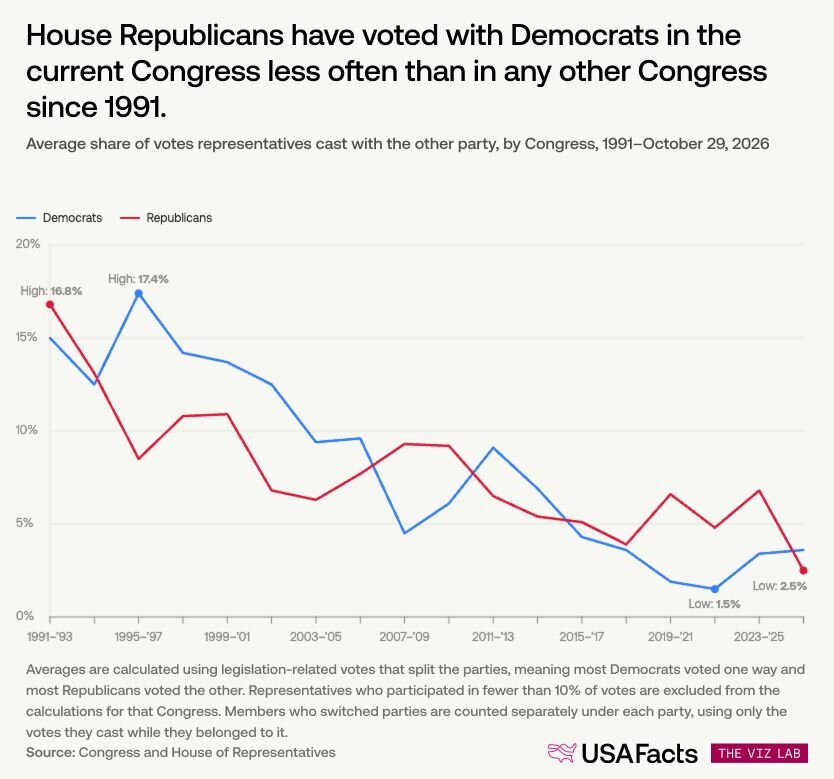
House members have crossed party lines less often than in the 1990s, with current crossover rates at 3.8% versus 13.2%.
Current crossover rates
In the current Congress, Democratic representatives voted with the other party on four out of every 100 votes, while Republicans did on almost three out of every 100.
Historical crossover rates
In the 1990s, the average crossover rate was 13.2%, compared with 3.8% over the past decade.
Lowest crossover rate

House Republicans have their lowest crossover rate in the current Congress at 2.5% since 1991.
Henry Cuellar's crossover rate
Democratic Representative Henry Cuellar of Texas has voted with the opposite party 35% of the time in the current Congress.
Historical context
In the Congress that began in 1991, 38 House members crossed party lines at least that often. Nine of them voted with the other party more often than their own.
Crossover rate trend
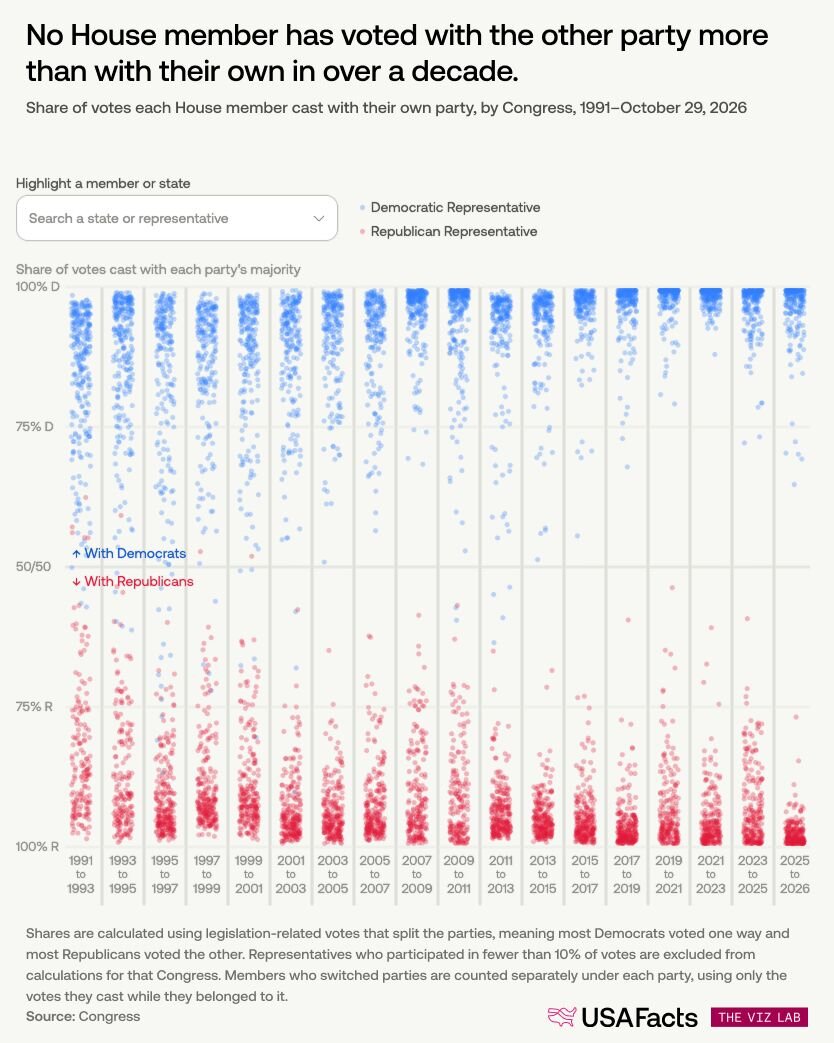
Since 2003, the average crossover rate has been 10% or lower for both parties in Congress.
Current crossover rate
In the current Congress, the typical House member crosses party lines on fewer than two out of every 100 votes.
The one thing
House members cross party lines less frequently than in the 1990s, with current crossover rates at 3.8% versus 13.2% in the 1990s.