From Ars Technica · · 2 min
Inside the Complete 3D Map of a Fruit Fly Brain
Researchers paired generative AI with electron microscopy to map every neuron and 300 million synapses in the male fruit fly brain.
In brief
Researchers paired generative AI with electron microscopy to map every neuron and 300 million synapses in the male fruit fly brain. Advanced AI image processing paired with micro-slicing has made mapping complete brain wiring feasible, opening a new era of constrained theoretical neuroscience. Originally reported by…
Male fly brain fully mapped
Researchers have mapped every single neuron and connection in the male fruit fly brain, completing a master wiring diagram known as a connectome.
“The “connectome” provides a tool that can accelerate neurobiology research.”
A grand interdisciplinary effort
Biologists at the Janelia Research Campus partnered with computer scientists at Google to process and interpret massive micro-imaging datasets.
“building a complete picture of the hundreds of millions of synapses... is a task that can’t be achieved by humans in a manageable amount of time.”
The logic of brain wiring
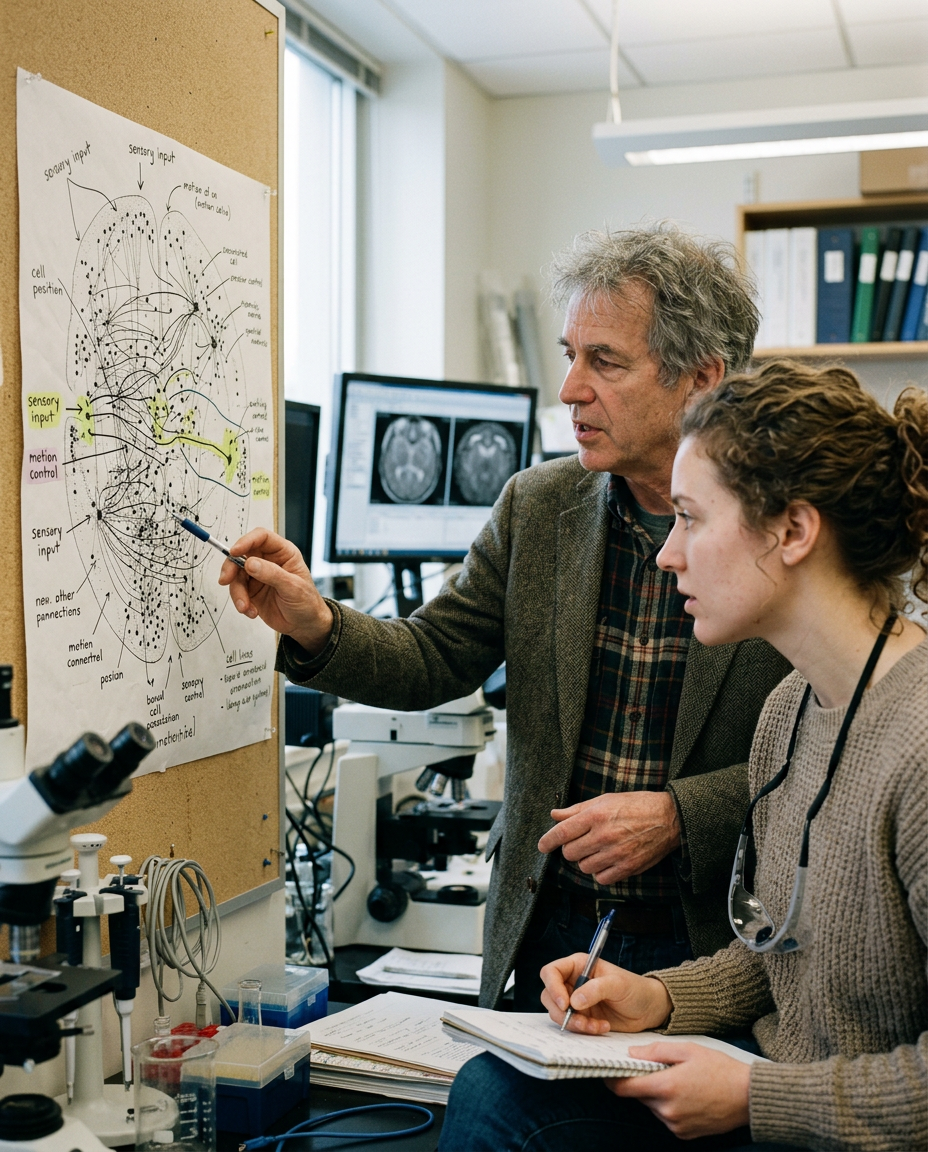
Connectomes map every neuron's 3D position and synaptic links, revealing how incoming sensory information transforms into memory, thought, and physical motion.
“To understand how a brain works, then, we need a catalog of the connections in the brain”
Hundreds of millions of connections
While a fruit fly brain contains only roughly 150,000 neurons, its heavily branched processes form over 300 million distinct synaptic connections.
“the new work discovered over 300 million synaptic connections in the fly brain.”
Early connectomics was hand drawn
In 1971, attempts to map the 300-neuron worm C. elegans failed on mainframe computers, forcing researchers to manually trace nerves with highlighters.
“they went with printing everything out on photographic prints and colored magic markers and circling neurons and tracing it by hand.”
Slicing the brain for 3D views
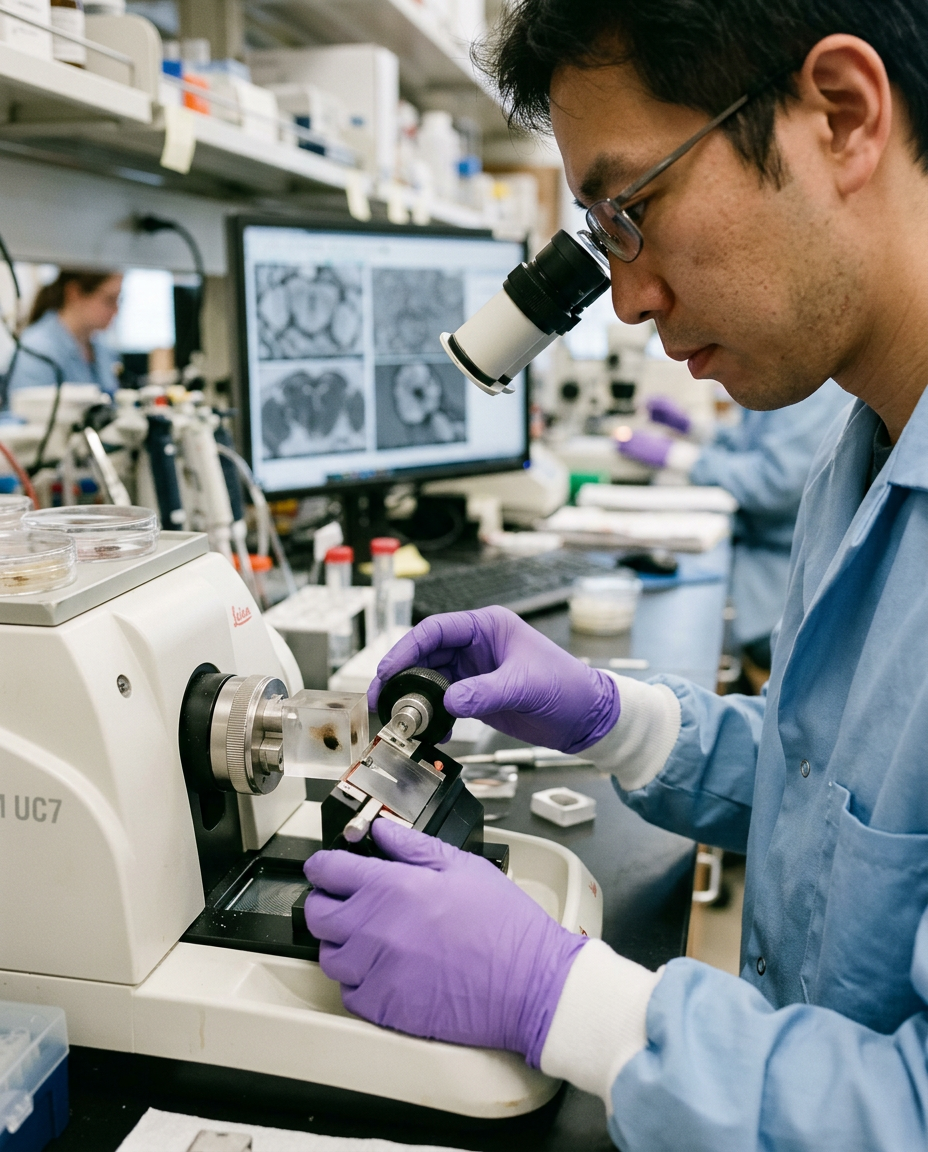
Scientists cut the fly brain into thousands of ultra-thin slices and scanned them with electron microscopes to capture tiny nanometer-scale structures.
Generative AI erases physical seams
Cutting brain tissue distorts slice edges and causes minor material loss. Generative AI fills those gap spaces computationally to reconstruct seamless tissue.
“We use [a generative] model to make the tissue look as if the seams were not there”
Tracking neurons across space
Custom 3D recurrent computer vision models fill in cell membrane boundaries, step-by-step tracing complex individual neurons through digital space.
“it literally moves through space as it makes the outline of the neurons”
Human proofreaders fine-tune AI
Automated algorithms detect and classify individual synapses, while human proofreaders continuously adjust model sensitivity to avoid misidentifications.
“it’s an iterative process between the humans giving feedback and the algorithms getting tuned.”
Preparing to map complex brains
Deep automation means future mouse brain connectomes, which contain a thousand times more neurons, won't require exponentially larger teams of scientists.
“The people will never go away, but the people will not need to scale with the number of neurons”
Comparing male and female brains
Comparing male and female connectomes revealed 289 male-specific neurons, 71 female-specific neurons, and 138 shared neurons with distinct sex-based wiring.
Master genes shape neural identity
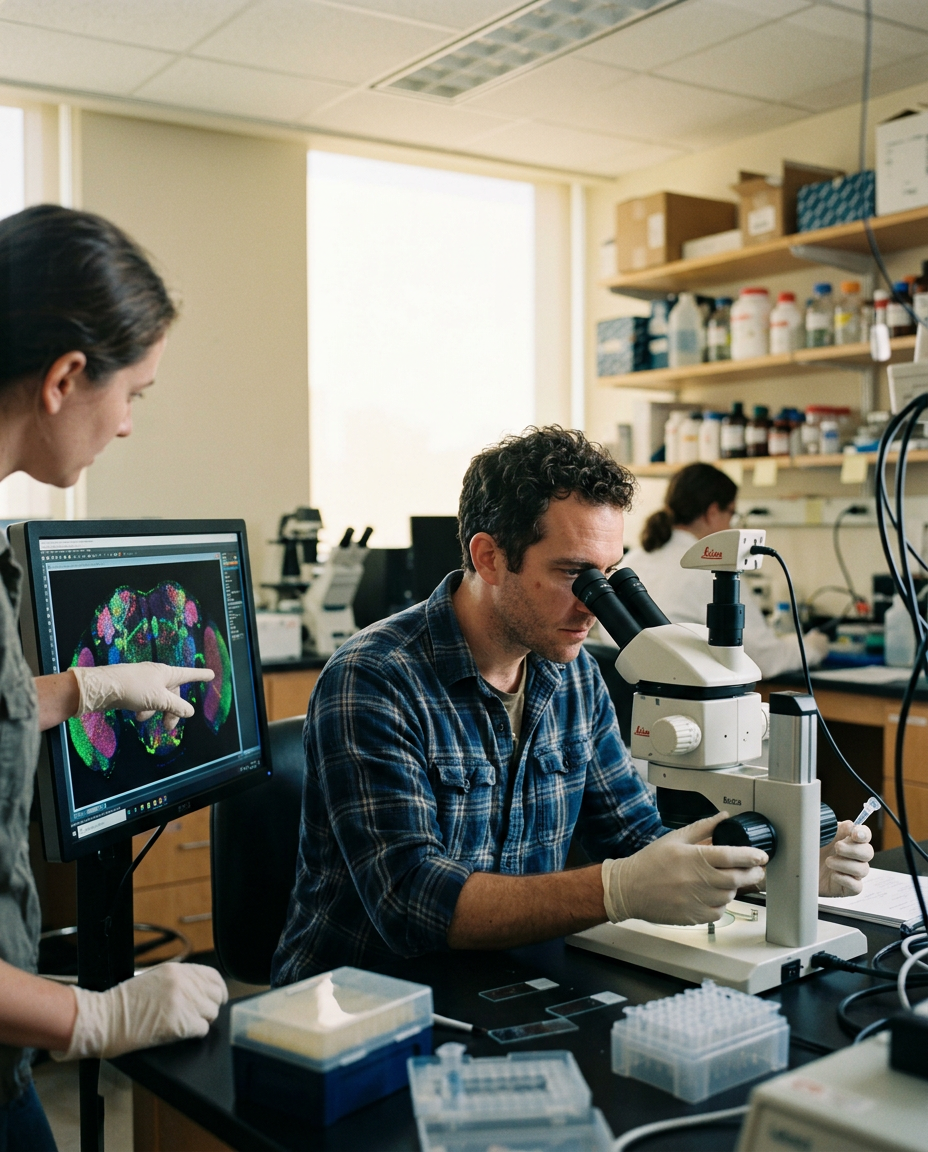
The sex-determination genes doublesex and fruitless drive key brain differences, though some neurons pick up sex-specific traits indirectly from neighbors.
Unexpected neural overlaps
Male flies possess neurons linked to female mating behaviors despite lacking the physical target tissues, altering only their internal signal routing.
Sex differences target decision hubs
Sex-specific neurons bypass basic sensory and motor systems, concentrating instead in high-level integrative areas that handle decision-making.
“sex differences primarily modify integrative and decision-making areas while sensory detection and the highly tuned motor interface remain more constant.”
Neural clusters boost signal strength
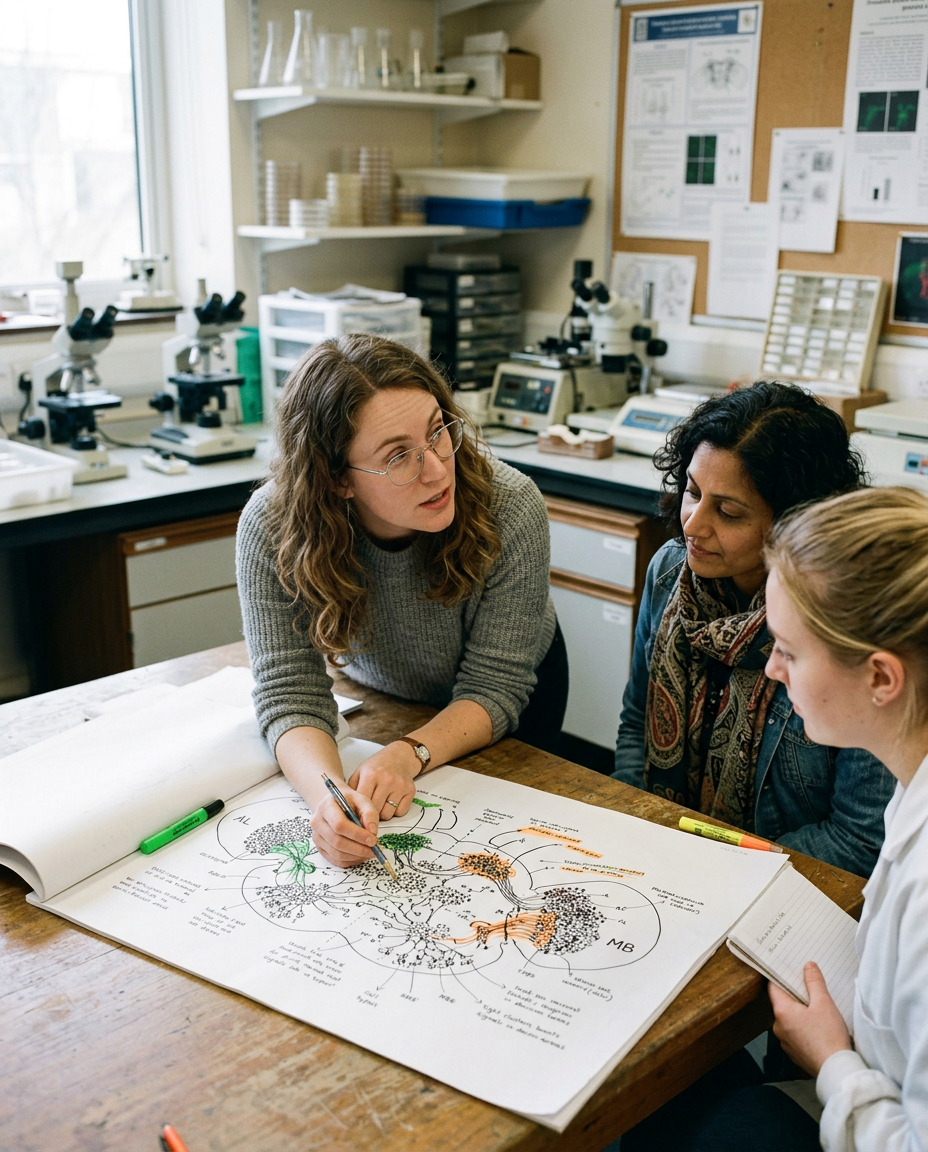
Sex-differentiated neurons cluster tightly together in decision areas, acting together to enhance the intensity of behavioral signals.
“the sex-specific neurons tend to cluster together, suggesting that they may act together to enhance the intensity of the signals they convey.”
A hard wiring map for neuroscience
Complete brain maps provide hard structural constraints, helping theoretical neuroscientists model exact physical circuits rather than guessing how brains work.
“Once they had the connectome, they could say, 'The brain does this and here’s the wiring diagram. How can this wiring diagram allow this function?'”
Uncovering individual brain variation
Future efforts must automate mapping further so scientists can analyze dozens of fly connectomes to distinguish normal individual variation from errors.
“To say anything meaningful about this kind of variability with statistical confidence, we’ll need dozens of examples.”
What to remember
Advanced AI image processing paired with micro-slicing has made mapping complete brain wiring feasible, opening a new era of constrained theoretical neuroscience.