From Cosmicave · · 5m
Why the universe expands
A physicist argues the standard model fails to explain cosmic expansion and proposes a radical alternative based on broken symmetry.
In brief
A physicist argues the standard model fails to explain cosmic expansion and proposes a radical alternative based on broken symmetry. The universe expands not because of mysterious forces, but because existence itself on a geometry where time's passage is the growth of space makes expansion inevitable. Originally…
Copernicus broke a false symmetry
Five hundred years ago, Copernicus proposed the Sun, not Earth, was the centre. His insight was that a simpler model could explain complex planetary motions like retrograde loops through our off-centre perspective.
The geocentric model needed endless dials
To match observations, the Earth-centred model required more and more adjustments. The Sun-centred model achieved the same accuracy with fewer assumptions by recognising that broken symmetry could do the explanatory work.
Newton explained what Copernicus started
Newton's law of universal gravitation unified planetary motion, tides, and falling apples into one principle. The hard work of finding minimal broken symmetries led to deeper physics.
The standard model is cosmology's Frankenstein
Like the geocentric model, today's standard cosmological model fits observations accurately but requires endless patches: inflation, dark energy, and evolving dark energy. Yet it still cannot explain why the universe should expand at all.
Einstein-de Sitter assumes matter is at rest
The standard model assumes the universe's clock matches an average galaxy's clock, meaning matter has no bulk motion. This assumption, rooted in Einstein's philosophical preference for Mach's principle, was never empirically required.
Matter should decelerate expansion
According to Einstein-de Sitter, all visible matter and light work against cosmic expansion, slowing it down. The model only explains expansion by assuming the Big Bang began with infinite speed to overcome infinite deceleration.
“One cannot deny the possibility, but it is difficult to see what mental satisfaction such a theory is supposed to afford.”
Inflation and dark energy are patches
Inflation fixes the horizon and flatness problems but doesn't explain initial expansion. Dark energy drives late-time acceleration but cannot explain why expansion started. Each patch requires its own patch.
Cracks are widening in dark energy
Measurements of expansion rate from early and late universe disagree. Galaxy surveys suggest dark energy weakens over time, not stays constant. Astronomers keep adding dials to a model that fundamentally abhors expansion.
Physics is recognising broken symmetries
The Sun's spin creates an equatorial bulge. Elliptical orbits create apparent annual motion of stars. Physics advances by identifying which symmetries nature actually breaks, not by assuming they hold.
A PhD student questions the foundation
In 2009, Daryl Janzen decided to tackle why the standard model cannot explain cosmic expansion. He took as his starting point a universe uniform in every direction, then asked what happens if matter and light swap roles.
Swapping matter and light worldlines
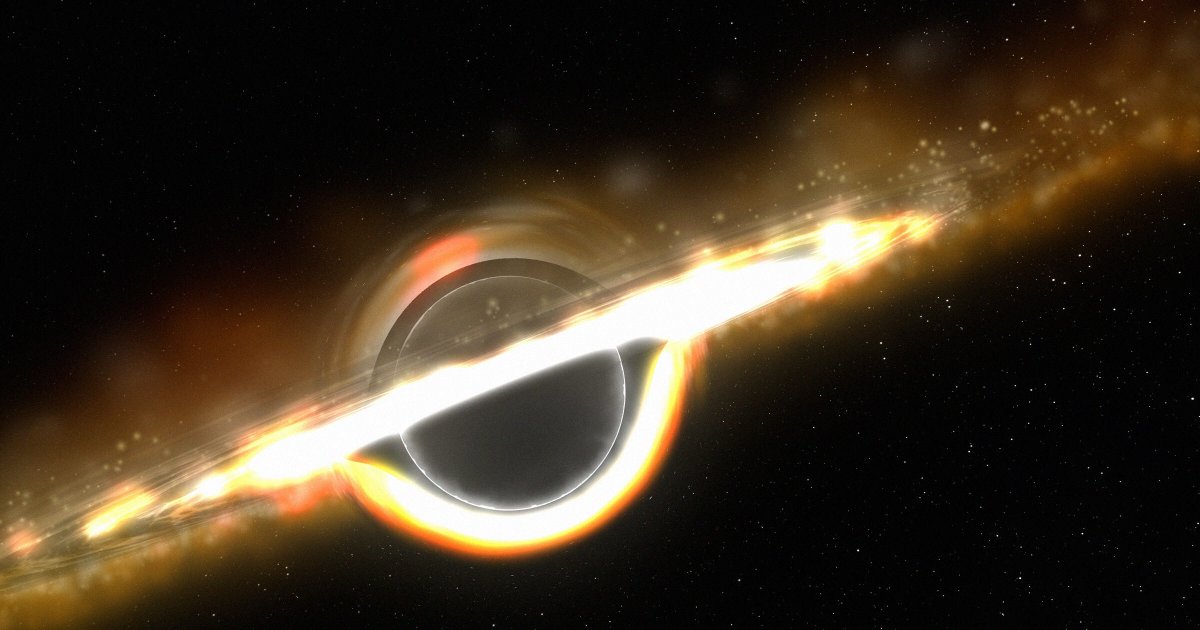
Janzen reassigned the worldlines typically given to photons to matter, and vice versa. The resulting spacetime has the form of a black hole but must grow over time, making expansion inevitable.
The geometry forces the expansion rate

When Janzen enforced general relativity on this geometry and calculated the expansion rate, he found it matched exactly the flat Lambda-CDM rate of the standard model, without adding dark energy as an assumption.
The supervisor's response was brutal
Janzen excitedly presented his findings to his PhD supervisor, who screamed "This is bullshit!" and slammed the paper on his desk. The rejection marked the beginning of a long struggle for recognition.
“This is bullshit!”
Years of institutional indifference
Janzen moved into hydrology, then returned to teaching astronomy. Despite growing the programme from hundreds to thousands of students, his department head dismissed astronomy as not their focus. He burned out after eight months without support.
A breakthrough in understanding
By spring 2025, Janzen developed clarity about black holes that pointed toward a consistent picture of gravitational collapse and cosmogenesis. He spent the summer working through mathematical details of a framework called Cosmological Relativity.
The universe expands because it exists
Janzen's answer: the universe expands because existing as a three-dimensional world enduring through time on a geometry where time's passage is growth of size makes expansion inevitable. Collapsed matter becomes expanding cosmology.
“the universe expands because it exists”
The Big Bang's infinities are shadows
In Janzen's model, infinite speed and deceleration at the Big Bang are not initial conditions but shadows of broken symmetry. They emerge naturally from a black hole's collapse passing through zero size into expansion.
Acceleration needs no dark energy
The late-time acceleration of expansion arises from the curvature of space itself, not from dark energy. The cosmological constant alone sets the entire expansion history, eliminating the Hubble tension.
The framework is testable and open
Janzen's Cosmological Relativity comprises eighteen papers with all calculations available on GitHub. The sharpest test: microwave background acoustic peaks land six point six percent off. If nothing can move them, the model is ruled out.
The short version
The universe expands not because of mysterious forces, but because existence itself on a geometry where time's passage is the growth of space makes expansion inevitable.